


Page 11 - SPEMD_61-3
P. 11
rev port estomatol med dent cir maxilofac . 2020;61(3):97-105          101


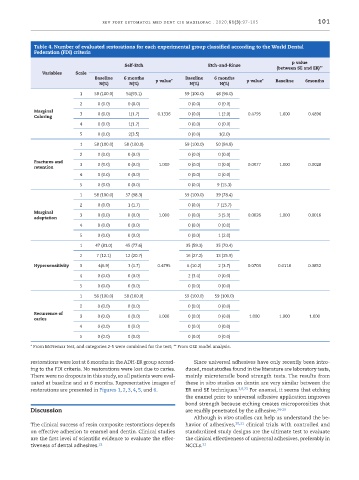
            Table 4. Number of evaluated restorations for each experimental group classified according to the World Dental
            Federation (FDI) criteria
                                                                                                  p value
                                          Self -Etch                  Etch -and -Rinse
                                                                                             (between SE and ER)**
               Variables  Scale
                                Baseline  6 months   p value*  Baseline  6 months   p value*  Baseline  6months
                                  N(%)      N(%)                N(%)      N(%)
                            1   58 (100.0)  54(93.1)          59 (100.0)  48 (96.0)
                            2    0 (0.0)   0 (0.0)             0 (0.0)   0 (0.0)
            Marginal
            Coloring        3    0 (0.0)    1(1.7)   0.1336    0 (0.0)   1 (2.0)   0.4795     1.000    0.4896
                            4    0 (0.0)    1(1.7)             0 (0.0)   0 (0.0)
                            5    0 (0.0)    2(3.5)             0 (0.0)    1(2.0)
                            1   58 (100.0)  58 (100.0)        59 (100.0)  50 (84.8)
                            2    0 (0.0)   0 (0.0)             0 (0.0)   0 (0.0)
            Fractures and   3    0 (0.0)   0 (0.0)    1.000    0 (0.0)   0 (0.0)   0.0077     1.000    0.0028
            retention
                            4    0 (0.0)   0 (0.0)             0 (0.0)   0 (0.0)
                            5    0 (0.0)   0 (0.0)             0 (0.0)   9 (15.3)
                            1   58 (100.0)  57 (98.3)         59 (100.0)  39 (78.4)
                            2    0 (0.0)   1 (1.7)             0 (0.0)   7 (13.7)
            Marginal
            adaptation      3    0 (0.0)   0 (0.0)    1.000    0 (0.0)   3 (5.9)   0.0026     1.000    0.0016
                            4    0 (0.0)   0 (0.0)             0 (0.0)   0 (0.0)
                            5    0 (0.0)   0 (0.0)             0 (0.0)   1 (2.0)
                            1    47 (81.0)  45 (77.6)          35 (59.3)  35 (70.4)
                            2    7 (12.1)  12 (20.7)           16 (27.2)  13 (25.9)
            Hypersensitivity  3   4(6.9)   1 (1.7)   0.4795    6 (10.2)  2 (3.7)   0.0703    0.0118    0.3852
                            4    0 (0.0)   0 (0.0)             2 (3.4)   0 (0.0)

                            5    0 (0.0)   0 (0.0)             0 (0.0)   0 (0.0)
                            1   58 (100.0)  58 (100.0)        59 (100.0)  59 (100.0)
                            2    0 (0.0)   0 (0.0)             0 (0.0)   0 (0.0)
            Recurrence of   3    0 (0.0)   0 (0.0)    1.000    0 (0.0)   0 (0.0)    1.000     1.000     1.000
            caries
                           4     0 (0.0)   0 (0.0)             0 (0.0)   0 (0.0)
                           5     0 (0.0)   0 (0.0)             0 (0.0)   0 (0.0)
           * From McNemar test, and categories 2 -5 were combined for the test; ** From GEE model analysis.

           restorations were lost at 6 months in the ADH -ER group accord-  Since universal adhesives have only recently been intro-
           ing to the FDI criteria. No restorations were lost due to caries.   duced, most studies found in the literature are laboratory tests,
           There were no dropouts in this study, so all patients were eval-  mainly microtensile bond strength tests. The results from
           uated at baseline and at 6 months. Representative images of   these in vitro studies on dentin are very similar between the
           restorations are presented in Figures 1, 2, 3, 4, 5, and 6.  ER and SE techniques. 3,8,23  For enamel, it seems that etching
                                                               the enamel prior to universal adhesive application improves
                                                               bond strength because etching creates microporosities that
           Discussion                                          are readily penetrated by the adhesive. 24-29
                                                                 Although in vitro studies can help us understand the be-
           The clinical success of resin composite restorations depends   havior of adhesives, 30,31  clinical trials with controlled and
           on effective adhesion to enamel and dentin. Clinical studies   standardized study designs are the ultimate test to evaluate
           are the first level of scientific evidence to evaluate the effec-  the clinical effectiveness of universal adhesives, preferably in
           tiveness of dental adhesives. 22                    NCCLs. 32

