


Page 9 - SPEMD_61-3
P. 9
rev port estomatol med dent cir maxilofac . 2020;61(3):97-105            99


                                                               dures: Adhese Universal (ADH, Ivoclar Vivadent, Schaan, Liech-
            Table 1. Distribution of restorations per tooth and arch.
                                                               tenstein) in the ER mode (ADH -ER) or Adhese Universal in the
                               SE technique    ER technique    SE mode (ADH -SE). A total of 117 cervical lesions were restored:
                                                               59 with ADH -ER and 58 with ADH -SE. Only a maximum of three
            Tooth distribution
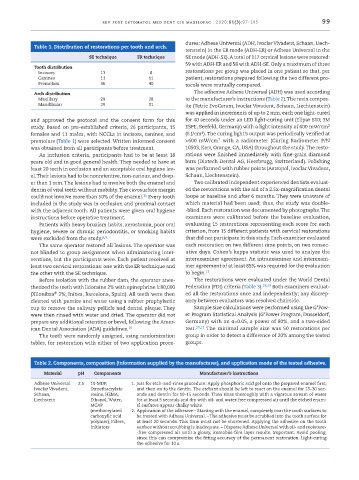
              Incisors            11               8           restorations per group was placed in one patient so that, per
              Canines             11              11           patient, restorations prepared following the two different pro-
              Premolars           36              40           tocols were mutually compared.
            Arch distribution                                    The adhesive Adhese Universal (ADH) was used according
              Maxillary           29              28           to the manufacturer’s instructions (Table 2). The resin compos-
              Mandibular          29              31           ite (Tetric EvoCeram, Ivoclar Vivadent, Schaan, Liechtenstein)
                                                               was applied in increments of up to 2 mm, each one light -cured
           and  approved  the  protocol  and  the  consent  form  for  this   for 40 seconds under an LED light -curing unit (Elipar S10; 3M
                                                                                                              2
           study. Based on pre -established criteria, 26 participants, 15   ESPE, Seefeld, Germany) with a light intensity of 600 mW/cm
           females and 11 males, with NCCLs in incisors, canines, and   (6 J/cm²). The curing light’s output was periodically verified at
                                                                         2
           premolars (Table 1) were selected. Written informed consent   >600 mW/cm  with a radiometer (Curing Radiometer P/N
           was obtained from all participants before treatment.  10503, Kerr, Orange, CA, USA) throughout the study. The resto-
              As inclusion criteria, participants had to be at least 18   rations were finished immediately with fine -grain diamond
           years old and in good general health. They needed to have at   burs (Diatech Dental AG, Heerbrugg, Switzerland). Polishing
           least 20 teeth in occlusion and an acceptable oral hygiene lev-  was performed with rubber points (Astropol, Ivoclar Vivadent,
           el. Their lesions had to be nonretentive, non -carious, and deep-  Schaan, Liechtenstein).
           er than 1 mm. The lesions had to involve both the enamel and   Two calibrated independent experienced dentists evaluat-
           dentin of vital teeth without mobility. The cavosurface margin   ed the restorations with the aid of a 2.5x -magnification dental
           could not involve more than 50% of the enamel. 15   Every tooth   loupe at baseline and after 6 months. They were unaware of
           included in the study was in occlusion and proximal contact   which material had been used; thus, the study was double-
           with the adjacent tooth. All patients were given oral hygiene   -blind. Each restoration was documented by photographs. The
           instructions before operative treatment.            examiners  were  calibrated  before  the  baseline  evaluation,
              Patients with heavy bruxism habits, xerostomia, poor oral   evaluating 15 restorations representing each score for each
           hygiene, severe or chronic periodontitis, or smoking habits   criterion, from 15 different patients with cervical restorations
           were excluded from the study. 8,9                   that did not participate in this study. Each examiner evaluated
              The same operator restored all lesions. The operator was   each restoration on two different time points, on two consec-
           not blinded to group assignment when administering inter-  utive days. Cohen’s kappa statistic was used to analyze the
           ventions, but the participants were. Each patient received at   interexaminer agreement. An intraexaminer and interexam-
           least two cervical restorations: one with the ER technique and   iner agreement of at least 85% was required for the evaluation
           the other with the SE technique.                    to begin. 17
              Before isolation with the rubber dam, the operator anes-  The restorations were evaluated under the World Dental
           thetized the teeth with lidocaine 2% with epinephrine 1:80,000   Federation (FDI) criteria (Table 3). 18,19  Both examiners evaluat-
                   ®
           (Xilonibsa  2%; Inibsa, Barcelona, Spain). All teeth were then   ed all the restorations once and independently; any discrep-
           cleaned with pumice and water using a rubber prophylactic   ancy between evaluators was resolved chairside.
           cup to remove the salivary pellicle and dental plaque. They   Sample size calculations were performed using the G*Pow-
           were then rinsed with water and dried. The operator did not   er Program Statistical Analysis (G*Power Program, Dusseldorf,
           prepare any additional retention or bevel, following the Amer-  Germany) with an α=0.05, a power of 80%, and a two -sided
           ican Dental Association (ADA) guidelines. 16        test. 20,21  The minimal sample size was 50 restorations per
              The teeth were randomly assigned, using randomization   group in order to detect a difference of 20% among the tested
           tables, for restoration with either of two application proce-  groups.


            Table 2. Components, composition (information supplied by the manufacturer), and application mode of the tested adhesive.

                Material   pH   Components                         Manufacturer’s instructions
            Adhese Universal  2,5  10 -MDP,   1. Just for etch -and -rinse procedure: Apply phosphoric acid gel onto the prepared enamel first,
            Ivoclar Vivadent,   Dimethacrylate   and then on to the dentin. The etchant should be left to react on the enamel for 15–30 sec-
            Schaan,            resins, HEMA,   onds and dentin for 10–15 seconds. Then rinse thoroughly with a vigorous stream of water
            Liechstein         Ethanol, Water,   for at least 5 seconds and dry with oil - and water -free compressed air until the etched enam-
                               MCAP           el surfaces appear chalky white.
                               (methacrylated   2. Application of the adhesive – Starting with the enamel, completely coat the tooth surfaces to
                               carboxylic acid   be treated with Adhese Universal. – The adhesive must be scrubbed into the tooth surface for
                               polymer), Fillers,   at least 20 seconds. This time must not be shortened. Applying the adhesive on the tooth
                               Initiators     surface without scrubbing is inadequate. – Disperse Adhese Universal with oil - and moisture-
                                              -free compressed air until a glossy, immobile film layer results. Important: Avoid pooling,
                                              since this can compromise the fitting accuracy of the permanent restoration. Light -curing
                                              the adhesive for 10 s.

