


Page 10 - SPEMD_61-3
P. 10
100                     rev port estomatol med dent cir maxilofac. 2020;61(3):97-105


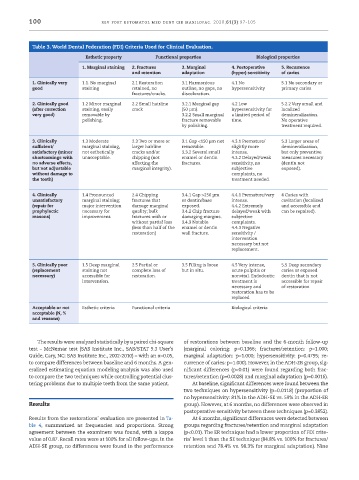
            Table 3. World Dental Federation (FDI) Criteria Used for Clinical Evaluation.
                             Esthetic property       Functional properties            Biological properties
                            1. Marginal staining  2. Fractures    3. Marginal   4. Postoperative   5. Recurrence
                                             and retention   adaptation       (hyper) sensitivity  of caries
            1. Clinically very   1.1. No marginal   2.1 Restoration   3.1 Harmonious   4.1 No   5.1 No secondary or
            good            staining         retained, no    outline, no gaps, no   hypersensitivity  primary caries
                                             fractures/cracks.  discoloration.
            2. Clinically good   1.2 Minor marginal   2.2 Small hairline   3.2.1 Marginal gap   4.2 Low   5.2.2 Very small and
            (after correction   staining, easily   crack     (50 µm).         hypersensitivity for   localized
            very good)      removable by                     3.2.2 Small marginal   a limited period of   demineralization.
                            polishing.                       fracture removable   time.       No operative
                                                             by polishing.                    treatment required.

            3. Clinically   1.3 Moderate     2.3 Two or more or   3.1 Gap <150 µm not   4.3.1 Premature/  5.3 Larger areas of
            sufficient/     marginal staining,   larger hairline   removable.  slightly more   demineralization,
            satisfactory (minor   not esthetically   cracks and/or   3.3.2 Several small   intense.  but only preventive
            shortcomings with   unacceptable.  chipping (not   enamel or dentin   4.3.2 Delayed/weak   measures necessary
            no adverse effects,              affecting the   fractures.       sensitivity, no   (dentin not
            but not adjustable               marginal integrity).             subjective      exposed).
            without damage to                                                 complaints, no
            the tooth)                                                        treatment needed.


            4. Clinically   1.4 Pronounced   2.4 Chipping    3.4.1 Gap >250 µm   4.4.1 Premature/very   4 Caries with
            unsatisfactory   marginal staining;   fractures that   or dentin/base   intense.  cavitation (localized
            (repair for     major intervention   damage marginal   exposed.   4.4.2 Extremely   and accessible and
            prophylactic    necessary for    quality; bulk   3.4.2 Chip fracture   delayed/weak with   can be repaired).
            reasons)        improvement.     fractures with or   damaging margins.  subjective
                                             without partial loss   3.4.3 Notable   complaints.
                                             (less than half of the   enamel or dentin   4.4.3 Negative
                                             restoration)    wall fracture.   sensitivity /
                                                                              intervention
                                                                              necessary but not
                                                                              replacement.

            5. Clinically poor   1.5 Deep marginal   2.5 Partial or   3.5 Filling is loose   4.5 Very intense,   5.5 Deep secondary
            (replacement    staining not     complete loss of   but in situ.  acute pulpitis or   caries or exposed
            necessary)      accessible for   restoration.                     nonvital. Endodontic   dentin that is not
                            intervention.                                     treatment is    accessible for repair
                                                                              necessary and   of restoration
                                                                              restoration has to be
                                                                              replaced.
            Acceptable or not   Esthetic criteria  Functional criteria        Biological criteria
            acceptable (N, %
            and reasons)


             The results were analyzed statistically by a paired chi -square   of restorations between baseline and the 6 -month follow -up
           test – McNemar test (SAS Institute Inc., SAS/STAT 9.3 User’s   (marginal coloring: p=0.1366; fractures/retention: p=1.000;
           Guide, Cary, NC: SAS Institute Inc., 2002 -2010) – with an α=0.05,   marginal adaptation: p=1.000; hypersensitivity: p=0.4795; re-
           to compare differences between baseline and 6 months. A gen-  currence of caries: p=1.000). However, in the ADH -ER group, sig-
           eralized estimating equation modeling analysis was also used   nificant differences (p<0.01) were found regarding both frac-
           to compare the two techniques while controlling potential clus-  tures/retention (p=0.0028) and marginal adaptation (p=0.0016).
           tering problems due to multiple teeth from the same patient.  At baseline, significant differences were found between the
                                                              two techniques on hypersensitivity (p=0.0118) (proportion of
                                                              no hypersensitivity: 81% in the ADH -SE vs. 59% in the ADH -ER
           Results                                            group). However, at 6 months, no differences were observed in
                                                              postoperative sensitivity between these techniques (p=0.3852).
           Results from the restorations’ evaluation are presented in Ta-  At 6 months, significant differences were detected between
           ble 4, summarized as frequencies and proportions. Strong   groups regarding fractures/retention and marginal adaptation
           agreement between the examiners was found, with a kappa   (p<0.01). The ER technique had a lower proportion of FDI crite-
           value of 0.87. Recall rates were at 100% for all follow -ups. In the   ria’ level 1 than the SE technique (84.8% vs. 100% for fractures/
           ADH -SE group, no differences were found in the performance   retention and 78.4% vs. 98.3% for marginal adaptation). Nine

