


Page 35 - SPEMD_61-2
P. 35
rev port estomatol med dent cir maxilofac . 2020;61(2):72-78             73


                                            Tratamento de malformação vascular labial com o laser de díodo
                                            cirúrgico: Caso clínico

                                            r e s u m o

           Palavras-chave:                  O objetivo deste estudo é apresentar um caso clínico de hemangioma do lábio inferior tra-
           Laser de díodo                   tado com sucesso, por laser de díodo. Paciente com 12 anos de idade com malformação
           Excisão com laser                vascular ocupando toda a zona vermelha do lábio inferior direito incluindo a face interna
           Incisão com laser                até à linha média. O tratamento cirúrgico foi efetuado em 2 sessões com o laser de díodo
           Cirurgia a laser                 (GaAl) de 980 nm com  fibra descartável (fiber tips) de Ø 400 µm. Houve reepitelização total
           Hemangioma oral                  das feridas em aproximadamente 21 a 30 dias. Não ocorreu dor pós-operatória e o resultado
           Cicatrização de feridas          funcional e estético foi bom. O uso do laser de díodo nas anomalias vasculares orais pode
                                            ser considerado uma boa opção de tratamento. (Rev Port Estomatol Med Dent Cir Maxilofac.
                                            2020;61(2):72-78)
                                                            © 2020 Sociedade Portuguesa de Estomatologia e Medicina Dentária.
                                                  Published by SPEMD. This is an open access article under the CC BY-NC-ND license
                                                                        (http://creativecommons.org/licenses/by-nc-nd/4.0/).


                                                               at 7 months of age. Clinical examination revealed a bluish
           Introduction
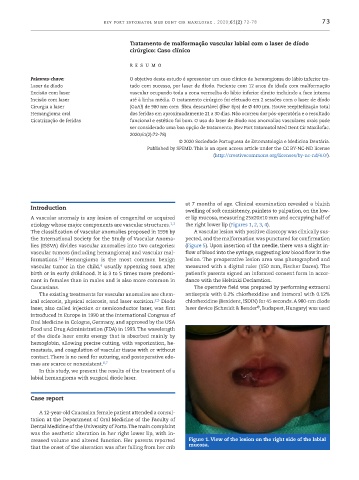
                                                               swelling of soft consistency, painless to palpation, on the low-
           A vascular anomaly is any lesion of congenital or acquired   er lip mucosa, measuring 25x20x10 mm and occupying half of
           etiology whose major components are vascular structures. 1,2    the right lower lip (Figures 1, 2, 3, 4).
           The classification of vascular anomalies proposed in 1996 by   A vascular lesion with positive diascopy was clinically sus-
           the International Society for the Study of Vascular Anoma-  pected, and the malformation was punctured for confirmation
           lies (ISSVA) divides vascular anomalies into two categories:   (Figure 5). Upon insertion of the needle, there was a slight in-
           vascular tumors (including hemangioma) and vascular mal-  flow of blood into the syringe, suggesting low blood flow in the
           formations. 2,3   Hemangioma  is  the  most  common  benign   lesion. The preoperative lesion area was photographed and
                                  4
           vascular tumor in the child,  usually appearing soon after   measured with a digital ruler (150 mm, Fischer Darex). The
           birth or in early childhood. It is 3 to 5 times more predomi-  patient’s parents signed an informed consent form in accor-
           nant in females than in males and is also more common in   dance with the Helsinki Declaration.
           Caucasians.                                           The operative field was prepared by performing extraoral
              The existing treatments for vascular anomalies are chem-  antisepsis with 0.2% chlorhexidine and intraoral with 0.12%
           ical sclerosis, physical sclerosis, and laser excision. 2,5  Diode   chlorhexidine (Bexident, ISDIN) for 45 seconds. A 980 -nm diode
                                                                                      ®
           laser, also called injection or semiconductor laser, was first   laser device (Schmidt & Bender , Budapest, Hungary) was used
           introduced in Europe in 1990 at the International Congress of
           Oral Medicine in Cologne, Germany, and approved by the USA
           Food and Drug Administration (FDA) in 1993. The wavelength
           of the diode laser emits energy that is absorbed mainly by
           hemoglobin, allowing precise cutting, with vaporization, he-
           mostasis, and coagulation of vascular tissue with or without
           contact. There is no need for suturing, and postoperative ede-
           mas are scarce or nonexistent. 6,7
              In this study, we present the results of the treatment of a
           labial hemangioma with surgical diode laser.


           Case report

              A 12 -year -old Caucasian female patient attended a consul-
           tation at the Department of Oral Medicine of the Faculty of
           Dental Medicine of the University of Porto. The main complaint
           was the aesthetic alteration in her right lower lip, with in-
           creased volume and altered function. Her parents reported   Figure 1. View of the lesion on the right side of the labial
           that the onset of the alteration was after falling from her crib   mucosa.

