


Page 29 - SPEMD_60-4
P. 29
rev port estomatol med dent cir maxilofac . 2019;60(4):175-188         177


           tional habits (bruxism and clenching), patient expectations   prerequisite is in accordance with the EAO guidelines for the
                                                                                                          th
           and financial situation represent some of the deciding factors   use of diagnostic imaging in Implant Dentistry and the 5  rec-
           that justify the therapeutic options proposed for each class.  ommendation of the American Academy of Oral and Maxillo-
              Based on a prosthodontic-driven implant placement ap-  facial Radiology’s position statement on selection criteria for
           proach, a properly designed prosthesis should always be ob-  the use of radiology in Implant Dentistry. 29,30
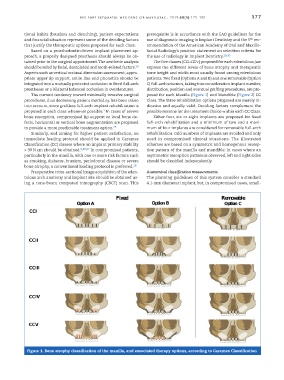
           tained prior to the surgical appointment. The aesthetic analysis   The five classes (CCI-CCV) proposed for each edentulous jaw
                                                          24
           should be ruled by facial, dentolabial and tooth-related factors.    express the different levels of bone atrophy and therapeutic
           Aspects such as vertical occlusal dimension assessment, appro-  bone height and width most usually found among edentulous
           priate upper lip support, smile line and phonetics should be   patients. Two fixed (Options A and B) and one removable (Option
           integrated into a mutually protected occlusion in fixed full-arch   C) full-arch schemes, taking into consideration implant number,
           prostheses or a bilateral balanced occlusion in overdentures.  distribution, position and eventual grafting procedures, are pro-
              The current tendency toward minimally invasive surgical   posed for each Maxilla (Figure 1) and Mandible (Figure 2) CC
           procedures, thus decreasing patient morbidity, has been taken   Class. The three rehabilitation options proposed are merely in-
           into account, since graftless full-arch implant rehabilitation is   dicative and equally valid. Deciding factors complement the
                                            7
           proposed in each class whenever possible.  In cases of severe   possible reasons for the treatment choice within each CC Class.
           bone resorption, compromised lip support or local bone de-  Either four, six or eight implants are proposed for fixed
           fects, horizontal or vertical bone augmentation are proposed   full-arch rehabilitation and a minimum of two and a maxi-
           to provide a more predictable treatment option. 25  mum of four implants are considered for removable full-arch
              Similarly, and aiming for higher patient satisfaction, an   rehabilitation. Odd numbers of implants are avoided and only
           immediate loading protocol should be applied in Carames   used in compromised clinical situations.  The illustrated
           Classification (CC) classes where an implant primary stability   schemes are based on a symmetric and homogenous resorp-
           > 30 N.cm should be obtained. 5,26,27  In compromised patients,   tion pattern of the maxilla and mandible. In cases where an
           particularly in the maxilla, with one or more risk factors such   asymmetric resorption pattern is observed, left and right sides
           as smoking, diabetes, bruxism, periodontal disease or severe   should be classified independently.
           bone atrophy, a conventional loading protocol is preferred. 28
              Preoperative cross-sectional image acquisition of the eden-  Anatomical classification measurements
           tulous arch anatomy and implant site should be obtained us-  The planning guidelines of this system consider a standard
           ing a cone-beam computed tomography (CBCT) scan. This   4.1-mm diameter implant, but, in compromised cases, small-


            Figure 1. Bone atrophy classification of the maxilla, and associated therapy options, according to Carames Classification

