


Page 33 - SPEMD_60-4
P. 33
rev port estomatol med dent cir maxilofac . 2019;60(4):175-188         181


           Maxilla CCIV                                        Option B – Placement of six implants with the same protocol
           Anterior – advanced resorption: height >8 mm and <12 mm;   as Option A for the anterior region of the maxilla. In the pos-
           width >6 mm                                         terior region, two pterygoid or tuberosity implants are placed
           Posterior – severe resorption: height <4 mm or width <6 mm  with an average angulation of 70.º to the occlusal plane. These
           Advanced bone resorption is seen in the anterior region. The   two implants are usually longer (15-20mm).  They pass
           bone height measured from the osteotomy level, with a >6-  through the maxillary tuberosity, the pyramidal process of
           mm crestal width, to the inferior border of the nasal cavity is   the palatine bone and are fixed in a dense cortical bone of the
           >8 mm and <12 mm. The posterior region is characterized by   pterygoid process of the sphenoid bone (Figure 9).
           severe bone resorption. The bone height measured from the   Option C – Although there is less bone availability compared
           alveolar ridge, with a <6-mm crestal width, to the inferior wall   to Option C of Class III, the rehabilitation scheme is similar,
           of the maxillary sinus is <4 mm.                    with four implants placed in the premaxilla to support an
                                                               overdenture.
           therapeutic options
           In this class, the severe posterior bone resorption (<4 mm)   deciding factor
           and the maxillary sinus extension prevent implant place-  Option A includes a sinus lift, which reestablishes adequate
           ment in the area without a sinus lift technique. Therefore, two   posterior bone volume for implant placement and is a well-
           surgical protocols are suggested for a fixed full-arch rehabili-  known approach widely supported in the literature with
                                                                                  37
           tation with either a grafting or a graftless approach.  long-term predictability.  The limitations of this option are
                                                               the time to the final rehabilitation, morbidity and the impos-
           Option A  – Placement of six implants. Four implants are   sibility of immediate loading. However, if the placement of
           placed in the anterior region of the maxilla. The two posteri-  four stable implants in the anterior area is possible, a serial
           or implants are placed simultaneously with a bilateral sinus   loading protocol with immediate loading of the anterior four
           elevation procedure. Taking into consideration the reduced   implants and a delayed loading after healing of the two pos-
           anterior bone height, only two anterior implants can be   terior implants allows a provisional immediate fixed rehabil-
           placed straight in the lateral incisors position, whereas the   itation, thus increasing the quality of life of the patient. It is
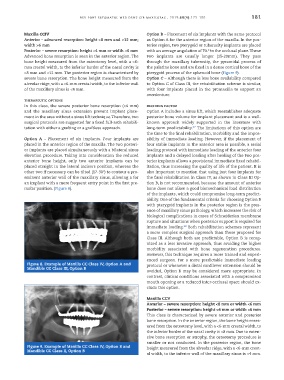
           other two if necessary can be tilted (17-30º) to contour a pro-  also important to mention that using just four implants for
           eminent anterior wall of the maxillary sinus, allowing a for   the final rehabilitation in Class IV, as shown in Class III Op-
           an implant with a more frequent entry point in the first pre-  tion B, is not recommended, because the amount of anterior
           molar position. (Figure 8).                         bone does not allow a good biomechanical load distribution
                                                               of the implants, which could compromise long-term predict-
                                                               ability. One of the fundamental criteria for choosing Option B
                                                               with pterygoid implants in the posterior region is the pres-
                                                               ence of maxillary sinus pathology, which increases the risk of
                                                               biological complications in cases of Schneiderian membrane
                                                               rupture and situations when posterior support is required for
                                                               immediate loading.  Both rehabilitation schemes represent
                                                                              38
                                                               a more complex surgical approach than those proposed for
                                                               Class III. Although both are predictable, Option B is recog-
                                                               nized as a less invasive approach, thus avoiding the higher
                                                               morbidity associated with bone regeneration procedures.
                                                               However, this technique requires a more trained and experi-
                                                               enced surgeon. For a more predictable immediate loading
            Figure 8. Example of Maxilla CC Class IV, Option A and   protocol or whenever a distal cantilever extension should be
            Mandible CC Class III, Option B
                                                               avoided, Option B may be considered more appropriate. In
                                                               contrast, clinical conditions associated with a compromised
                                                               mouth opening or a reduced inter-occlusal space should ex-
                                                               clude this option.

                                                               Maxilla CCV
                                                               Anterior – severe resorption: height <8 mm or width <6 mm
                                                               Posterior – severe resorption: height <4 mm or width <6 mm
                                                               This class is characterized by severe anterior and posterior
                                                               bone resorption. In the anterior region, the bone height meas-
                                                               ured from the osteotomy level, with a <6-mm crestal width, to
                                                               the inferior border of the nasal cavity is <8 mm. Due to exten-
                                                               sive bone resorption or atrophy, the osteotomy procedure is
                                                               smaller or not conducted. In the posterior region, the bone
            Figure 9. Example of Maxilla CC Class IV, Option B and   height measured from the alveolar ridge, with a <6-mm crest-
            Mandible CC Class II, Option B
                                                               al width, to the inferior wall of the maxillary sinus is <4 mm.

