


Page 34 - SPEMD_60-4
P. 34
182                    rev port estomatol med dent cir maxilofac. 2019;60(4):175-188


           This class is usually  defined  as a severely  atrophic  maxilla   skillful in this technique and should be considered as the last
           and is the most challenging class in full-arch rehabilitation.  option in treatment planning due to the possible surgical
                                                              complications (Figure 11).
           therapeutic options                                Option C – The severe bone resorption of this class requires
           Both the anterior and posterior areas have a minimum height   short implants or augmentation of the premaxilla to stabilize
           and width, challenging the implant placement. Despite the   the implants and support an overdenture.
           different graft extension, the two fixed full-arch rehabilitation
           options proposed require horizontal regeneration procedures.  deciding factor
                                                              The key factor in deciding between these two approaches is
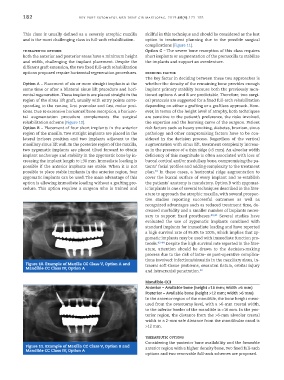
           Option A – Placement of six or more straight implants at the   whether the density of the remaining bone provides enough
           same time or after a bilateral sinus lift procedure and hori-  implant primary stability because both the previously men-
           zontal regeneration. These implants are placed straight in the   tioned options A and B are predictable. Therefore, two surgi-
           region of the sinus lift graft, usually with entry points corre-  cal protocols are suggested for a fixed full-arch rehabilitation
           sponding to the canine, first premolar and first molar posi-  depending on either a grafting or a graftless approach. How-
           tions. Due to extensive horizontal bone resorption, a horizon-  ever, in terms of the height level of atrophy, both techniques
           tal augmentation procedure complements the surgical   are sensitive to the patient’s preference, the risks involved,
           rehabilitation scheme (Figure 10).                 the expertise and the learning curve of the surgeon. Patient
           Option B – Placement of four short implants in the anterior   risk factors such as heavy smoking, diabetes, bruxism, sinus
           region of the maxilla. Two straight implants are placed in the   pathology and other compromising factors have to be con-
           lateral incisors position and two implants adjacent to the   sidered in the decision process. Regardless of the vertical
           maxillary sinus lift wall. In the posterior region of the maxilla,   augmentation with sinus lift, treatment complexity increas-
           two zygomatic implants are placed tilted forward to obtain   es in the presence of a thin ridge (<5 mm). An alveolar width
           implant anchorage and stability in the zygomatic bone by in-  deficiency of this magnitude is often associated with loss of
           creasing the implant length to ≥30 mm. Immediate loading is   buccal cortical and/or medullary bone, compromising the pa-
           possible if the anterior implants are stable. When it is not   tients’ facial profiles and adding complexity to the treatment
           possible to place stable implants in the anterior region, four   plan.  In  these  cases, a horizontal ridge augmentation to
                                                                  39
           zygomatic implants can be used. The main advantage of this   cover the buccal surface of every implant and re-establish
           option is allowing immediate loading without a grafting pro-  the patients’ anatomy is mandatory. Option B with zygomat-
           cedure. This option requires a surgeon who is trained and   ic implants is one of several techniques described in the liter-
                                                              ature to approach the atrophic maxilla, with several prospec-
                                                              tive studies reporting successful outcomes as well as
                                                              recognized advantages such as reduced treatment time, de-
                                                              creased morbidity and a smaller number of implants neces-
                                                              sary to  support  fixed  prostheses. 40,41  Several  studies have
                                                              evaluated the use of zygomatic implants combined with
                                                              standard implants for immediate loading and have reported
                                                              a high survival rate of 95.8% to 100%, which implies that zy-
                                                              gomatic implants may be used with immediate function pro-
                                                              tocols. 42-44  Despite the high survival rate reported in the liter-
                                                              ature, attention should be drawn to the decision-making
                                                              process due to the risk of intra- or post-operative complica-
                                                              tions involved: infections/sinusitis in the maxillary sinus, in-
            Figure 10. Example of Maxilla CC Class V, Option A and   traoral soft-tissue problems, oroantral fistula, orbital injury
            Mandible CC Class IV, Option A
                                                              and intracranial penetration. 40

                                                              Mandible CCI
                                                              Anterior – Available bone (height >16 mm; width >6 mm)
                                                              Posterior – Available bone (height >12 mm; width >6 mm)
                                                              In the anterior region of the mandible, the bone height meas-
                                                              ured from the osteotomy level, with a >6-mm crestal width,
                                                              to the inferior border of the mandible is >16 mm. In the pos-
                                                              terior region, the distance from the >6-mm alveolar crestal
                                                              width to a 2-mm safe distance from the mandibular canal is
                                                              >12 mm.

                                                              therapeutic options
                                                              Considering the posterior bone availability and the favorable
            Figure 11. Example of Maxilla CC Class V, Option B and   anterior region with a higher density bone, two fixed full-arch
            Mandible CC Class IV, Option A
                                                              options and two removable full-arch schemes are proposed.

