


Page 31 - SPEMD_60-4
P. 31
rev port estomatol med dent cir maxilofac . 2019;60(4):175-188         179


           sinus and the nasal cavity. In the posterior region, the first
           molar position is considered. The height is measured from the
           >6-mm width level of the alveolar ridge to the inferior wall of
           the maxillary sinus.
              In the mandible, the measurements are also made in five
           positions: in the anterior region, at the midline and on each
           side of the mandible at 4 mm anterior to the position of the
           mental foramen. The height is measured from the >6-mm
           width crestal level to the inferior border of the mandible. In
           the posterior region, the first molar position is considered. The
           posterior therapeutic bone height is measured as the distance
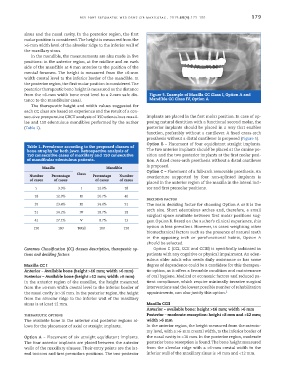
           from the >6-mm width bone crest level to a 2-mm safe dis-  Figure 5. Example of Maxilla CC Class I, Option A and
           tance to the mandibular canal.                       Mandible CC Class IV, Option A
              The therapeutic height and width values suggested for
           each CC class are based on experience and the result of a con-
           secutive preoperative CBCT analysis of 150 edentulous maxil-  implants are placed in the first molar position. In case of op-
           lae and 150 edentulous mandibles performed by the author   posing natural dentition with a functional second molar, the
           (Table 1).                                          posterior implants should be placed in a way that enables
                                                               function, preferably without a cantilever. A fixed cross-arch
                                                               prosthesis without a distal cantilever is proposed (Figure 5).
                                                               Option B – Placement of four equidistant straight implants.
            Table 1. Prevalence according to the proposed classes of
            bone atrophy for both jaws. Retrospective analysis of   The two anterior implants should be placed at the canine po-
            150 consecutive cases of maxillary and 150 consecutive   sition and the two posterior implants at the first molar posi-
            of mandibular edentulous patients.                 tion. A fixed cross-arch prosthesis without a distal cantilever
                                                               is proposed.
                   Maxilla                    Mandible
                                                               Option C – Placement of a full-arch removable prosthesis. An
                                 Class
             Number    Percentage       Percentage   Number    overdenture supported by four non-splinted implants is
              of cases  of cases         of cases  of cases
                                                               placed in the anterior region of the maxilla in the lateral inci-
                5          3.3%    I      12.0%      18        sor and first premolar positions.
                18       12.0%     II     26.7%      40
                                                               deciding factor
                35       23.4%    III     34.0%      51        The main deciding factor for choosing Option A or B is the
                                                               arch size. Short edentulous arches and, therefore, a small
                51       34.2%    IV      18.7%      28
                                                               surgical space available between first molar positions sug-
                41       27.1%     V        8.7%     13        gest Option B. Based on the author’s clinical experience, this
               150       100     Total     100       150       option is less prevalent. However, in cases weighting other
                                                               biomechanical factors such as the presence of natural teeth
                                                               in the opposing arch or parafunctional habits, Option  A
                                                               should be selected.
           Carames Classification (CC) classes description, therapeutic op-  Option C (CCI, CCII and CCIII) is specifically indicated in
           tions and deciding factors                          patients with any cognitive or physical impairment. An eden-
                                                               tulous older adult who needs daily assistance or has some
           Maxilla CC I                                        degree of dependence could be a candidate for this therapeu-
           Anterior – Available bone (height >16 mm; width >6 mm)  tic option, as it offers a favorable condition and maintenance
           Posterior – Available bone (height >12 mm; width >6 mm)  of oral hygiene. Medical or economic factors and reduced pa-
           In the anterior region of the maxillae, the height measured   tient compliance, which require minimally invasive surgical
           from the >6-mm width crestal level to the inferior border of   interventions and the lowest possible number of rehabilitation
           the nasal cavity is >16 mm. In the posterior region, the height   appointments, can also justify this option. 2
           from the alveolar ridge to the inferior wall of the maxillary
           sinus is at least 12 mm.                            Maxilla CCII
                                                               Anterior – available bone: height >16 mm; width >6 mm
           therapeutic options                                 Posterior – moderate resorption: height >8 mm and <12 mm;
           The available bone in the anterior and posterior regions al-  width >6 mm
           lows for the placement of axial or straight implants.  In the anterior region, the height measured from the osteoto-
                                                               my level, with a >6-mm crestal width, to the inferior border of
           Option A  – Placement of six straight equidistant implants.   the nasal cavity is >16 mm. In the posterior region, moderate
           The four anterior implants are placed between the anterior   posterior bone resorption is found. The bone height measured
           walls of the maxillary sinuses. Their entry points are the lat-  from the alveolar ridge with a >6-mm crestal width to the
           eral incisors and first premolars positions. The two posterior   inferior wall of the maxillary sinus is >8 mm and <12 mm.

