


Page 50 - SPEMD_59-4
P. 50
222                    rev port estomatol med dent cir maxilofac. 2018;59(4):221-224


                                            ção anticonvulsivante. Diretrizes sobre hábitos de higiene oral e alimentar, bem como
                                            aplicação tópica de verniz fluoretado foram implementadas. A hiperplasia foi revertida
                                            em 2 semanas e o paciente tem recebido acompanhamento. O paciente encontra-se em
                                            monitorização e houve melhoria de sua condição oral. (Rev Port Estomatol Med Dent Cir
                                            Maxilofac. 2018;59(4):221-224)
                                                            © 2018 Sociedade Portuguesa de Estomatologia e Medicina Dentária.
                                                 Published by SPEMD. This is an open access article under the CC BY-NC-ND license
                                                                       (http://creativecommons.org/licenses/by-nc-nd/4.0/).


                                                              had been born with hydrocephalus, facial changes, and cleft
           Introduction
                                                              lip/palate.
           Peters-plus syndrome, also known as Krause-Kivlin syn-  The patient had already undergone 10 surgical interven-
           drome, is a rare congenital disorder of glycosylation with an   tions, including cheiloplasty to correct the cleft lip at the age
                                 1,2
           autosomal recessive pattern.  Its exact incidence is still un-  of 6 months, two interventions for the implantation of ventric-
           known, and fewer than 75 cases with this anomaly have been   uloperitoneal shunt valves to relieve intracranial pressure, two
           identified in the medical literature. 3            to correct an inguinal hernia, two surgeries for eyelid recon-
             Peters-plus syndrome can be diagnosed clinically by the   struction, and three external and middle ear surgeries.
           presence of Peters anomaly – a congenital corneal opacity sec-  The patient had undergone cardiac examinations for the
           ondary to a defect in neural crest cell migration that causes a   diagnosis of possible heart abnormalities, which are common-
           malformation of the anterior eye segment, associated with   ly associated with the syndrome, but no abnormalities were
           other symptoms. These symptoms include a delayed psycho-  found. There was no report of food or medication hypersensi-
           motor development, variable degrees of mental retardation,   tivity. The anticonvulsant drug Gardenal  (40mg/mL) had been
                                                                                             ®
           disproportionate short stature, and some facial features such   continuously administered orally twice a day over the previous
           as cleft lip or palate (present in about half of the cases), hyper-  10 months, together with vitamin C. At the extraoral clinical
           telorism, narrow eyes, prominent forehead, a thin/cupid’s   examination, the syndrome’s typical facial appearance was
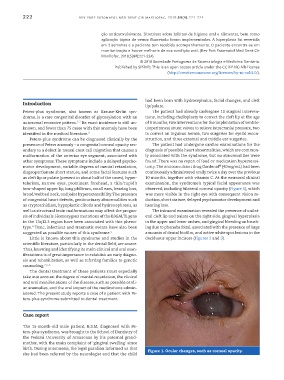
           bow-shaped upper lip, long philtrum, small ears, hearing loss,   observed, including bilateral corneal opacity (Figure 1), which
           broad/webbed neck, and joint hyperextensibility. The presence   was more visible in the right eye with consequent vision re-
           of congenital heart defects, genitourinary abnormalities such   duction, short stature, delayed psychomotor development and
           as cryptorchidism, hypoplastic clitoris and hydronephrosis, as   hearing loss.
           well as structural brain malformations may affect the progno-  The intraoral examination revealed the presence of unilat-
           sis of individuals. Homozygous mutations of the B3GALTL gene   eral cleft lip and palate on the right side, gingival hyperplasia
           in the 13q12.3 region have been associated with this pheno-  in the upper and lower arches, and gingival bleeding on brush-
              4
           type.  Toxic, infectious and traumatic events have also been   ing due to phenobarbital, associated with the presence of large
           suggested as possible causes of this syndrome. 5   amounts of dental biofilm, and active white spot lesions in the
             Little is known about this syndrome and studies in the   deciduous upper incisors (Figures 2 and 3).
           scientific literature, particularly in the dental field, are scarce.
           Thus, knowing and identifying its main clinical and oral man-
           ifestations is of great importance to establish an early diagno-
           sis and rehabilitation, as well as referring families to genetic
           counseling. 2,5-6
             The dental treatment of these patients must especially
           take into account the degree of mental retardation, the clinical
           and oral manifestations of the disease, such as possible cardi-
           ac anomalies, and the oral impact of the medications admin-
           istered. The present study reports a case of a patient with Pe-
           ters-plus syndrome submitted to dental treatment.


           Case report

           The  15-month-old  male  patient,  B.S.M,  diagnosed  with  Pe-
           ters-plus syndrome, was brought to the School of Dentistry of
           the  Federal  University  of Amazonas  by  his  paternal  grand-
           mother, with the main complaint of ‘gingival swelling’ since
           birth. During anamnesis, the legal guardian informed us that   Figure 1. Ocular changes, such as corneal opacity.
           she had been referred by the neurologist and that the child

