


Page 58 - SPEMD_59-2
P. 58
116                    rev port estomatol med dent cir maxilofac. 2018;59(2):115-118


                                            rido para queratoacantoma gigante. O objetivo deste estudo é analisar as características
                                            clinicopatológicas do queratoacantoma gigante de cabeça e pescoço, revisando os estudos
                                            publicados na literatura inglesa e relatando um novo caso da lesão que apareceu no lábio.
                                            (Rev Port Estomatol Med Dent Cir Maxilofac. 2018;59(2):115-118)
                                                            © 2017 Sociedade Portuguesa de Estomatologia e Medicina Dentária.
                                                 Publicado por SPEMD. Este é um artigo Open Access sob uma licença CC BY-NC-ND
                                                                       (http://creativecommons.org/licenses/by-nc-nd/4.0/).


           Introduction                                       Case report

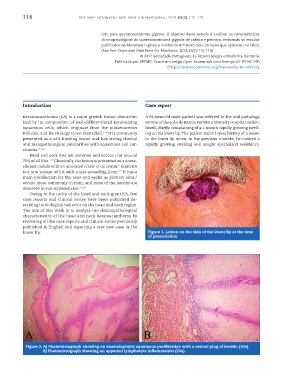
           Keratoacanthoma (KA) is a rapid growth tumor character-  A 64-year-old male patient was referred to the oral pathology
           ized by its composition of well-differentiated keratinizing   service of the João de Barros Barreto University Hospital, Belém,
           squamous  cells,  which  originate from  the  pilosebaceous   Brazil, chiefly complaining of a 1-month rapidly growing swell-
           follicles, and its etiology is not identified. 1-4  It is commonly   ing on his lower lip. The patient had a 1-year history of a lesion
           presented as a self-limiting lesion and has strong clinical   in the lower lip when, in the previous 4 weeks, he noticed a
           and histopathological similarities with squamous cell car-  rapidly growing swelling and sought specialized assistance.
           cinoma. 2,3,6
             Head and neck KAs are common and account for around
                      1,3
           70% of all KAs.  Classically, the lesion is presented as a dome-
                                                   6
           shaped nodule with an ulcerated crater in its center.  Giant KA
           is a rare variant of KA with a size exceeding 2 cm. 1,7  It has a
                                                          8
           main predilection for the nose and eyelid as primary sites,
           occurs more commonly in men, and most of the lesions are
           observed in sun-exposed skin. 1,4,6
             Owing to the rarity of the head and neck giant KA, few
           case reports and clinical series have been published de-
           scribing its biological behavior on the head and neck region.
           The aim of this work is to analyze the clinicopathological
           characteristics of the head and neck keratoacanthoma by
           reviewing all the case reports and clinical series previously
           published in English and reporting a rare new case in the
           lower lip.                                          Figure 1. Lesion on the skin of the lower lip at the time
                                                               of presentation


            Figure 2.  A) Photomicrograph showing an exoendophytic squamous proliferation with a central plug of keratin (10x).
                   B) Photomicrograph showing an apparent lymphocyte inflammation (20x).

