


Page 54 - SPEMD_59-2
P. 54
112                    rev port estomatol med dent cir maxilofac. 2018;59(2):107-114


                                                                 Contrary to what occurs with other teeth, and as proven by
                                                              the clinical cases here presented, eruptive disorders involving the
                                                                                                             3
                                                              MCI are frequently detected at the early mixed dentition phase.
                                                              Detailed clinical history and both clinical and radiographic ex-
                                                                                                      2
                                                              aminations are pivotal for making a correct diagnosis.  In partic-
                                                              ular, the clinical history is invaluable to screen for possible local
                                                              or systemic pathologies or the occurrence of trauma during child-
                                                              hood. 10,13  In Case 2, the patient’s history prior to tooth impaction,
                                                              in association with a traumatic episode involving the MCI’s pre-
                                                              decessor, demonstrates that traumatology is an important etio-
                                                              logical factor of this pathology and is usually responsible for the
                                                              dilaceration of MCIs that prompts impaction. 14,15  Dilaceration
                                                              refers to the displacement of a tooth’s root in relation to its nor-
                                                                                     16
                                                              mal alignment with the crown. Such deformity can pose com-
                                                              plications for impacted tooth treatment since the curved root can
                                                              affect the adjacent teeth or enter the labial cortical bone, which
                                                              causes pulp and periapical problems. 17,18  Case 2 presented an
                                                              MCI with an apical dilaceration of moderate severity, and its
                                                              treatment was achieved without complications, probably be-
                                                              cause during traction the apex slipped into the bone marrow,
                                                              despite being close to the intermaxillary suture.
                                                                 When impaction of an MCI is suspected, it is essential to
                                                              search for certain indications of impaction in clinical exam-
                                                              inations – namely, an asymmetrical eruption with the homol-
                                                              ogous contralateral for roughly 6 months, the alteration of the
                                                              sequence or chronology of eruption, deciduous tooth reten-
                                                              tion, midline deviation, loss of space, and elevations in the soft
                                                              palatine tissue or labial mucosa. Following a careful clinical
                                                                                       13
                                                              examination, it is imperative to use a complementary means
                                                              of diagnosis. In all clinical cases presented, panoramic radiog-
                                                              raphy and lateral teleradiography were important methods for
                                                              studying the impacted MCI and general orthodontics.
                                                                 With all the requisite information, it is possible to establish
                                                              a diagnosis and elaborate a treatment plan. Once complete,
                                                              the symbiosis of several medical specialties may be neces-
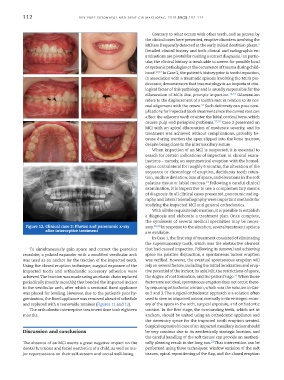
            Figure 12.  Clinical case 3: Photos and panoramic x-ray   sary. 19,20  In response to the situation, several treatment options
                    after interceptive treatment
                                                              are available.
                                                                 In Case 1, the first step of treatment consisted of eliminating
                                                              the supernumerary tooth, which was the obstructive element
             To simultaneously gain space and correct the posterior   that had caused impaction. Following its removal and achieving
           crossbite, a palatal expander with a modified vestibular arch   space via palatine disjunction, a spontaneous incisor eruption
           was used as an anchor for the traction of the impacted tooth.   was verified. However, the eventual spontaneous eruption will
           Using the closed eruption technique, surgical exposure of the   rely on several factors, including the initial localization and erup-
           impacted tooth and orthodontic accessory adhesion were   tive potential of the incisor, its axial tilt, the restrictions of space,
                                                                                                   21
           achieved. The traction was made using an elastic chain replaced   the degree of root formation, and the patient’s age.  When those
           periodically (mostly monthly) that bonded the impacted incisor   factors are not ideal, spontaneous eruption does not occur, there-
           to the vestibular arch, after which a sectional fixed appliance   by requiring orthodontic traction, which was the solution in Cas-
           was placed for leveling. However, due to the patient’s poor hy-  es 2 and 3. The surgical orthodontic approach is a solution often
           gienization, the fixed appliance was removed ahead of schedule   used to save an impacted incisor, normally in three stages: recov-
           and replaced with a removable retainer (Figures 11 and 12).   ery of the space in the arch, surgical exposure, and orthodontic
             The orthodontic interceptive treatment time took eighteen   traction. In the first stage, the surrounding teeth, which act as
           months.                                            anchors, should be united using an orthodontic appliance and
                                                              the necessary space for the impacted tooth eruption created.
                                                              Surgical exposure in case of an impacted maxillary incisor should
           Discussion and conclusions                         be very cautious due to its aesthetically strategic location, and
                                                              the careful handling of the soft tissues can provide an aestheti-
                                                                                         22
           The absence of an MCI exerts a great negative impact on the   cally pleasing result in the long run. That intervention can be
           dental functions and facial aesthetics of a child, as well as ma-  performed using three techniques: window excision of the soft
           jor repercussions on their self-esteem and social well-being.  tissues, apical repositioning of the flap, and the closed eruption

