


Page 50 - SPEMD_59-2
P. 50
108                    rev port estomatol med dent cir maxilofac. 2018;59(2):107-114


                                            nam-se imperativos. Uma das principais abordagens passa pela exposição cirúrgica, aber-
                                            tura ortodôntica de espaço e tração do incisivo para a sua posição normal, o que acarreta
                                            benefícios como a manutenção do dente e a possibilidade de manutenção do osso alveolar.
                                            Este artigo apresenta a análise de três casos clínicos de indivíduos portadoras de um inci-
                                            sivo central maxilar impactado com causa de impactação distinta nomeadamente dente
                                            supranumerário, dilaceração da raiz e desvio de erupção, submetidos a tratamento e desta-
                                            cando a tração ortodôntica. (Rev Port Estomatol Med Dent Cir Maxilofac. 2018;59(2):107-114)
                                                            © 2017 Sociedade Portuguesa de Estomatologia e Medicina Dentária.
                                                 Publicado por SPEMD. Este é um artigo Open Access sob uma licença CC BY-NC-ND
                                                                       (http://creativecommons.org/licenses/by-nc-nd/4.0/).


           Introduction                                       Case report

           The maxillary incisors definitively shape a person’s smile,   Clinical Case 1
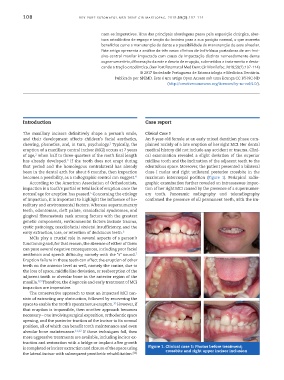
           and their development affects children’s facial aesthetics,   An 8-year-old female at an early mixed dentition phase com-
                                               1
           chewing, phonetics, and, in turn, psychology.  Typically, the   plained mainly of a late eruption of her right MCI. Her dental
           eruption of a maxillary central incisor (MCI) occurs at 7 years   medical history did not include any accident or trauma. Clini-
                2
           of age,  when half to three-quarters of the root’s final length   cal examination revealed a slight deviation of the superior
           has  already developed.   If the  tooth  does not  erupt  during   midline tooth and the inclination of the adjacent teeth to the
                             3
           that  period  and  the  homologous  contralateral  has  already   edentulous space. Moreover, the patient presented a bilateral
           been in the dental arch for about 6 months, then impaction   class I molar and right unilateral posterior crossbite in the
                                                          4
           becomes a possibility, as a radiographic control can suggest.    maximum intercuspal position (Figure 1). Periapical radio-
             According to the American Association of Orthodontists,   graphic examination further revealed an intraosseous impac-
           impaction is a tooth’s partial or total lack of eruption once the   tion of her right MCI caused by the presence of a supernumer-
           normal age for eruption has passed.  Concerning the etiology   ary tooth. Panoramic radiography and teleradiography
                                       5
           of impaction, it is important to highlight the influence of he-  confirmed the presence of all permanent teeth, with the im-
           reditary and environmental factors. Whereas supernumerary
           teeth, odontomas, cleft palate, craniofacial syndromes, and
           gingival fibromatosis rank among factors with the greatest
           genetic components, environmental factors include trauma,
           cystic pathology, maxillofacial skeletal insufficiency, and the
                                                     6
           early extraction, loss, or retention of deciduous teeth.
             MCIs play a crucial role in several aspects of a person’s
           functioning and, for that reason, the absence of either of them
           can pose several negative consequences, including poor facial
                                                          7
           aesthetics and speech difficulty, namely with the “s” sound.
           Eruption failure in those teeth can affect the eruption of other
           teeth on the anterior level as well, namely the canine, due to
           the loss of space, middle line deviation, or reabsorption of the
           adjacent tooth or alveolar bone in the anterior region of the
           maxilla.  Therefore, the diagnosis and early treatment of MCI
                 8,9
           impaction are imperative.
             The conservative approach to treat an impacted MCI con-
           sists of extracting any obstruction, followed by recovering the
                                                 10
           space to enable the tooth’s spontaneous eruption.  However, if
           that eruption is impossible, then another approach becomes
           necessary – one involving surgical exposition, orthodontic space
           opening, and the posterior traction of the incisor to its normal
           position, all of which can benefit tooth maintenance and even
           alveolar bone maintenance. 11,12  If those techniques fail, then
           more aggressive treatments are available, including incisor ex-
           traction and restoration with a bridge or implant after growth
           is completed or incisor extraction and closure of the space using   Figure 1.  Clinical case 1: Photos before treatment;
                                                                      crossbite and right upper incisor inclusion
           the lateral incisor with subsequent prosthetic rehabilitation. (11)

