


Page 36 - SPEMD_59-1
P. 36
28                      rev port estomatol med dent cir maxilofac. 2018;59(1):24-29


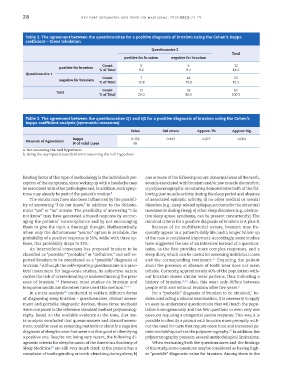
            Table 2. The agreement between the questionnaires for a positive diagnosis of bruxism using the Cohen’s kappa
            coefficient – Cross tabulation
                                                                 Questionnaire 2
                                                                                                  Total
                                                     positive for bruxism  negative for bruxism
                                            Count           6                   6                  12
                          positive for bruxism
                                           % of Total      9.2                 9.2                 18.5
            Questionnaire 1
                                            Count           7                  46                  53
                          negative for bruxism
                                           % of Total      10.8                70.8                81.5
                                            Count          13                  52                  65
                         Total
                                           % of Total      20.0                80.0               100.0


            Table 3. The agreement between the questionnaires Q1 and Q2 for a positive diagnosis of bruxism using the Cohen’s
            kappa coefficient analysis (symmetric measures)

                                                        Value        Std errora     Approx. Tb    Approx Sig.
                                kappa                   0.356          0.143          2.877          0.004
            Measure of Agreement
                                N of valid cases         65
           a. Not assuming the null hypothesis
           b. Using the asymptotic standard error assuming the null hypothesi


           limiting factor of this type of methodology is the individual’s per-  one or more of the following occurs: abnormal wear of the teeth,
           ception of the symptoms, since waking up with a headache may   sounds associated with bruxism and/or jaw muscle discomfort;
           be associated with other pathologies and, in addition, such symp-  c) polysomnographic monitoring demonstrates both of the fol-
           toms may already be part of the patient’s routine. 8  lowing: jaw muscle activity during the sleep period and absence
             The results may have also been influenced by the possibil-  of associated epileptic activity; d) no other medical or mental
           ity of answering “I do not know,” in addition to the dichoto-  disorders (e.g., sleep-related epilepsy, accounts for the abnormal
           mous “yes” or “no” answer. The possibility of answering “I do   movements during sleep); e) other sleep disorders (e.g., obstruc-
           not know” may have generated a biased response by encour-  tive sleep apnea syndrome, can be present concurrently). The
           aging the patients’ noncompliance and by not encouraging   minimal criteria for a positive diagnosis of bruxism is A plus B.
           them to give the topic a thorough thought. Mathematically,   Because of its multifactorial nature, bruxism may fre-
           when only the dichotomous “yes/no” option is available, the   quently appear in a patient’s daily life, and a longer follow-up
           probability of a positive response is 50%, while with three op-  of the case is considered important. Accordingly, some studies
           tions, this probability drops to 33%.              have suggested the use of an interview instead of a question-
             An international consensus has proposed bruxism to be   naire, as the first provides more complex responses, and a
           classified as “possible,” “probable,” or “definitive,” and self-re-  sleep diary, which can be useful for assessing individual cases
                                                                                          17
           ported bruxism to be considered as a “possible” diagnosis of   and the corresponding treatment.  Enquiring the patient
                  1
           bruxism.  Although the self-reporting questionnaire is a prac-  about the presence or absence of tooth wear does not seem
           tical instrument for large-scale studies, its subjective nature   reliable. Currently, approximately 40% of the population with-
           carries the risk of overestimating or underestimating the pres-  out bruxism shows similar wear patterns, thus indicating a
           ence of bruxism. 1,4  However, most studies on bruxism and   history of bruxism. 8,11  Also, this wear only differs between
           temporomandibular disorders have used this method. 15-17  people with and without bruxism after two years. 2
                            18
                                                                                                          1
             In a meta-analysis  conducted to validate different forms   For a “probable” diagnosis of bruxism to be obtained,  be-
           of diagnosing sleep bruxism – questionnaires, clinical assess-  sides conducting a clinical examination, it is necessary to apply
           ment and portable diagnostic devices, these three methods   an easy-to-understand questionnaire that will reach the popu-
           were compared to the reference standard method polysomnog-  lation homogeneously and has few questions or even only one
           raphy. Based on the available evidence at the time, that me-  question requiring a categorical yes/no response. This way, it is
           ta-analysis concluded that questionnaires and clinical assess-  possible to identify a patient with bruxism more promptly with-
           ment could be used as screening methods to identify a negative   out the need for tests that require more time and increased pa-
                                                                                                 15
           diagnosis of sleep bruxism but were not that good in identifying   tient availability, such as the polysomnography.  In addition, the
           a positive one. Despite not being very recent, the following di-  polysomnography presents several methodological limitations.
           agnostic criteria for sleep bruxism of the American Academy of   When evaluating both the questionnaires and the findings
           Sleep Medicine  are still very much cited: a) the patient has a   of this study, some questions may be considered as having high-
                      19
           complaint of tooth-grinding or tooth-clenching during sleep; b)   er “possible” diagnostic value for bruxism. Among them is the

