


Page 34 - SPEMD_59-1
P. 34
26                      rev port estomatol med dent cir maxilofac. 2018;59(1):24-29


                           1
           nature is a limitation.  To date, there is no consensus on which   and used for this study. Bruxism data were collected using two
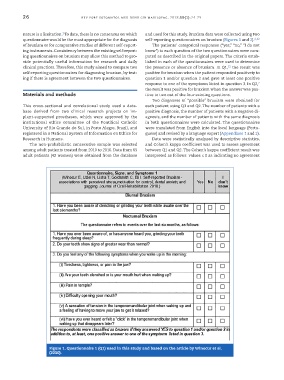
           questionnaire would be the most appropriate for the diagnosis   self-reporting questionnaires on bruxism (Figures 1 and 2). 2,12
           of bruxism or for comparative studies of different self-report-  The patients’ categorical responses (“yes,” “no,” “I do not
           ing instruments. Consistency between the existing self-report-  know”) to each question of the two questionnaires were com-
           ing questionnaires on bruxism may allow this method to pro-  puted as described in the original papers. The criteria estab-
           vide potentially useful information for research and daily   lished in each of the questionnaires were used to determine
                                                                                                 12
           clinical practices. Therefore, this study aimed to compare two   the presence or absence of bruxism. In Q1,  the result was
           self-reporting questionnaires for diagnosing bruxism, by test-  positive for bruxism when the patient responded positively to
           ing if there is agreement between the two questionnaires.  question 1 and/or question 2 and gave at least one positive
                                                                                                             2
                                                              response to one of the symptoms listed in question 3. In Q2,
                                                              the result was positive for bruxism when the answer was pos-
           Materials and methods                              itive to two out of the four existing questions.
                                                                 Two diagnoses of “possible” bruxism were obtained for
           This  cross-sectional  and  correlational  study  used  a  data-  each patient using Q1 and Q2. The number of patients with a
           base derived from two clinical research projects on im-  positive diagnosis, the number of patients with a negative di-
           plant-supported prostheses, which were approved by the   agnosis, and the number of patients with the same diagnosis
           institutional ethics committee of the Pontifical Catholic   in both questionnaires were calculated. The questionnaires
           University of Rio Grande do Sul, in Porto Alegre, Brazil, and   were translated from English into the local language (Portu-
           registered in a National System of Information on Ethics for   guese) and revised by a language expert (Appendixes 1 and 2).
           Research in Humans.                                   Data were statistically analyzed by descriptive statistics,
             The non-probabilistic consecutive sample was selected   and Cohen’s kappa coefficient was used to assess agreement
           among adult patients treated from 2010 to 2016. Data from 65   between Q1 and Q2. The Cohen’s kappa coefficient result was
           adult patients (42 women) were obtained from the database   interpreted as follows: values ≤ 0 as indicating no agreement


                      Figure 1. Questionnaire 1 (Q1) used in this study and based on the article by Winocur et al.
                      (2010). 12

