


Page 44 - SPEMD_60-3
P. 44
132                    rev port estomatol med dent cir maxilofac. 2019;60(3):130-136


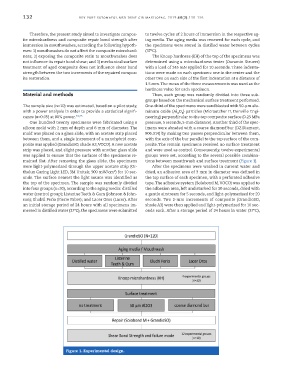
             Therefore, the present study aimed to investigate compos-  to twelve cycles of 2 hours of immersion in the respective ag-
           ite microhardness and composite repair bond strength after   ing media. The aging media was renewed for each cycle, and
           immersion in mouthwashes, according the following hypoth-  the specimens were stored in distilled water between cycles
           eses: 1) mouthwashes do not affect the composite microhard-  (37ºC).
           ness; 2) exposing the composite resin to mouthwashes does   The Knoop hardness (KH) of the top of the specimens was
           not influence its repair bond shear; and 3) mechanical surface   determined using a microhardness tester (Duramin Struers)
           treatment of aged composite does not influence shear bond   with a load of 245 mN applied for 10 seconds. Three indenta-
           strength between the two increments of the repaired compos-  tions were made on each specimen: one in the center and the
           ite restoration.                                   other two on each side of the first indentation at a distance of
                                                              1.5 mm. The mean of the three measurements was used as the
                                                              hardness value for each specimen.
           Material and methods                                  Then, each group was randomly divided into three sub-
                                                              groups based on the mechanical surface treatment performed.
           The sample size (n=10) was estimated, based on a pilot study,   One-third of the specimens were sandblasted with 50-µm alu-
           with a power analysis in order to provide a statistical signifi-  minum oxide (Al O ) particles (Microetcher II, Danville Engi-
                                                                           2  3
           cance (α=0.05) at 80% power. 24,25                 neering) perpendicular to the top composite surface (0.25 MPa
             One hundred twenty specimens were fabricated using a   pressure, 5 seconds, 5-mm distance). Another third of the spec-
           silicon mold with 2 mm of depth and 6 mm of diameter. The   imens were abraded with a coarse diamond bur (DZ Diamant,
           mold was placed on a glass slide, with an acetate strip placed   806.314) by making two passes perpendicular between them,
           between them, and a single increment of a nanohybrid com-  with the axis of the bur parallel to the top surface of the com-
           posite was applied (GrandioSO, shade A3, VOCO). A new acetate   posite. The remain specimens received no surface treatment
           strip was placed, and slight pressure with another glass slide   and were used as control. Consequently, twelve experimental
           was applied to ensure that the surfaces of the specimens re-  groups were set, according to the several possible combina-
           mained flat. After removing the glass slide, the specimens   tions between mouthwash and surface treatment (Figure 1).
           were light-polymerized through the upper acetate strip (Or-  After the specimens were washed in current water and
                                                 2
           tholux Curing Light LED, 3M Unitek; 900 mW/cm ) for 10 sec-  dried, an adhesion area of 3 mm in diameter was defined in
           onds. The surface nearest the light source was identified as   the top surface of each specimen, with a perforated adhesive
           the top of the specimen. The sample was randomly divided   tape. The adhesive system (Solobond M, VOCO) was applied to
           into four groups (n=30), according to the aging media: distilled   the adhesion area, left undisturbed for 30 seconds, dried with
           water (control group); Listerine Teeth & Gum (Johnson & John-  a gentle airstream for 5 seconds, and light-polymerized for 20
           son); Eludril Perio (Pierre Fabre); and Lacer Oros (Lacer). After   seconds. Two 2-mm increments of composite (GrandioSO,
           an initial storage period of 24 hours with all specimens im-  shade A3) were then applied and light-polymerized for 10 sec-
           mersed in distilled water (37ºC), the specimens were submitted   onds each. After a storage period of 24 hours in water (37ºC),


                             Figure 1. Experimental design.

