


Page 45 - SPEMD_60-3
P. 45
rev port estomatol med dent cir maxilofac . 2019;60(3):130-136         133


           the repaired specimens were submitted to shear bond strength
           (SBS) tests, performed with a single-plane lap device in a uni-
           versal testing machine (Instron Model 4502, Instron Ltd.), with
           a 1 kN load cell and at a crosshead speed of 1 mm/min, until
           fracture. 25
              The mode of failure was evaluated using a stereomicro-
           scope (EMZ-8TR, Meiji Techno Co.) at 20x magnification. It was
           classified as adhesive if the failure occurred at the adhesive
           interface between the aged and the repair composite resins,
           as cohesive if it occurred in the composite resin, and as mixed
           when a combination of the two previous types was observed.
              Data were analyzed using the IBM SPSS Statistics for Mac-
           intosh, version 25.0 (IBM Corp.). The microhardness data were
           submitted to one-way  ANOVA, followed by Student-New-
           man-Keuls multiple comparison post-hoc tests. SBS data were
           analyzed with a two-way ANOVA and the mode of failure with
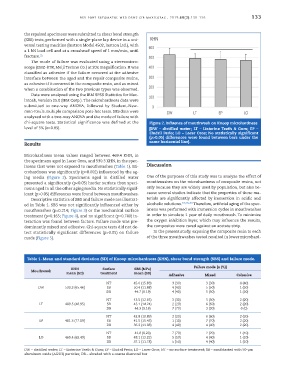
           chi-square tests. Statistical significance was defined at the   Figure 2. Influence of mouthwash on Knoop microhardness
           level of 5% (α=0.05).                                [DW – distilled water; LT – Listerine Teeth & Gum; EP –
                                                                Eludril Perio; LO – Lacer Oros; No statistically significant
                                                                (p>0.05) differences were found between bars under the
           Results                                              same horizontal line].

           Microhardness mean values ranged between 469.4 KHN, in
           the specimens aged in Lacer Oros, and 530.3 KHN, in the spec-
           imens that were not exposed to mouthwashes (Table 1). Mi-  Discussion
           crohardness was significantly (p=0.002) influenced by the ag-
           ing media (Figure 2). Specimens aged in distilled water   One of the purposes of this study was to analyze the effect of
           presented a significantly (p<0.05) harder surface then speci-  mouthwashes on the microhardness of composite resins, not
           mens aged in all the other aging media. No statistically signif-  only because they are widely used by population, but also be-
           icant (p>0.05) differences were found between mouthwashes.  cause several studies indicate that the properties of these ma-
              Descriptive statistics of SBS and failure mode are illustrat-  terials are significantly affected by immersion in acidic and
           ed in Table 1. SBS was not significantly influenced either by   alcoholic solutions. 18,26-30  Therefore, artificial aging of the spec-
           mouthwashes (p=0.214; Figure 3) or the mechanical surface   imens was performed with immersion cycles in mouthwashes
           treatment (p=0.165; Figure 4), and no significant (p=0.740) in-  in order to simulate 1 year of daily mouthwash. To minimize
           teraction was found between factors. Failure mode was pre-  the oxygen inhibition layer, which may influence the results,
           dominantly mixed and adhesive. Chi-square tests did not de-  the composites were cured against an acetate strip.
           tect statistically significant differences (p>0.05) on failure   In the present study, exposing the composite resin to each
           mode (Figure 5).                                    of the three mouthwashes tested resulted in lower microhard-


            Table 1. Mean and standard deviation (SD) of Knoop microhardness (KHN), shear bond strength (SBS) and failure mode.
                                                                                  Failure mode [n (%)]
                               KHN          Surface      SBS (MPa)
              Mouthwash
                             mean (SD)     treatment     mean (SD)
                                                                        Adhesive       Mixed        Cohesive
                                              NT         45.0 (15.83)    3 (30)        3 (30)         4 (40)
                 DW         530.3 (65.46)     SB         50.4 (11.88)    4 (40)        5 (50)         1 (10)
                                              DB         44.7 (8.19)     4 (40)        5 (50)         1 (10)
                                              NT         43.5 (12.85)    3 (30)        5 (50)         2 (20)
                  LT        489.5 (48.95)     SB         43.1 (14.24)    2 (20)        6 (60)         2 (20)
                                              DB         44.3 (9.18)     7 (70)        3 (30)         0 (0)
                                              NT         42.8 (10.89)    2 (20)        6 (60)         2 (20)
                 EP         481.3 (77.09)     SB         41.5 (15.45)    1 (10)        7 (70)         2 (20)
                                              DB         36.2 (11.08)    4 (40)        4 (40)         2 (20)
                                              NT         41.8 (8.20)     7 (70)        2 (20)         1 (10)
                 LO         469.4 (62.49)     SB         48.1 (13.22)    5 (50)        4 (40)         1 (10)
                                              DB         37.1 (11.78)    5 (50)        4 (40)         1 (10)
           DW – distilled water; LT – Listerine Teeth & Gum; EP – Eludril Perio; LO – Lacer Oros; NT – no surface treatment; SB – sandblasted with 50-µm
           aluminum oxide (Al2O3) particles; DB – abraded with a coarse diamond bur

