


Page 46 - SPEMD_60-3
P. 46
134                    rev port estomatol med dent cir maxilofac. 2019;60(3):130-136


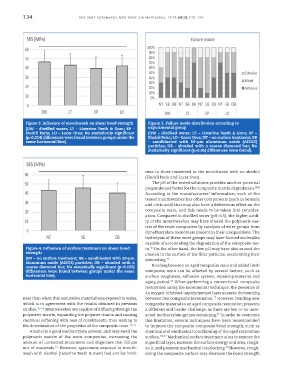
            Figure 3. Influence of mouthwash on shear bond strength  Figure 5. Failure mode distribution according to
            [DW – distilled water; LT – Listerine Teeth & Gum; EP –   experimental group
            Eludril Perio; LO – Lacer Oros; No statistically significant   [DW – distilled water; LT – Listerine Teeth & Gum; EP –
            (p=0.214) differences were found between groups under the   Eludril Perio; LO – Lacer Oros; NT – no surface treatment; SB
            same horizontal line].                             – sandblasted with 50-µm aluminum oxide (Al2O3)
                                                               particles; DB – abraded with a coarse diamond bur; No
                                                               statistically significant (p>0.05) differences were found].


                                                              ness to those immersed in the mouthwash with no alcohol
                                                              (Eludril Perio and Lacer Oros).
                                                                 The pH of the tested solutions provides another potential
                                                              preponderant factor for the composite matrix degradation. (30)
                                                              According to the manufacturers’ information, each of the
                                                              tested mouthwashes has other components (such as benzoic
                                                              and citric acid) that may also have a deleterious effect on the
                                                              composite resin, and this needs to be taken into consider-
                                                              ation. Compared to distilled water (pH=5.5), the higher acidi-
                                                              ty of the mouthwashes may have altered the polymeric ma-
                                                              trix of the resin composites by catalysis of ester groups from
                                                              dimethacrylate monomers present in their compositions. The
                                                              hydrolysis of these ester groups may have formed molecules
                                                              capable of accelerating the degradation of the composite res-
            Figure 4. Influence of surface treatment on shear bond   in.  On the other hand, the low pH may have also caused the
                                                                30
            strength                                          erosion in the surface of the filler particles, accelerating their
            [NT – no surface treatment; SB – sandblasted with 50-µm   debonding. 16
            aluminum oxide (Al2O3) particles; DB – abraded with a
            coarse diamond bur; No statistically significant (p=0.165)   Bonding between an aged composite resin and added fresh
            differences were found between groups under the same   composite resin can be affected by several factors, such as
            horizontal line].                                 surface roughness, adhesive system, repairing material and
                                                                        34
                                                              aging period.  When performing a conventional composite
                                                              restoration using the incremental technique, the presence of
                                                              an oxygen-inhibited unpolymerized layer ensures the bonding
                                                                                          23
           ness than when this restorative material was exposed to water,   between two composite increments.  However, bonding new
           which is in agreement with the results obtained in previous   composite material to an aged composite restoration presents
           studies. 30-33  Mouthwashes are capable of diffusing through the   a different and harder challenge, as there are few or no unre-
                                                                                            35
           polymeric matrix, expanding the polymer chains and causing   acted methacrylate groups remaining.  In order to overcome
           chemical softening with loss of constituents, thus leading to   this limitation, several techniques have been recommended
           the deterioration of the properties of the composite resin. 14,15  to improve the composite-composite bond strength, such as
             Alcohol is a good methacrylate solvent, and may swell the   chemical and mechanical conditioning of the aged restoration
           polymeric  matrix  of  the  resin  composites,  increasing  the   surface. 36,37  Mechanical surface treatment aims to remove the
           amount of unreacted monomers and oligomers that diffuse   superficial layer, increase the surface energy and area, rough-
                                                                                                38
                        18
           out of materials.  However, specimens exposed to mouth-  en it, and promote mechanical interlocking.  However, rough-
           wash with alcohol (Listerine Teeth & Gum) had similar hard-  ening the composite surface may decrease the bond strength

