


Page 53 - SPEMD_59-1
P. 53
rev port estomatol med dent cir maxilofac . 2018;59(1):44-48             45


                                            Tratamento não-cirúrgico de fratura bilateral de côndilo mandibular:
                                            Seis anos de acompanhamento

                                            r e s u m o

           Palavras-chave:                  O côndilo mandibular é a área mais frequentemente afetada em fraturas mandibulares. O
           Tratamento conservador           tratamento destas fraturas pode ser não cirúrgico, através da redução fechada, ou por redu-
           Côndilo mandibular               ção aberta e fixação com mini-placas e parafusos. Este estudo relata o tratamento selecio-
           Fratura mandibular               nado para uma paciente com três fraturas mandibulares, sendo uma fratura em região de
                                            sínfise mandibular e as outras fraturas nas regiões subcondilares bilateralmente após trauma
                                            facial. A fratura de sínfise foi tratada com redução aberta e osteossíntese. Já as fraturas sub-
                                            condilares foram tratadas pelo método não-cirúrgico. (Rev Port Estomatol Med Dent Cir Ma-
                                            xilofac. 2018;59(1):44-48)
                                                            © 2018 Sociedade Portuguesa de Estomatologia e Medicina Dentária.
                                                  Publicado por SPEMD. Este é um artigo Open Access sob uma licença CC BY-NC-ND
                                                                        (http://creativecommons.org/licenses/by-nc-nd/4.0/).


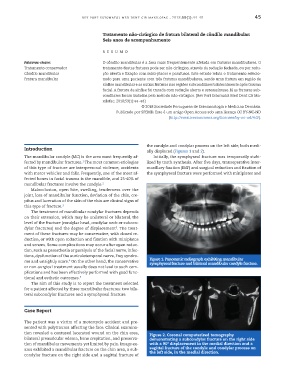
                                                               the condyle and condylar process on the left side, both medi-
           Introduction
                                                               ally displaced (Figures 1 and 2).
           The mandibular condyle (MC) is the area most frequently af-  Initially, the symphyseal fracture was temporarily stabi-
                                    1
           fected by mandibular fractures.  The most common etiologies   lized by tooth synthesis. After five days, transoperative inter-
           of this type of fracture are interpersonal violence, accidents   maxillary fixation (IMF) and surgical reduction and fixation of
           with motor vehicles and falls. Frequently, one of the most af-  the symphyseal fracture were performed with miniplates and
           fected bones in facial trauma is the mandible, and 25-40% of
           mandibular fractures involve the condyle. 2
              Malocclusion, open bite, swelling, tenderness over the
           joint, loss of mandibular function, deviation of the chin, cre-
           pitus and laceration of the skin of the chin are clinical signs of
           this type of fracture. 3
              The treatment of mandibular condylar fractures depends
           on their extension, which may be unilateral or bilateral, the
           level of the fracture (condylar head, condylar neck or subcon-
           dylar fractures) and the degree of displacement . The treat-
                                                  3
           ment of these fractures may be conservative, with closed re-
           duction, or with open reduction and fixation with miniplates
           and screws. Some complications may occur after open reduc-
           tion, such as paresthesia or paralysis of the facial nerve, infec-
           tions, dysfunction of the auriculotemporal nerve, Frey syndro-
                              4
           me and unsightly scars.  On the other hand, the conservative   Figure 1. Panoramic radiograph exhibiting mandibular
                                                                symphyseal fracture and bilateral mandibular condyle fracture.
           or non-surgical treatment usually does not lead to such com-
           plications and has been effectively performed with good func-
           tional and esthetic outcomes. 5
              The aim of this study is to report the treatment selected
           for a patient affected by three mandibular fractures: two bila-
           teral subcondylar fractures and a symphyseal fracture.


           Case Report

           The patient was a victim of a motorcycle accident and pre-
           sented with polytrauma affecting the face. Clinical examina-
           tion revealed a contused lacerated wound on the chin area,   Figure 2. Coronal computerized tomography
           bilateral preauricular edema, bone crepitation, and preserva-  demonstrating a subcondylar fracture on the right side
           tion of mandibular movements yet limited by pain. Image ex-  with a 90º displacement in the medial direction and a
           ams exhibited a mandibular fracture on the chin area, a sub-  sagittal fracture of the condyle and condylar process on
                                                                the left side, in the medial direction.
           condylar fracture on the right side and a sagittal fracture of

