


Page 63 - SPEMD_62-1
P. 63
rev port estomatol med dent cir maxilofac . 2021;62(1):56-62             57


                                            Dez anos de acompanhamento do tratamento imediato de múltiplos
                                            traumas dentários durante prática desportiva: caso clínico

                                            r e s u m o

           Palavras-chave:                  Este relato de caso teve como objetivo descrever um acompanhamento de dez anos após
           Endodontia                       o tratamento imediato de múltiplos traumas dentários. Uma paciente do sexo feminino de
           Fratura radicular                quinze anos compareceu a uma clínica privada trinta minutos após um acidente na esco-
           Lesão desportiva                 la. Após exames clínicos e radiográficos, o dente 21 foi diagnosticado com fratura de es-
           Traumatismo dentário             malte e fratura radicular horizontal, o dente 22 foi diagnosticado com luxação lateral, e os
                                            dentes 12, 11 e 23 foram diagnosticados com subluxação. Os dentes 21 e 22 apresentaram
                                            necrose pulpar e foram tratados endodonticamente. O dente 21 foi obturado com uma
                                            pasta composta de hidróxido de cálcio, gel de clorexidina 2% e óxido de zinco, e o dente 22
                                            foi obturado de maneira convencional. Após acompanhamento de dez anos, os dentes 21
                                            e 22 não apresentam reabsorção radicular ou lesão periapical, enquanto os dentes 12, 11 e
                                            23 continuam apresentando vitalidade pulpar.  (Rev Port Estomatol Med Dent Cir Maxilofac.
                                            2021;62(1):56-62)
                                                            © 2021 Sociedade Portuguesa de Estomatologia e Medicina Dentária.
                                                  Published by SPEMD. This is an open access article under the CC BY-NC-ND license
                                                                        (http://creativecommons.org/licenses/by-nc-nd/4.0/).


                                                               signed an informed consent form authorizing the publication
           Introduction
                                                               of the case’s photographs and details.
           Dental trauma is a worldwide public health problem affecting   A 15 -year -old Caucasian female patient was admitted to a
           mainly school -age children, with an average prevalence of   private clinic 30 minutes after suffering a severe impact to the
                                                          1
           23% in primary dentition and 15% in permanent dentition.    oral region during a basketball game at school in 2010. She was
                                                       2
           Traumatic dental injuries (TDIs) can be caused by falls,  car   not wearing a mouthguard at the moment of the trauma. The
                   3
           accidents,  and physical violence.  As the practice of sports   intraoral examination revealed a cut on the lower lip and heavy
                                      2,3
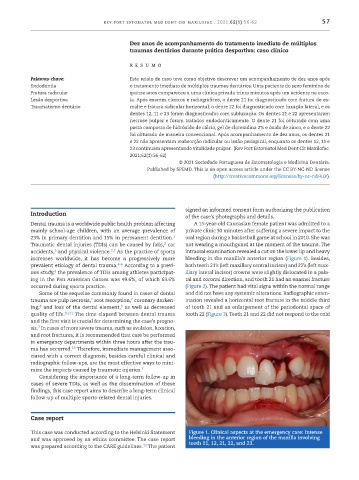
           increases worldwide, it has become a progressively more   bleeding in the maxilla’s anterior region (Figure 1). Besides,
           prevalent etiology of dental trauma. 4-6  According to a previ-  both teeth 21’s (left maxillary central incisor) and 22’s (left max-
                   4
           ous study,  the prevalence of TDIs among athletes participat-  illary lateral incisor) crowns were slightly dislocated in a pala-
           ing in the Pan American Games was 49.6%, of which 63.6%   tal and coronal direction, and tooth 21 had an enamel fracture
           occurred during sports practice.                    (Figure 2). The patient had vital signs within the normal range
              Some of the sequelae commonly found in cases of dental   and did not have any systemic alterations. Radiographic exam-
                               7
                                            7
           trauma are pulp necrosis,  root resorption,  coronary darken-  ination revealed a horizontal root fracture in the middle third
                                         9
           ing,  and loss of the dental element,  as well as decreased   of tooth 21 and an enlargement of the periodontal space of
              8
           quality of life. 10,11  The time elapsed between dental trauma   tooth 22 (Figure 3). Teeth 21 and 22 did not respond to the cold
           and the first visit is crucial for determining the case’s progno-
              7
           sis.  In cases of more severe trauma, such as avulsion, luxation,
           and root fractures, it is recommended that care be performed
           in emergency departments within three hours after the trau-
           ma has occurred.  Therefore, immediate management asso-
                         13
           ciated with a correct diagnosis, besides careful clinical and
           radiographic follow -ups, are the most effective ways to mini-
           mize the impacts caused by traumatic injuries. 7
              Considering the importance of a long -term follow -up in
           cases of severe TDIs, as well as the dissemination of these
           findings, this case report aims to describe a long -term clinical
           follow -up of multiple sports‐related dental injuries.


           Case report

           This case was conducted according to the Helsinki Statement   Figure 1. Clinical aspects at the emergency care: intense
           and was approved by an ethics committee. The case report   bleeding in the anterior region of the maxilla involving
                                                14
           was prepared according to the CARE guidelines.  The patient   teeth 11, 12, 21, 22, and 23.

