


Page 64 - SPEMD_62-1
P. 64
58                      rev port estomatol med dent cir maxilofac. 2021;62(1):56-62


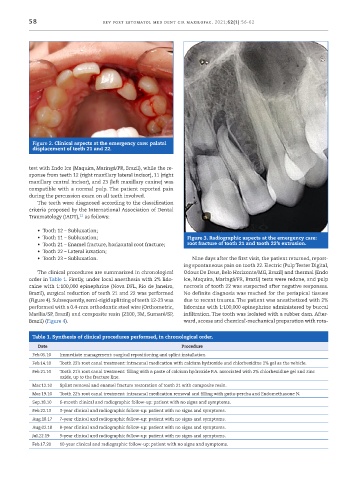
            Figure 2. Clinical aspects at the emergency care: palatal
            displacement of teeth 21 and 22.


           test with Endo Ice (Maquira, Maringá/PR, Brazil), while the re-
           sponse from teeth 12 (right maxillary lateral incisor), 11 (right
           maxillary central incisor), and 23 (left maxillary canine) was
           compatible with a normal pulp. The patient reported pain
           during the percussion exam on all teeth involved.
             The teeth were diagnosed according to the classification
           criteria proposed by the International Association of Dental
                           12
           Traumatology (IADT),  as follows:
             •  Tooth 12 – Subluxation;
             •  Tooth 11 – Subluxation;                        Figure 3. Radiographic aspects at the emergency care:
             •  Tooth 21 – Enamel fracture, horizontal root fracture;  root fracture of tooth 21 and tooth 22’s extrusion.
             •  Tooth 22 – Lateral luxation;
             •  Tooth 23 – Subluxation.                          Nine days after the first visit, the patient returned, report-
                                                              ing spontaneous pain on tooth 22. Electric (Pulp Tester Digital,
             The clinical procedures are summarized in chronological   Odous De Deus, Belo Horizonte/MG, Brazil) and thermal (Endo
           order in Table 1. Firstly, under local anesthesia with 2% lido-  Ice, Maquira, Maringá/PR, Brazil) tests were redone, and pulp
           caine with 1:100,000 epinephrine (Nova DFL, Rio de Janeiro,   necrosis of tooth 22 was suspected after negative responses.
           Brazil), surgical reduction of teeth 21 and 22 was performed   No definite diagnosis was reached for the periapical tissues
           (Figure 4). Subsequently, semi -rigid splitting of teeth 12 -23 was   due to recent trauma. The patient was anesthetized with 2%
           performed with a 0.4 -mm orthodontic steel wire (Orthometric,   lidocaine with 1:100,000 epinephrine administered by buccal
           Marília/SP, Brazil) and composite resin (Z100, 3M, Sumaré/SP,   infiltration. The tooth was isolated with a rubber dam. After-
           Brazil) (Figure 4).                                ward, access and chemical -mechanical preparation with rota-

            Table 1. Synthesis of clinical procedures performed, in chronological order.
              Date                                           Procedure
            Feb.05.10  Immediate management: surgical repositioning and splint installation.
            Feb.14.10  Tooth 22’s root canal treatment: intracanal medication with calcium hydroxide and chlorhexidine 2% gel as the vehicle.
            Feb.21.10  Tooth 21’s root canal treatment: filling with a paste of calcium hydroxide P.A. associated with 2% chlorhexidine gel and zinc
                     oxide, up to the fracture line.
            Mar.12.10  Splint removal and enamel fracture restoration of tooth 21 with composite resin.
            Mar.19.10  Tooth 22’s root canal treatment: intracanal medication removal and filling with gutta -percha and Endomethasone N.
            Sep.18.10  6 -month clinical and radiographic follow -up: patient with no signs and symptoms.
            Feb.22.13  3 -year clinical and radiographic follow -up: patient with no signs and symptoms.
            Aug.18.17  7 -year clinical and radiographic follow -up: patient with no signs and symptoms.
            Aug.02.18  8 -year clinical and radiographic follow -up: patient with no signs and symptoms.
            Jul.22.19  9 -year clinical and radiographic follow -up: patient with no signs and symptoms.
            Feb.17.20  10 -year clinical and radiographic follow -up: patient with no signs and symptoms.

