


Page 50 - SPEMD_62-1
P. 50
44                      rev port estomatol med dent cir maxilofac. 2021;62(1):42-49


            Table 1. Clinical criteria for the diagnosis of Coffin-Siris syndrome
                                                     Presence of the
                       Clinical criteria of CSS 6                           Profile of the examined patient
                                                     characteristic
            Predominant

             1. Intellectual disability (mild to severe)  Yes     Moderate intellectual disability
             2. Coarse facial features                   Yes      Bulbous nose, thick eyebrows, thick lips, and flattened nasal
                                                                  bridge
             3. Hypoplasia of the fifth-digit nail       Yes      Deformations in the fingers and toes, absence of nails and
                                                                  fifth phalanxes in some fingers
            Less frequent
             1.  Ectodermal defects (hypertrichosis, hirsutism, sparse   Yes  Hypertrichosis and diastemas
              hair, and dental anomalies)
             2.  Constitutional (microcephaly, short stature, growth   Yes  Short stature, motor and speech difficulties, and respiratory
              retardation, and respiratory tract infections)      tract infections
              3.  Organic (hearing loss, congenital heart defects,   Yes  Atrial septal defect and unilateral hearing impairment
              ophthalmic anomalies as well as feeding difficulties)
            Result / Confirmation                        Yes      Coffin-Siris type A


           cardiologist, otorhinolaryngologist, and speech therapist. Her   Physical examination revealed deformations in the fingers
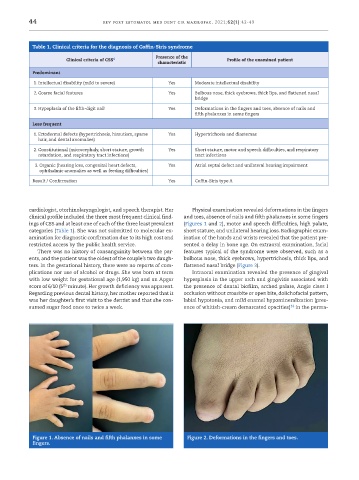
           clinical profile included the three most frequent clinical find-  and toes, absence of nails and fifth phalanxes in some fingers
           ings of CSS and at least one of each of the three least prevalent   (Figures 1 and 2), motor and speech difficulties, high palate,
           categories (Table 1). She was not submitted to molecular ex-  short stature, and unilateral hearing loss. Radiographic exam-
           amination for diagnostic confirmation due to its high cost and   ination of the hands and wrists revealed that the patient pre-
           restricted access by the public health service.    sented a delay in bone age. On extraoral examination, facial
             There was no history of consanguinity between the par-  features typical of the syndrome were observed, such as a
           ents, and the patient was the oldest of the couple’s two daugh-  bulbous nose, thick eyebrows, hypertrichosis, thick lips, and
           ters. In the gestational history, there were no reports of com-  flattened nasal bridge (Figure 3).
           plications nor use of alcohol or drugs. She was born at term   Intraoral examination revealed the presence of gingival
           with low weight for gestational age (1,950 kg) and an Apgar   hyperplasia in the upper arch and gingivitis associated with
                      th
           score of 6/10 (5  minute). Her growth deficiency was apparent.   the presence of dental biofilm, arched palate, Angle class I
           Regarding previous dental history, her mother reported that it   occlusion without crossbite or open bite, dolichofacial pattern,
           was her daughter’s first visit to the dentist and that she con-  labial hypotonia, and mild enamel hypomineralization (pres-
                                                                                                 14
           sumed sugar food once to twice a week.             ence of whitish-cream demarcated opacities)  in the perma-


            Figure 1. Absence of nails and fifth phalanxes in some   Figure 2. Deformations in the fingers and toes.
            fingers.

