


Page 26 - SPEMD_62-1
P. 26
20                      rev port estomatol med dent cir maxilofac. 2021;62(1):16-22


            Table 2. Two -way analysis of variance for variables surface treatment and adhesive system.
                                          Degrees of   Sum of squares  Mean square    F -value      P -value
                                           freedom
            Surface treatment                2           2043.57        1021.79       702.99         0.0001

            Adhesive system                  1            0.06           0.06          0.04          0.8415
            Surface treatment * adhesive system  2        5.51           2.76          1.90          0.1566
            Residual                         84           122.09         1.45


            Table 3. Post -hoc tests by the Student -Newman -Keuls method for surface treatment, with a statistical significance of 5%.
                Effect: Surface treatment    Mean difference        Critical difference   Statistical significance
            No treatment vs. Tungsten bur        7.50                    0.62                    Yes
            No treatment vs. Sandblasting Al O 3  11.49                  0.74                    Yes
                                  2
            Tungsten bur vs. Sandblasting Al O   3.99                    0.62                    Yes
                                  2  3


                                                                      26
                                                              adhesion.  Additionally, all samples were thermocycled,
                                                              which is another factor that reduces bond strength. 6,27  Both
                                                              these procedures simulate what happens in the oral envi-
                                                              ronment when temporary crowns have been cemented for
                                                              some time. Although 500 is the number of cycles estimated
                                                              to occur in less than 2 months in the mouth, in this study, it
                                                              was chosen following the 1994 ISO/TR 11405,  since there is
                                                                                                  28
                                                              still no standardized protocol in the literature for thermal
                                                              cycling. 29
                                                                 By bonding brackets to PMMA using a Bis -GMA resin, such
                                                              as Transbond XT, materials with different chemical compo-
                                                              sitions are used, and consequently, adhesion forces are ex-
                                                              pected to diminish. Since these experimental conditions
                                                              were the most adverse from the adhesion point of view, bond
                                                              strength was expected to be significantly lower than in the
                                                              control group. Mechanical surface treatment was the only
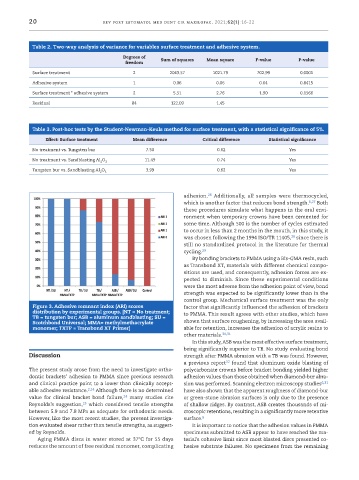
            Figure 3. Adhesive remnant index (ARI) scores     factor that significantly influenced the adhesion of brackets
            distribution by experimental groups. [NT = No treatment;
            TB = tungsten bur; ASB = aluminum sandblasting; SU =   to PMMA. This result agrees with other studies, which have
            Scotchbond Universal; MMA= methylmethacrylate     shown that surface roughening, by increasing the area avail-
            monomer; TXTP = Transbond XT Primer]              able for retention, increases the adhesion of acrylic resins to
                                                              other materials. 30,31
                                                                 In this study, ASB was the most effective surface treatment,
                                                              being significantly superior to TB. No study evaluating bond
           Discussion                                         strength after PMMA abrasion with a TB was found. However,
                                                                            32
                                                              a previous report  found that aluminum oxide blasting of
           The present study arose from the need to investigate ortho-  polycarbonate crowns before bracket bonding yielded higher
           dontic brackets’ adhesion to PMMA since previous research   adhesion values than those obtained when diamond -bur abra-
           and clinical practice point to a lower than clinically accept-  sion was performed. Scanning electron microscopy studies 6,31
           able adhesive resistance. 2,14  Although there is no determined   have also shown that the apparent roughness of diamond -bur
           value for clinical bracket bond failure,  many studies cite   or green -stone abrasion surfaces is only due to the presence
                                          24
                            25
           Reynolds’s suggestion,  which considered tensile strengths   of shallow ridges. By contrast, ASB creates thousands of mi-
           between 5.9 and 7.8 MPa as adequate for orthodontic needs.   croscopic retentions, resulting in a significantly more retentive
           However, like the most recent studies, the present investiga-  surface. 6
           tion evaluated shear rather than tensile strengths, as suggest-  It is important to notice that the adhesion values in PMMA
           ed by Reynolds.                                    specimens submitted to ASB appear to have reached the ma-
             Aging PMMA discs in water stored at 37ºC for 55 days   terial’s cohesive limit since most blasted discs presented co-
           reduces the amount of free residual monomer, complicating   hesive substrate failures. No specimens from the remaining

