


Page 25 - SPEMD_62-1
P. 25
rev port estomatol med dent cir maxilofac . 2021;62(1):16-22             19


           bracket base; Index 2 – mixed failure, with 0–50% of remaining
           adhesive on the bracket base; Index 3 – 0% of adhesive remain-
           ing on the bracket base, corresponding to bracket -adhesive
           interface failure. The presence of cohesive substrate failure
           (Yes / No) was also evaluated.
              Statistical analysis was performed using Statview software
           (Abacus Concepts Inc., Berkeley, California, USA). The Shapiro-
           -Wilk test was used to assess normality in distribution, and
           the Levene test for homogeneity of variance. The adhesive
           strength values obtained in the experimental groups were
           evaluated by a two -way analysis of variance (ANOVA), using
           the surface treatment and the adhesive system as indepen-
           dent variables. Comparisons between groups were performed
           with post -hoc tests by the Student -Newman -Keuls method.
           The control group and the experimental groups were com-
           pared with a one -way ANOVA, using the combination surface
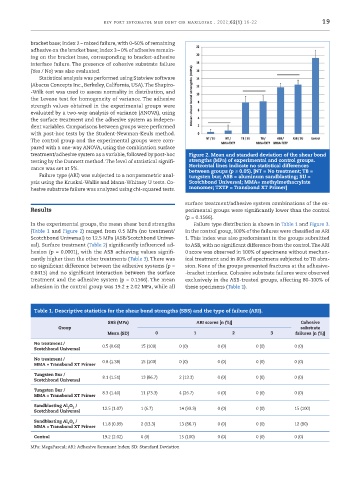
           treatment/adhesive system as a variable, followed by post -hoc   Figure 2. Mean and standard deviation of the shear bond
           testing by the Dunnett method. The level of statistical signifi-  strengths (MPa) of experimental and control groups.
           cance was set at 5%.                                 Horizontal lines indicate no statistical differences
                                                                between groups (p ≥ 0.05). [NT = No treatment; TB =
              Failure type (ARI) was subjected to a nonparametric anal-  tungsten bur; ASB = aluminum sandblasting; SU =
           ysis using the Kruskal -Wallis and Mann -Whitney U tests. Co-  Scotchbond Universal; MMA= methylmethacrylate
           hesive substrate failure was analyzed using chi -squared tests.  monomer; TXTP = Transbond XT Primer]

                                                              surface treatment/adhesive system combinations of the ex-
           Results                                            perimental groups were significantly lower than the control
                                                              (p = 0.1566).
           In the experimental groups, the mean shear bond strengths   Failure type distribution is shown in Table 1 and Figure 3.
           (Table 1 and Figure 2) ranged from 0.5 MPa (no treatment/  In the control group, 100% of the failures were classified as ARI
           Scotchbond Universal) to 12.5 MPa (ASB/Scotchbond Univer-  1. This index was also predominant in the groups submitted
           sal). Surface treatment (Table 2) significantly influenced ad-  to ASB, with no significant difference from the control. The ARI
           hesion (p = 0.0001), with the ASB achieving values signifi-  0 score was observed in 100% of specimens without mechan-
           cantly higher than the other treatments (Table 3). There was   ical treatment and in 80% of specimens subjected to TB abra-
           no significant difference between the adhesive systems (p =   sion. None of the groups presented fractures at the adhesive-
           0.8415) and no  significant interaction between  the  surface   -bracket interface. Cohesive substrate failures were observed
           treatment and the adhesive system (p = 0.1566). The mean   exclusively in the ASB -treated groups, affecting 80–100% of
           adhesion in the control group was 19.2 ± 2.02 MPa, while all   these specimens (Table 1).


            Table 1. Descriptive statistics for the shear bond strengths (SBS) and the type of failure (ARI).
                                     SBS (MPa)                    ARI scores [n (%)]                 Cohesive
                    Group                                                                            substrate
                                     Mean (SD)       0           1            2            3       failures [n (%)]
            No treatment /
            Scotchbond Universal   0.5 (0.66)   15 (100)    0 (0)        0 (0)        0 (0)        0 (0)
            No treatment /         0.8 (1.38)   15 (100)    0 (0)        0 (0)        0 (0)        0 (0)
            MMA + Transbond XT Primer
            Tungsten Bur /         8.1 (1.51)   13 (86.7)   2 (13.3)     0 (0)        0 (0)        0 (0)
            Scotchbond Universal
            Tungsten Bur /
            MMA + Transbond XT Primer  8.3 (1.40)  11 (73.3)  4 (26.7)   0 (0)        0 (0)        0 (0)
            Sandblasting Al O  /
                         3
                       2
            Scotchbond Universal   12.5 (1.07)  1 (6.7)     14 (93.3)    0 (0)        0 (0)        15 (100)
            Sandblasting Al O  /   11.8 (0.99)  2 (13.3)    13 (86.7)    0 (0)        0 (0)        12 (80)
                       2
                         3
            MMA + Transbond XT Primer
            Control                19.2 (2.02)  0 (0)       15 (100)     0 (0)        0 (0)        0 (0)
           MPa: MegaPascal; ARI: Adhesive Remnant Index; SD: Standard Deviation

