


Page 31 - SPEMD_62-1
P. 31
rev port estomatol med dent cir maxilofac . 2021;62(1):23-28             25


              Some individuals with minor malocclusions are not happy
                                                          17
           with their dental appearance, but the contrary is also true.
           Thus, orthodontists and laypersons may disagree when eval-
           uating the necessity and/or the improvement with orthodon-
           tic treatment. Since no single element is responsible for the
           whole face’s attractiveness, knowing each component’s weight
           to the overall evaluation by laypersons is significant, especial-
           ly the smile, to quantify the influence of orthodontic treatment
           on facial beauty. 18
              This study aimed to evaluate the impact of different facial
           components on the frontal assessment of smiling facial attrac-
           tiveness. Its secondary objective was to test the influence of
           gender on the correlation between attractiveness of the upper
           two -thirds, the lower third, and the smile and facial attractive-
           ness when smiling.


           Material and methods


           The present study was accepted by the Faculty of Dental Med-
           icine of the University of Lisbon’s (FMDUL) Ethics Review
           Board. Individuals for this study were recruited from the Or-
           thodontics Department of FMDUL. Inclusion criteria were
           having 18 to 35 years old (mean 23.7 years), European ances-
           try, and upper incisors and canines of normal size and shape.
           Patients with cavities or fillings on the anterior upper teeth,
           periodontal disease or gingivitis obvious when smiling, and
           craniofacial anomalies were excluded. Sixty individuals were
           included in the study, 30 of each gender. The selected individ-
           uals were requested to sign an informed consent form.
              Photographs of the participant’s smiling faces were ob-
           tained with a natural head position and a standard back-
           ground. They were standing up, undisturbed, and looking into
           the horizon. When their head was considerably tilted, the cli-
                                                   19
           nician guided it toward the correct oriented position.  A posed
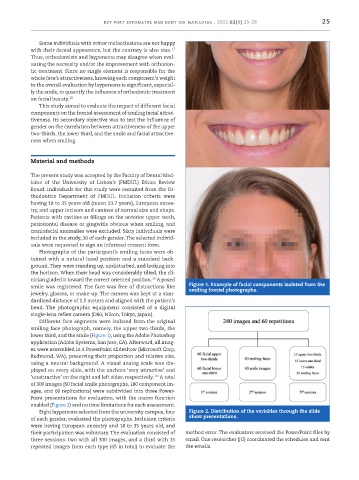
           smile was registered. The face was free of distractions like   Figure 1. Example of facial components isolated from the
                                                                smiling frontal photographs.
           jewelry, glasses, or make -up. The camera was kept at a stan-
           dardized distance of 1.5 meters and aligned with the patient’s
           head. The photographic equipment consisted of a digital
           single -lens reflex camera (D80; Nikon, Tokyo, Japan).
              Different face segments were isolated from the original
           smiling face photograph, namely, the upper two -thirds, the
           lower third, and the smile (Figure 1), using the Adobe Photoshop
           application (Adobe Systems, San Jose, CA). Afterward, all imag-
           es were assembled in a PowerPoint slideshow (Microsoft Corp,
           Redmond, WA), preserving their proportion and relative size,
           using a neutral background. A visual analog scale was dis-
           played on every slide, with the anchors ‘very attractive’ and
                                                    20
           ‘unattractive’ on the right and left sides, respectively.   A total
           of 300 images (60 facial smile photographs, 180 component im-
           ages, and 60 replications) were subdivided into three Power-
           Point presentations for evaluation, with the macro function
           enabled (Figure 2) and no time limitations for each assessment.
              Eight laypersons selected from the university campus, four   Figure 2. Distribution of the variables through the slide
           of each gender, evaluated the photographs. Inclusion criteria   show presentations.
           were having European ancestry and 18 to 35 years old, and
           their participation was voluntary. The evaluation consisted of   method error. The evaluators received the PowerPoint files by
           three sessions: two with all 300 images, and a third with 15   email. One researcher (JG) coordinated the schedules and sent
           repeated images from each type (45 in total) to evaluate the   the emails.

