


Page 32 - SPEMD_62-1
P. 32
26                      rev port estomatol med dent cir maxilofac. 2021;62(1):23-28


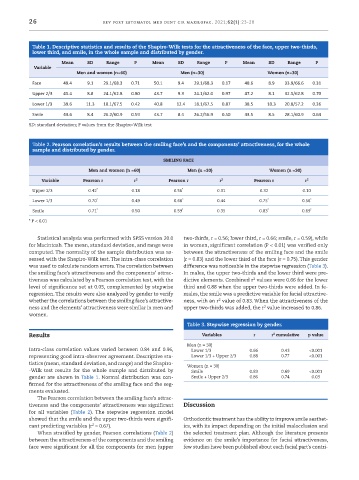
            Table 1. Descriptive statistics and results of the Shapiro -Wilk tests for the attractiveness of the face, upper two -thirds,
            lower third, and smile, in the whole sample and distributed by gender.
                     Mean     SD    Range     P     Mean    SD    Range     P     Mean    SD    Range     P
            Variable
                          Men and women (n=60)               Men (n=30)                   Women (n=30)
            Face      49.4    9.1  29.1/68.3  0.71  50.1    9.4  29.1/68.3  0.17  48.6    8.9  33.9/66.6  0.31

            Upper 2/3  45.4   8.8  24.1/62.8  0.80  43.7    9.3  24.1/62.0  0.97  47.2    8.1  32.5/62.8  0.70
            Lower 1/3  39.6   11.3  18.1/67.5  0.42  40.8   12.4  18.1/67.5  0.87  38.5   10.3  20.8/57.2  0.36
            Smile     43.6    8.4  26.2/60.9  0.59  43.7    8.4  26.2/56.9  0.50  43.5    8.5  28.1/60.9   0.64
           SD: standard deviation; P values from the Shapiro -Wilk test


            Table 2. Pearson correlation’s results between the smiling face’s and the components’ attractiveness, for the whole
            sample and distributed by gender.

                                                       SMILING FACE
                              Men and women (n =60)            Men (n =30)                Women (n =30)
               Variable      Pearson r       r 2         Pearson r        r 2        Pearson r        r 2
            Upper 2/3         0.42 *         0.18          0.56 *        0.31          0.32          0.10
            Lower 1/3         0.70 *         0.49          0.66 *        0.44          0.75 *        0.56 *
            Smile             0.71 *         0.50          0.59 *        0.35          0.83 *        0.69 *
           * P < 0.01


             Statistical analysis was performed with SPSS version 20.0   two -thirds, r = 0.56; lower third, r = 0.66; smile, r = 0.59), while
           for Macintosh. The mean, standard deviation, and range were   in women, significant correlation (P < 0.01) was verified only
           computed. The normality of the sample distribution was as-  between the attractiveness of the smiling face and the smile
           sessed with the Shapiro -Wilk test. The intra -class correlation   (r = 0.83) and the lower third of the face (r = 0.75). This gender
           was used to calculate random errors. The correlation between   difference was noticeable in the stepwise regression (Table 3).
           the smiling face’s attractiveness and the components’ attrac-  In males, the upper two -thirds and the lower third were pre-
           tiveness was calculated by a Pearson correlation test, with the   dictive elements. Combined r  values were 0.66 for the lower
                                                                                     2
           level of significance set at 0.05, complemented by stepwise   third and 0.88 when the upper two -thirds were added. In fe-
           regression. The results were also analyzed by gender to verify   males, the smile was a predictive variable for facial attractive-
                                                                          2
           whether the correlations between the smiling face’s attractive-  ness, with an r  value of 0.83. When the attractiveness of the
           ness and the elements’ attractiveness were similar in men and   upper two -thirds was added, the r  value increased to 0.86.
                                                                                         2
           women.
                                                               Table 3. Stepwise regression by gender.
           Results                                                  Variables         r    r cumulative  p value
                                                                                            2
                                                               Men (n = 30)
           Intra -class correlation values varied between 0.84 and 0.96,     Lower 1/3  0.66  0.43      <0.001
           representing good intra -observer agreement. Descriptive sta-    Lower 1/3 + Upper 2/3  0.88  0.77  <0.001
           tistics (mean, standard deviation, and range) and the Shapiro-
                                                               Women (n = 30)
           -Wilk  test results for  the whole  sample  and  distributed  by     Smile  0.83   0.69      <0.001
           gender are shown in Table 1. Normal distribution was con-    Smile + Upper 2/3  0.86  0.74   0.03
           firmed for the attractiveness of the smiling face and the seg-
           ments evaluated.
             The Pearson correlation between the smiling face’s attrac-
           tiveness and the components’ attractiveness was significant   Discussion
           for all  variables (Table 2). The stepwise regression  model
           showed that the smile and the upper two -thirds were signifi-  Orthodontic treatment has the ability to improve smile aesthet-
                                2
           cant predicting variables (r = 0.67).              ics, with its impact depending on the initial malocclusion and
             When stratified by gender, Pearson correlations (Table 2)   the selected treatment plan. Although the literature presents
           between the attractiveness of the components and the smiling   evidence  on the  smile’s importance for  facial  attractiveness,
           face were significant for all the components for men (upper   few studies have been published about each facial part’s contri-

