


Page 37 - SPEMD_62-1
P. 37
rev port estomatol med dent cir maxilofac . 2021;62(1):29-34             31


           tients’ clinical  records to preserve the anonymity and   Table 2. Lichen Planus lesions by location.
           confidentiality of all data. This study was approved by the
           Hospital Ethics Committee.                           Lichen planus lesions’ location  N   Percentage
              The variables under study were:
                                                                Skin                            132      75.9%
              –  Regarding the patient: 1) date of the appointment; 2) gen-  Oral mucosa            4      2.3%
               der; 3) age of the 1st manifestation of LP (except when   Genital mucosa             4      2.3%
               otherwise indicated, the date of the patient’s first Der-
               matology appointment was considered); 4) location of the   Skin + oral mucosa      20     11.5%
               LP’s lesions (cutaneous vs. oral vs. genital); 5) topograph-  Skin + oral mucosa + genital mucosa      5      2.9%
               ic distribution of skin lesions; 6) topographic distribution
               of oral lesions; 7) topographic distribution of genital le-  Skin + genital mucosa      8      4.6%
               sions; 8) administration of therapy (yes/no).    Oral + genital mucosa               1      0.6%
              –  Regarding the therapeutic regimen (data not collected if
               no therapy was administered): 9) therapy start date; 10)   TOTAL                 174    100.0%
               pharmacological group(s) administered; 11) corticoste-
               roid active substance (AS)* (and corresponding a) route
               of administration; b) pharmaceutical form; c) dose; d)   Table 3. Lichen Planus lesions’ location in the oral cavity.
               daily dosage; and e) drug administration scheme); 12)   Locations in the oral cavity  N  Percentage
               antihistamine AS (followed by data from a) to e)*); 13)
               immunosuppressant AS (followed by data from a) to e)*);   Buccal mucosa          21       70.0%
               14) follow-up; 15) result of the established therapy; 16)   Palate                 1        3.3%
               mean duration of symptoms; 17) recurrence events; and
               18) symptom remission period. Variables 15 to 18 were   Tongue                     2        6.7%
               only collected if there were records of the follow -up.  Buccal mucosa, palate and tongue    1      3.3%

              The statistical analysis was performed using the software   Buccal mucosa, tongue and alveolar ridge     1      3.3%
           IBM  SPSS Statistics, version 25. Hypotheses were tested us-  No information           4      13.3%
              ®
                   ®
           ing the binomial and chi -square tests of one sample and the
           Kolmogorov-Smirnov test of two independent samples.  TOTAL                           30     100.0%
                                                               first manifestation of the disease, divided by decades, reflect-
           Results                                             ing that the 4th and 5th were the most affected. There were
                                                               no differences in age distribution between genders (p=0.989).
           The  study  population  consisted  of  85  men  (48.9%)  and  89   Regarding the distribution of LP lesions, no statistical dif-
           women  (51.1%),  meaning  that  LP  occurred  in  both  genders   ferences were found between trimesters (p=0.235). As shown
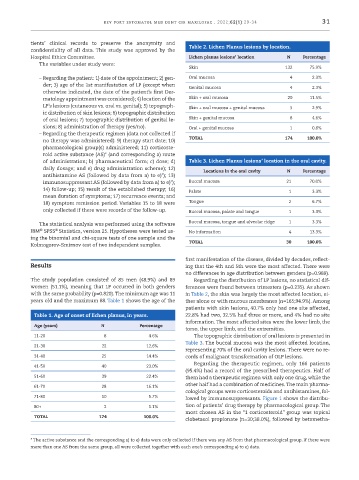
           with the same probability (p=0.820). The minimum age was 11   in Table 2, the skin was largely the most affected location, ei-
           years old and the maximum 88. Table 1 shows the age of the   ther alone or with mucous membranes (n=165;94.9%). Among
                                                               patients with skin lesions, 40.7% only had one site affected,
            Table 1. Age of onset of lichen planus, in years.  22.8% had two, 32.5% had three or more, and 4% had no site
                                                               information. The most affected sites were the lower limb, the
            Age (years)            N           Percentage
                                                               torso, the upper limb, and the extremities.
            11-20                     8              4.6%        The topographic distribution of oral lesions is presented in
                                                               Table 3. The buccal mucosa was the most affected location,
            21-30                   22             12.6%
                                                               representing 70% of the oral cavity lesions. There were no re-
            31-40                   25             14.4%       cords of malignant transformation of OLP lesions.
                                                                 Regarding the therapeutic regimen, only 166 patients
            41-50                   40             23.0%
                                                               (95.4%) had a record of the prescribed therapeutics. Half of
            51-60                   39             22.4%       them had a therapeutic regimen with only one drug, while the
                                                               other half had a combination of medicines. The main pharma-
            61-70                   28             16.1%
                                                               cological groups were corticosteroids and antihistamines, fol-
            71-80                   10               5.7%      lowed by immunosuppressants. Figure 1 shows the distribu-
            80+                       2              1.1%      tion of patients’ drug therapy by pharmacological group. The
                                                               most chosen AS in the “1 corticosteroid” group was topical
            TOTAL                 174            100.0%
                                                               clobetasol propionate (n=30;38.0%), followed by betametha-

           * The active substance and the corresponding a) to e) data were only collected if there was any AS from that pharmacological group. If there were
           more than one AS from the same group, all were collected together with each one’s corresponding a) to e) data.

