


Page 38 - SPEMD_62-1
P. 38
32                      rev port estomatol med dent cir maxilofac. 2021;62(1):29-34


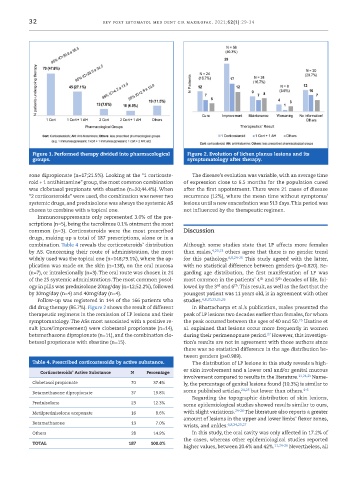
            Figure 1. Performed therapy divided into pharmacological   Figure 2. Evolution of lichen planus lesions and its
            groups.                                            symptomatology after therapy.


           sone dipropionate (n=17;21.5%). Looking at the “1 corticoste-  The disease’s evolution was variable, with an average time
           roid + 1 antihistamine” group, the most common combination   of expression close to 6.5 months for the population cured
           was clobetasol propionate with ebastine (n=20;44.4%). When   after the first appointment. There were 21 cases of disease
           “2 corticosteroids” were used, the combination was never two   recurrence (12%), where the mean time without symptoms/
           systemic drugs, and prednisolone was always the systemic AS   lesions until a new exacerbation was 513 days. This period was
           chosen to combine with a topical one.              not influenced by the therapeutic regimen.
             Immunosuppressants only represented 3.0% of the pre-
           scriptions (n=5), being the tacrolimus 0.1% ointment the most
           common  (n=3).  Corticosteroids  were  the  most  prescribed   Discussion
           drugs, making up a total of 187 prescriptions, alone or in a
           combination. Table 4 reveals the corticosteroids’ distribution   Although some studies state that LP affects more females
           by AS. Concerning their route of administration, the most   than males, 4,20,23  others agree that there is no gender trend
           widely used was the topical one (n=148;79.1%), where the ap-  for this pathology. 6,8,24-26  This study agreed with the latter,
           plication was made on the skin (n=138), on the oral mucosa   with no statistical difference between genders (p=0.820). Re-
           (n=7), or intralesionally (n=3). The oral route was chosen in 24   garding age distribution, the first manifestation of LP was
                                                                                             th
                                                                                       th
           of the 25 systemic administrations. The most common posol-  most common in the patients’ 4  and 5  decades of life, fol-
                                                                               th
           ogy in pills was prednisolone 20mg/day (n=12;52.2%), followed   lowed by the 3  and 6 . This result, as well as the fact that the
                                                                         rd
           by 30mg/day (n=4) and 40mg/day (n=4).              youngest patient was 11 years old, is in agreement with other
             Follow -up was registered in 144 of the 166 patients who   studies. 4,8,20,23,25,26
           did drug therapy (86.7%). Figure 2 shows the result of different   In Bhattacharya et al.’s publication, males presented the
           therapeutic regimens in the remission of LP lesions and their   peak of LP lesions two decades earlier than females, for whom
                                                                                                    25
           symptomatology. The ASs most associated with a positive re-  the peak occurred between the ages of 40 and 50.  Usatine et
           sult (cure/improvement) were clobetasol proprionate (n=14),   al. explained that lesions occur more frequently in women
                                                                                          27
           betamethasone dipropionate (n=11), and the combination clo-  during their perimenopause period.  However, this investiga-
           betasol proprionate with ebastine (n=15).          tion’s results are not in agreement with those authors since
                                                              there was no statistical difference in the age distribution be-
                                                              tween genders (p=0.989).
            Table 4. Prescribed corticosteroids by active substance.  The distribution of LP lesions in this study reveals a high-
              Corticosteroids’ Active Substance  N  Percentage  er skin involvement and a lower oral and/or genital mucous
                                                              involvement compared to results in the literature. 11,24,25  Name-
            Clobetasol propionate             70     37.4%    ly, the percentage of genital lesions found (10.3%) is similar to
            Betamethasone dipropionate        37     19.8%    some published articles, 24,25  but lower than others. 4-6
                                                                 Regarding the topographic distribution of skin lesions,
            Prednisolone                      23     12.3%
                                                              some epidemiological studies showed results similar to ours,
            Metilprednisolone aceponate       16       8.6%   with slight variations. 24-26  The literature also reports a greater
                                                              amount of lesions in the upper and lower limbs’ flexor zones,
            Betamethasone                     13       7.0%                  6,8,24,25,27
                                                              wrists, and ankles.
            Others                            28     14.9%       In this study, the oral cavity was only affected in 17.2% of
                                                              the cases, whereas other epidemiological studies reported
            TOTAL                           187    100.0%                                   11,24-26
                                                              higher values, between 20.6% and 42%.   Nevertheless, all

