


Page 11 - SPEMD_62-1
P. 11
rev port estomatol med dent cir maxilofac . 2021;62(1):1-8               5


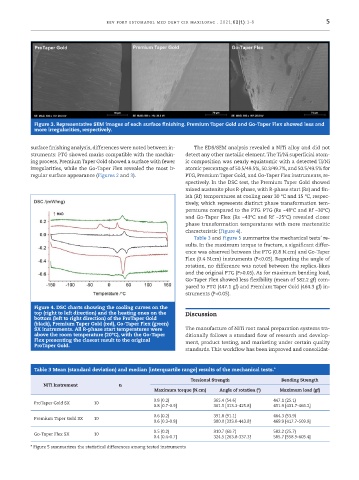
            Figure 3. Representative SEM images of each surface finishing. Premium Taper Gold and Go -Taper Flex showed less and
            more irregularities, respectively.


           surface finishing analysis, differences were noted between in-  The EDS/SEM analysis revealed a NiTi alloy and did not
           struments: PTG showed marks compatible with the machin-  detect any other metallic element. The Ti/Ni superficial atom-
           ing process, Premium Taper Gold showed a surface with fewer   ic composition was nearly equiatomic with a detected Ti/Ni
           irregularities, while the Go -Taper Flex revealed the most ir-  atomic percentage of 50.5/49.5%, 50.3/49.7%, and 50.5/49.5% for
           regular surface appearance (Figures 2 and 3).       PTG, Premium Taper Gold, and Go -Taper Flex instruments, re-
                                                               spectively. In the DSC test, the Premium Taper Gold showed
                                                               mixed austenite plus R -phase, with R -phase start (Rs) and fin-
                                                               ish (Rf) temperatures at cooling near 30 ºC and 15 ºC, respec-
                                                               tively, which represents distinct phase transformation tem-
                                                               peratures compared to the PTG. PTG (Rs ~48ºC and Rf ~30ºC)
                                                               and Go -Taper Flex (Rs ~43ºC and Rf ~25ºC) revealed closer
                                                               phase transformation temperatures with more martensitic
                                                               characteristic (Figure 4).
                                                                 Table 3 and Figure 5 summarize the mechanical tests’ re-
                                                               sults. In the maximum torque to fracture, a significant differ-
                                                               ence was observed between the PTG (0.8 N.cm) and Go -Taper
                                                               Flex (0.4 N.cm) instruments (P<0.05). Regarding the angle of
                                                               rotation, no difference was noted between the replica -likes
                                                               and the original PTG (P>0.05). As for maximum bending load,
                                                               Go -Taper Flex showed less flexibility (mean of 582.2 gf) com-
                                                               pared to PTG (447.1 gf) and Premium Taper Gold (464.3 gf) in-
                                                               struments (P<0.05).

            Figure 4. DSC charts showing the cooling curves on the
            top (right to left direction) and the heating ones on the   Discussion
            bottom (left to right direction) of the ProTaper Gold
            (black), Premium Taper Gold (red), Go -Taper Flex (green)
            SX instruments. All R -phase start temperatures were   The manufacture of NiTi root canal preparation systems tra-
            above the room temperature (20ºC), with the Go -Taper   ditionally follows a standard flow of research and develop-
            Flex presenting the closest result to the original   ment, product testing, and marketing under certain quality
            ProTaper Gold.
                                                               standards. This workflow has been improved and consolidat-


            Table 3 Mean (standard deviation) and median [interquartile range] results of the mechanical tests.*
                                                                Torsional Strength            Bending Strength
               NiTi Instrument          n
                                                    Maximum torque (N.cm)  Angle of rotation (º)  Maximum load (gf)
                                                    0.8 (0.2)           365.4 (54.6)        447.1 (25.1)
            ProTaper Gold SX    10
                                                    0.8 [0.7 -0.9]      361.5 [313.3 -425.8]  451.9 [431.7 -466.2]
                                                    0.6 (0.2)           391.8 (91.1)        464.3 (53.9)
            Premium Taper Gold SX  10
                                                    0.6 [0.3 -0.8]      380.0 [333.0 -443.8]  469.9 [417.7 -509.9]
                                                    0.5 (0.2)           310.7 (60.7)        582.2 (25.7)
            Go -Taper Flex SX   10
                                                    0.4 [0.4 -0.7]      324.5 [263.8 -337.3]  585.7 [558.9 -605.4]
           * Figure 5 summarizes the statistical differences among tested instruments

