


Page 10 - SPEMD_62-1
P. 10
4                        rev port estomatol med dent cir maxilofac. 2021;62(1):1-8


           proximately 2 minutes, followed by neutralization with dis-  45º. The maximum load (in gram/force [gf]) required to induce
           tilled water.  Then, they were weighed on an M -Power   the 45º displacement was assessed in the Tesc v3.04 software
           microbalance (Sartorius, Goettingen, Germany). Two alumi-  (Mattest Automação e Informática, Brazil).
           num pans (38 mg and 5 -mm inner diameter) were prepared,   All collected data was introduced in the SPSS software (IBM
           one with the fragments to be tested and the other empty   SPSS Statistics Version 22, Chicago, IL, USA). The dependent
           (control). The thermal cycle test was conducted on a differen-  variables of maximum torque, angle of rotation, and maxi-
           tial scanning calorimeter (DSC 204 F1 Phoenix; Netzsch-  mum bending load were submitted to analytical analysis. The
           -Gerätebau GmbH, Selb, Germany) under a gaseous nitrogen   assumption of normality was assessed using the Shapiro -Wilk
           atmosphere and comprised: (a) heating from room tempera-  test. The results were determined in mean and standard devi-
           ture to +150 ºC, (b) holding this temperature for 2 min, (c)   ations or median and interquartile range. The helix angle, an-
           cooling to  -150 ºC, (d) holding this temperature for 2 min, (e)   gle of rotation, and maximum bending load results were com-
           heating to +150 ºC, (f) holding this temperature for 2 min and   pared using the one -way ANOVA and post hoc Tukey tests, while
           (g) cooling to room temperature. Heating and cooling rates   the Kruskal -Wallis test was chosen for the maximum torque.
           were 10 K/min. The final data were assessed using the Netzsch   The significance level was set at 0.05.
           Proteus Thermal Analysis (Netzsch -Gerätebau GmbH) soft-
           ware, from which the R -phase start (Rs) and R -phase finish
           (Rf) temperatures were extracted. In each group, the DSC test   Results
           was performed twice, for the repetition to confirm the results
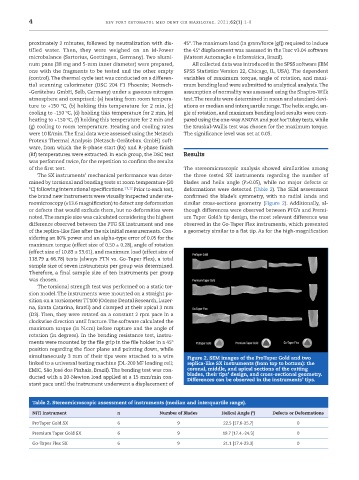
           of the first test.                                 The stereomicroscopic analysis showed similarities  among
             The SX instruments’ mechanical performance was deter-  the three tested SX instruments regarding the number of
           mined by torsional and bending tests at room temperature (20   blades and helix angle (P>0.05), while no major defects or
           ºC) following international specifications. 11,12  Prior to each test,   deformations were detected (Table 2). The SEM assessment
           the brand new instruments were visually inspected under ste-  confirmed the blade’s symmetry, with no radial lands and
           reomicroscopy (×13.6 magnification) to detect any deformation   similar cross -sections geometry (Figure 2). Additionally,  al-
           or defects that would exclude them, but no deformities were   though differences were observed between PTG’s and Premi-
           noted. The sample size was calculated considering the highest   um Taper Gold’s tip design, the most relevant difference was
           difference observed between the PTG SX instrument and one   observed in the Go -Taper Flex instruments, which presented
           of the replica -like files after the six initial measurements. Con-  a geometry similar to a flat tip. As for the high -magnification
           sidering an 80% power and an alpha -type error of 0.05 for the
           maximum torque (effect size of 0.50 ± 0.28), angle of rotation
           (effect size of 10.83 ± 53.61), and maximum load (effect size of
           118.79 ± 66.78) tests (always PTN vs. Go -Taper Flex), a total
           sample size of seven instruments per group was determined.
           Therefore, a final sample size of ten instruments per group
           was chosen.
             The torsional strength test was performed on a static tor-
           sion model. The instruments were mounted on a straight po-
           sition on a torsiometer TT100 (Odeme Dental Research, Luzer-
           na, Santa Catarina, Brazil) and clamped at their apical 3 mm
           (D3). Then, they were rotated on a constant 2 rpm pace in a
           clockwise direction until fracture. The software calculated the
           maximum torque (in N.cm) before rupture and the angle of
           rotation (in degrees). In the bending resistance test, instru-
           ments were mounted by the file grip in the file holder in a 45º
           position regarding the floor plane and pointing down, while
           simultaneously 3 mm of their tips were attached to a wire   Figure 2. SEM images of the ProTaper Gold and two
           linked to a universal testing machine (DL -200 MF loading cell;   replica -like SX instruments (from top to bottom): the
           EMIC, São José dos Pinhais, Brazil). The bending test was con-  coronal, middle, and apical sections of the cutting
           ducted with a 20 -Newton load applied at a 15 mm/min con-  blades, their tips’ design, and cross -sectional geometry.
                                                               Differences can be observed in the instruments’ tips.
           stant pace until the instrument underwent a displacement of


            Table 2. Stereomicroscopic assessment of instruments (median and interquartile range).
            NiTi Instrument             n             Number of Blades     Helical Angle (º)  Defects or Deformations
            ProTaper Gold SX            6                   9              22.5 [17.6 -25.7]        0
            Premium Taper Gold SX       6                   9              19.7 [17.4. -24.3]       0
            Go -Taper Flex SX           6                   9              21.1 [17.4 -23.3]        0

