


Page 59 - SPEMD_60-4
P. 59
rev port estomatol med dent cir maxilofac . 2019;60(4):205-209         207


           prognosis. 1,2,27  The aim of this paper is to describe a clinical
           case of a trichilemmoma in the perioral region, addressing the
           clinical and histological characteristics that allowed its diag-
           nosis, as well as review the treatment suggested in the litera-
           ture for this pathology, in order to contribute to a greater
           knowledge of this rare condition.


           Case report

           A 68-year-old male patient presented with an asymptomatic
           lesion in his right lip commissure region after referral by his
           oral hygienist for an oral medicine appointment. No relevant
           medical history and no smoking or alcoholism were stated.
           The patient was under treatment with simvastatin to control
           hypercholesterolemia and pregabalin due to cervical spinal
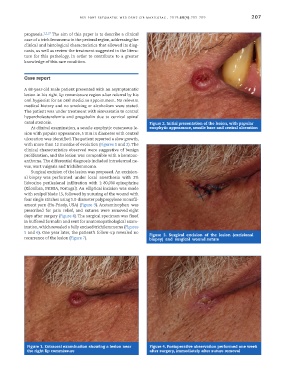
           canal stenosis.                                      Figure 2. Initial presentation of the lesion, with papular
              At clinical examination, a sessile exophytic cutaneous le-  exophytic appearance, sessile base and central ulceration
           sion with papular appearance, 5 mm in diameter with central
           ulceration was identified. The patient reported a slow growth,
           with more than 12 months of evolution (Figures 1 and 2). The
           clinical characteristics observed were suggestive of benign
           proliferation, and the lesion was compatible with a keratoac-
           anthoma. The differential diagnosis included intradermal ne-
           vus, wart vulgaris and trichilemmoma.
              Surgical excision of the lesion was proposed. An excision-
           al biopsy was performed under local anesthesia with 2%
           lidocaine perilesional infiltration with 1: 80,000 epinephrine
           (Xilonibsa, INIBSA, Portugal). An elliptical incision was made
           with scalpel blade 15, followed by suturing of the wound with
           four single stitches using 5.0-diameter polypropylene monofil-
           ament yarn (Hu-Friedy, USA) (Figure 3). Acetaminophen  was
           prescribed for pain relief, and sutures were removed eight
           days after surgery (Figure 4). The surgical specimen was fixed
           in buffered formalin and sent for anatomopathological exam-
           ination, which revealed a fully excised trichilemmoma (Figures
           5 and 6). One year later, the patient’s follow-up revealed no   Figure 3. Surgical excision of the lesion (excisional
           recurrence of the lesion (Figure 7).                 biopsy) and surgical  wound suture


            Figure 1. Extraoral examination showing a lesion near   Figure 4. Postoperative observation performed one week
            the right lip commissure                            after surgery, immediately after suture removal

