


Page 18 - SPEMD_60-4
P. 18
166                    rev port estomatol med dent cir maxilofac. 2019;60(4):163-168


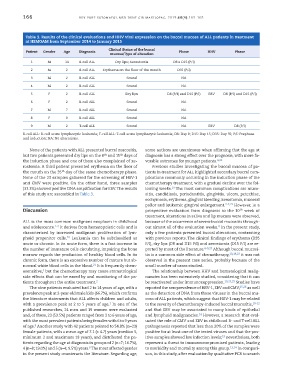
            Table 3. Results of the clinical evaluations and HHV viral expression on the buccal mucosa of ALL patients in treatment
            at HEMOAM from September 2014 to January 2015
                                               Clinical Status of the buccal
            Patient  Gender  Age  Diagnosis                                 Phase       HHV         Phase
                                               mucosa/Type of alteration
              1      M      14    B-cell ALL     Dry lips; Xerostomia     D8 e D15 (P/I)
              2      M       2    B-cell ALL  Erythema on the floor of the mouth  D35 (P/I)
              3      M       2    B-cell ALL          Sound                  NA
              4      M       2    B-cell ALL          Sound                  NA
              5      F       2    B-cell ALL          Dry lips         D8 (P/I) and D15 (P/I)  EBV  D8 (P/I) and D15 (P/I)
              6      F       2    B-cell ALL          Sound                  NA
              7      M       7    B-cell ALL          Sound                  NA
              8      F       9    B-cell ALL          Sound                  NA
              9      M       2    T-cell ALL          Sound                  NA         EBV        D8 (P/I)
           B-cell ALL: B-cell acute lymphocytic leukemia; T-cell ALL: T-cell acute lymphocytic leukemia; D8: Day 8; D15: Day 15; D35: Day 35; P/I: Prephase
           and induction; NA: No alterations.
             None of the patients with ALL presented buccal mucositis,   some authors are unanimous when affirming that the age at
                                                   th
           but two patients presented dry lips on the 8  and 15  days of   diagnosis has a strong effect over the prognosis, with more fa-
                                             th
           the induction phase and one of them also complained of xe-  vorable outcomes for younger patients. 4,22
           rostomia. A third patient presented erythema on the floor of   Previous studies investigating the buccal mucosa of pa-
                           th
           the mouth on the 35  day of the same chemotherapy phase.   tients in treatment for ALL highlighted secondary buccal com-
           None of the 23 samples gathered for the screening of HSV-1   plications commonly occurring in the induction phase of the
           and CMV were positive. On the other hand, three samples   chemotherapy treatment, with a gradual decline over the fol-
           (33.3%) showed positive DNA amplification for EBV. The results   lowing weeks.  The most common complications are muco-
                                                                         23
           of this study are assembled in Table 3.            sitis, candidiasis, periodontitis, gingivitis, ulcers, petechiae,
                                                              ecchymosis, erythema, gingival bleeding, xerostomia, mucosal
                                                              pallor and leukemic gingival enlargement. 7-9,23  However, in a
           Discussion                                         prospective evaluation from diagnosis to the 10  week of
                                                                                                     th
                                                              treatment, alterations in saliva and lip mucosa were observed,
           ALL is the most common malignant neoplasm in childhood   because of the occurrence of severe buccal mucositis through-
           and adolescence. 1-3  It derives from hematopoietic cells and is   out almost all of the evaluation weeks.  In the present study,
                                                                                             8
           characterized by increased malignant proliferation of lym-  only a few patients presented buccal alterations, contrasting
           phoid progenitor cells.  Leukemia can be subclassified as   with previous reports. The clinical findings of erythema (D35
                             20
           acute or chronic. In its acute form, there is a fast increase in   P/I), dry lips (D8 and D15 P/I) and xerostomia (D15 P/I) are re-
           the number of immature cells circulating, impairing the bone   ported by most of the literature. 6-9,23  Although buccal mucosi-
           marrow regards the production of healthy blood cells. In its   tis is a common side effect of chemotherapy, 10,18,23  it was not
           chronic form, there is an excessive number of mature but ab-  observed in the present case series, probably because of the
                                        21
           normal white blood cells in the blood.  It is frequently chem-  small number of cases studied.
                   4
           osensitive,  but the chemotherapy may cause stomatological   The relationship between HHV and hematological malig-
           side effects that can be eased by oral monitoring of the pa-  nancies has been extensively studied, considering that it can
           tients throughout the entire treatment. 2          be reactivated under immunosuppression. 10,24,25  Studies have
             The nine patients evaluated had 2 to 14 years of age, with a   reported the seroprevalence of HSV-1, EBV and CMV, 25,26  as well
           prevalence peak at 2-year-old male kids (66.7%), which confirms   as the detection of DNA from those viruses in the buccal mu-
           the literature statements that ALL affects children and adults,   cosa of ALL patients, which suggest that HSV-1 may be related
                                               1
           with a prevalence peak at 2 to 5 years of age.  In one of the   to the severity of chemotherapy-induced buccal mucositis, 10-12
           published researches, 24 men and 19 women were evaluated   and that EBV may be associated to many kinds of epithelial
           and, of those, 23 (53.5%) patients ranged from 3 to 6 years of age,   and lymphoid malignancies.  However, a research that eval-
                                                                                    14
           with the most prevalent patients being females with 6 to 9 years   uated the role of CMV and EBV in childhood B- and T-cell ALL
           of age.  Another study with 42 patients pointed to 54.8% (n=23)   pathogenesis reported that less than 20% of the samples were
                9
           female patients, with a mean age of 7.1 (± 4.7) years (median 5,   positive for at least one of the tested viruses and that the pos-
           minimum 2 and maximum 18 years), and distributed the pa-  itive samples showed low infection levels;  nevertheless, both
                                                                                              19
           tients regarding the age at diagnosis in groups of 2 (n=7; 16.7%),   represent a threat to immunocompromised patients, leading
           4 (n=8; 19.0%) and 5 (n=4; 9.5%) years.  The most affected gender   to morbidity and mortality among this group. 13,14  In compari-
                                      8
           in the present study counteracts the literature. Regarding age,   son, in this study, after evaluation by qualitative PCR to search

