


Page 60 - SPEMD_60-3
P. 60
148                    rev port estomatol med dent cir maxilofac. 2019;60(3):145-149


                                                                 Unexpected morphological variations make endodontic
                                                              treatment a challenge for clinicians, who must be aware of all
                                                              possible anatomical configurations of the tooth as well as the
                                                              different diagnostic features that lead to successful endodon-
                                                              tic treatment. 12-14
                                                                 Radiographic examinations are an essential component
                                                              in endodontic treatment. They are used for diagnosis, plan-
                                                              ning and to evaluate the success rate of treatments. The
                                                              amount of information obtained by two-dimensional periapi-
                                                              cal radiographs is limited, since it may be affected by geomet-
                                                              ric distortions and overlap of anatomical structures. 1,4,9,15  The
                                                              use of CT scans has been encouraged to diagnose cases of
                                                              multiple root canals. 3,16  In the present report, this resource
                                                              ensured treatment safety as it indicated the location of the
                                                              root canals. However, when computed tomography is not
                                                              available, radiographic images at different angulations can
                                                              be an option. 4,10
                                                                 Using magnification might also be an advantage when
                                                              dealing with severe anatomic deviations. 6-8,17,18  In order to car-
                                                              ry out the root canal treatment of the presented case, an op-
                                                              erating microscope was used, at 16x and 25x magnification.
                                                              This device also contributed to the success of the technical
                                                              procedure, by preventing excessive wear of the dentin area and
                                                              improving visibility to locate the root canals.
                                                                 In this case report, the possible etiology for pulp necrosis
                                                              and apical periodontitis in the teeth may have been an old
                                                              traumatic event reported by the patient.
                                                                 The therapeutic protocol using tomographic examinations
            Figure 5. 12-month follow-up                      and magnification enabled the correct identification of the
                                                              anatomical variation and, consequently, treatment safety,
                                                              which ultimately lead to a favorable treatment outcome.
                                            ®
           mo-compactor associated with the AH Plus  Sealer (Dentsply/
           Maillefer, Switzerland).
             After obturation, the cavity was cleaned and restored with   Acknowledgment
           a temporary restoration using glass ionomer cement, and a
           final periapical radiograph was obtained.          The authors thank the patient for granting permission for
             Clinical and radiographic follow-up were performed 6 and   publishing this case.
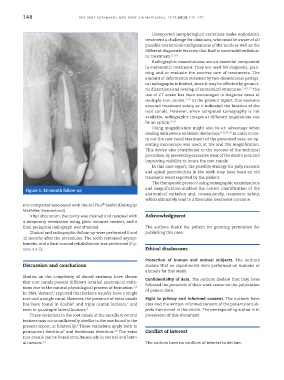
           12 months after the procedures. The tooth remained asymp-
           tomatic, and a final coronal rehabilitation was performed (Fig-
           ures 4 e 5).                                       Ethical disclosures

                                                              Protection of human and animal subjects. The  authors
           Discussion and conclusions                         declare that no experiments were performed on humans or
                                                              animals for this study
           Studies on the complexity of dental anatomy have shown
                                                              Confidentiality of data. The authors declare that they have
           that root canals present different internal anatomical varia-  followed the protocols of their work center on the publication
           tions due to the natural physiological process of formation.    of patient data.
                                                         1,2
                       1
           In 1984, Vertucci  reported that incisors usually have a single
           root and a single canal. However, the presence of extra canals   Right to privacy and informed consent. The authors have
                                                      7
                                6
           has been found in double  and triple central incisors,  and   obtained the written informed consent of the patients or sub-
           even in quadruple lateral incisors. 8              jects mentioned in the article. The corresponding author is in
             These variations in the root canals of the maxillary central   possession of this document.
           incisors may occur unilaterally, similar to the one found in the
                                 4
           present report, or bilaterally.  These variations apply both to
                                                 10
                           9
           permanent dentition  and deciduous dentition.  The extra   Conflict of interest
           root canals can be found simultaneously in central and later-
           al incisors. 11                                    The authors have no conflicts of interest to declare.

