


Page 14 - SPEMD_59-2
P. 14
72                      rev port estomatol med dent cir maxilofac. 2018;59(2):67-74


           alignment showed a statistically significant difference (p<0.05)   Discussion
           between the groups, as the group with an oral breathing pat-
           tern had greater, more positive values.            In our sample of males and females aged 12 to 15 years, 63.3%
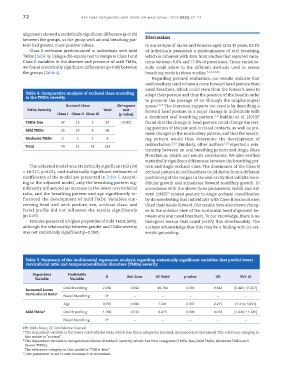
             Class II occlusion predominated in individuals with mild   of individuals presented a predominance of oral breathing,
           TMDs (Table 4). Using a chi -square test to compare Class I and   which is coherent with data from studies that reported varia-
           Class II variables in the absence and presence of mild TMDs,   tions between 6.6% and 77.8% of prevalence. Those varied re-
           we found statistically significant differences (p<0.05) between   sults could relate to the different methods used to assess
           the groups (Table 4).                              breathing mode in those studies. 5,18,19,20
                                                                 Regarding postural evaluation, our results indicate that
                                                              oral breathers tend to have a more forward head posture than
                                                              nasal breathers, which could stem from the former’s need to
            Table 4. Comparative analysis of occlusal class according   adapt their posture and thus the position of the head in order
            to the TMDs severity
                                                              to promote the passage of air through the oropharyngeal
                             Occlusal Class       Chi -square   space. 1,6 -8  The literature supports our results by describing a
            TMDs Severity                   Total    test     forward head posture as a major change in individuals with
                         Class I Class II Class III  (p value)
                                                              a dominant oral breathing pattern. 7,9  Baldini et al. (2013) 6
            TMDs -free     47    15    5     67     <0.001    found that the change in head posture could change the rest-
                                                              ing position of the jaw and occlusal contacts, as well as pro-
            Mild TMDs      25    35    8     68
                                                              mote changes in the masticatory pattern, and that the breath-
            Moderate TMDs  2     1     1      4               ing pattern would thus determine the development of
                                                              malocclusion. 5,19  Similarly, other authors 7,10  reported a rela-
            Total          74    51    14    139
                                                              tionship between an oral breathing pattern and Angle Class
                                                              II occlusion, which our results corroborate. We also verified
                                                              statistically significant differences between the breathing pat-
             The adjusted model was statistically significant (G2 (24)   tern and Angle occlusal class. The dominance of the Class II
           = 48.317; p<0.01), and statistically significant estimates of   occlusal pattern in oral breathers could derive from a different
           coefficients of the model are presented in Table 5. Accord-  positioning of the tongue in the oral cavity that inhibits man-
           ing to the adjusted model, only the breathing pattern sig-  dibular growth and stimulates forward maxillary growth. In
           nificantly influenced an increase in the lower cervicofacial   accordance with the above three parameters, Nobili and Ad-
                                                                       20
           ratio, and the breathing pattern and age significantly in-  versi (1996)  related posture to Angle occlusal classification
           fluenced  the  development  of  mild TMDs. Variables  con-  by demonstrating that individuals with Class II malocclusion
           cerning  head and  neck posture, sex,  occlusal  class, and   tilted their heads forward. Our results have also shown chang-
           facial profile did not influence the results significantly   es in the anterior view of the horizontal head alignment be-
           (p>0.05).                                          tween oral and nasal breathers. To our knowledge, there is no
             Females presented a higher proportion of mild TMDs (60%),   biological reason that could justify this directionality. The
           although the relationship between gender and TMDs severity   authors acknowledge that this may be a finding with no sci-
           was not statistically significant (p=0.290).       entific grounding.


            Table 5. Summary of the multinomial regression analysis regarding statistically significant variables that predict lower
            cervicofacial ratio and temporomandibular disorders (TMDs) severity

               Dependent     Predictable     B        Std. Error  X2 Wald     p value      OR         95% CI
                Variable      Variable

                            Oral Breathing  2.266       0.692      10.714      0.001       9.643   [2.483; 37.457]
            Increased Lower
            Cervicofacial Ratio a  Nasal Breathing  0 c    –           –          –           –           –
                            Age             0.795       0.296      7.241       0.007       2.215    [1.214; 3.953]
            Mild TMDs b     Oral Breathing  1.390       0.530      6.875       0.009       4.014   [1.420; 11.343]
                            Nasal Breathing  0 c           –           –          –           –           –
           OR: Odds Ratio; CI: Confidence Interval
           a   The dependent variable is the lower cervicofacial ratio, which has three categories (normal, increased and decreased). The reference category in
           this model is “normal”.
           b   The dependent variable is temporomandibular disorders’ severity, which has four categories (TMDs -free, Mild TMDs, Moderate TMDs and
           Severe TMDs).
           The reference category in this model is “TMDs -free”.
           c  This parameter is set to zero because it is redundant.

