


Page 19 - SPEMD_59-2
P. 19
rev port estomatol med dent cir maxilofac . 2018;59(2):75-79             77


                                                               Table 1. Descriptive analysis: mean and standard
                                                               deviation regarding number of cycles to fracture (NCF).
                                                               Group 1 is the one with higher mean values; the lower
                                                               values are present in Group 4.

                                                                          Group    Type of file  Mean ± St. Deviation
                                                                            1      PTG F2     549.1 ± 115.1
                                                                            2      PTU F2     283.5 ± 33.9
                                                                 NCF
                                                                            3      PTG F3     294.5 ± 88.0
                                                                            4      PTU F3     158.5 ± 37.57


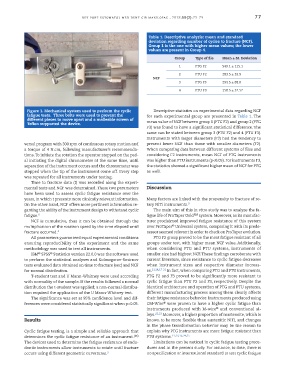
            Figure 1. Mechanical system used to perform the cyclic   Descriptive statistics on experimental data regarding NCF
            fatigue tests.  Three bolts were used to prevent the   for each experimental group are presented in Table 1. The
            different pieces to move apart and a malleable screen of
            Teflon supported the device.                       mean value of NCF between group 1 (PTG F2) and group 2 (PTG
                                                               F3) was found to have a significant statistical difference. The
                                                               same can be stated between group 3 (PTU F2) and 4 (PTU F3).
                                                               Instruments with larger diameters (F3) had the tendency to
           versal program with 300 rpm of continuous rotary motion and   present lower NCF than those with smaller diameters (F2).
           a torque of 4 N.cm, following manufacturer’s recommenda-  When comparing data between different systems of files and
           tions. To initiate the rotation the operator stepped on the ped-  considering F2 instruments, mean NCF of PTG instruments
           al initiating the digital chronometer at the same time, until   was higher than PTU instruments (p<0.05). For instruments F3,
           separation of the instrument occurs and the chronometer was   the statistics showed a significant higher mean of NCF for PTG
           stopped when the tip of the instrument come off. Every step   as well.
           was repeated for all instruments under testing.
              Time to fracture data (t) was recorded along the experi-
           mental tests and NCF was determined. These two parameters   Discussion
           have been used to assess cyclic fatigue resistance over the
           years, in which t presents more clinically relevant information.   Many factors are linked with the propensity to fracture of ro-
           On the other hand, NCF offers more pertinent information re-  tary NiTi instruments. 9
           garding the ability of the instrument design to withstand cyclic   The main aim of this in vitro study was to analyze the fa-
           fatigue. 6                                          tigue life of ProTaper Gold RM  system. Moreover, as its manufac-
              NCF is cumulative, thus it can be obtained through the   turer proclaimed improved fatigue resistance of this system
           multiplication of the rotation speed by the time elapsed until   over ProTaper  Universal system, comparing it with its prede-
                                                                         ®
           fracture occurred. 4                                cessor seemed relevant in order to check on ProTaper evolution.
              All parameters guaranteed equal experimental conditions   PTG F2 group proved to be the most fatigue resistant of all
           ensuring reproducibility of the experiment and the same   groups under test, with higher mean NCF value. Additionally,
           methodology was used to test all instruments.       when considering PTG and PTU systems, instruments of
                      ®
                 ®
              IBM  SPSS  Statistics version 22.0.0 was the software used   smaller size had highest NCF. These findings corroborate with
           to perform the statistical analyses and Kolmogorov-Smirnov   current literature, since resistance to cyclic fatigue decreases
           tests evaluated data obtained on time to fracture (sec) and NCF   when  instrument  sizes  and  respective  diameter  increas-
           for normal distribution.                            es. 11,14,17-21  In fact, when comparing PTG and PTU instruments,
              T-student test and U Mann-Whitney were used according   PTG F2 and F3 proved to be significantly more resistant to
           with normality of the sample. If the results followed a normal   cyclic fatigue than PTU F2 and F3, respectively. Despite the
           distribution the t-student was applied; a non-normal distribu-  identical architecture and operation of PTG and PTU systems,
           tion required the application of the U Mann-Whitney test.   different manufacturing process among them clearly affects
              The significance was set at 95% confidence level and dif-  their fatigue resistance behavior. Instruments produced using
           ferences were considered statistically significant when p<0.05.  CM-Wire  were proven to have a higher cyclic fatigue than
                                                                      ®
                                                                                            ®
                                                               instruments produced with M-wire  and conventional al-
                                                               loys. 22,23  Moreover, a higher proportion of martensite, which is
           Results                                             known to be more flexible than austenitic NiTi, and changes
                                                               in the phase transformation behavior may be the reason to
           Cyclic fatigue testing, is a simple and reliable approach that   explain why PTG instruments are more fatigue resistant than
           determines the cyclic fatigue resistance of an instrument. (16)    PTU systems. 11,13,16,24,25
           The devices used to determine the fatigue resistance of endo-  Limitations can be noticed in cyclic fatigue testing proce-
           dontic instruments allow instruments to rotate until fracture   dures and in the present study. For instance, to date, there is
           occurs using different geometric curvatures. 3      no specification or international standard to test cyclic fatigue

