


Page 14 - SPEMD_58-4
P. 14
202                    rev port estomatol med dent cir maxilofac. 2017;58(4):199-204


            Table 2. Prevalence of dental and ear nose and throat   Discussion
            findings by deciduous and mixed dentition
                                                              Although the literature has been showing interest on the
                     Variables         Deciduous   Mixed      impact of oral breathing in growth and dentofacial develop-
                                        n    %    n    %      ment for many years, many questions remain unanswered
                                                              regarding the real meaning of nasal obstruction as an etio-
            Sagittal relationship (n=867)                     logical factor for malocclusion. Classic cephalometric stud-
             Normal                      58  16.3    50    9.8
             Class I malocclusion      159  44.7  250  48.9   ies have associated upper airway obstruction with skeletal
             Class II malocclusion     110  43.0  159  31.1   and dentofacial deviations from the norm, but there are few
             Class III malocclusion      29    8.1    52  10.2  clinical evaluations on these patients’ occlusion. 19-22
            Vertical relationship (n=864)                        Cross-sectional studies, even the ones with a large sample
             Normal                    172  47.5  283  56.4   as this here presented, have some limitations that need to be
             Deep bite                  59  16.3  69   13.7   addressed. In this study, although children were supposed to
             Open bite                 131  36.2  150  29.9
                                                              be submitted to evaluation by the whole professional team at
            Transversal relationship (n=874)                  the first appointment, sometimes that was not possible. For
             Normal                    283  78.4  382  74.5   example, the diagnosis of allergic rhinitis was not made in the
             Posterior crossbite w/o shift    40  11.1    88  17.1  first appointment in some cases due to antihistamine use or
             Posterior crossbite w/ shift    38  10.5    43    8.4
                                                              airway infections, and patients did not show up on recall.
            Tonsils status (n=874)                            Therefore, some data was missing from the original 1002 pa-
             Grades 0, I, II           172  46.6  330  65.3   tients. All non-syndromic children, in both deciduous and
             Grades III, IV            197  53.4  175  34.7
                                                              mixed dentition, who were consecutively referred and diag-
            Adenoid obstruction status (n=832)                nosed as mouth breathers enrolled the present study and,
             <75%                      111  32.0  257  53.0   therefore, the age range was wide. There was no information
             ≥75%                      236  68.0  228  47.0
                                                              available on the onset of oral respiration, sucking habits, and,
            Rhinitis (n=778)                                  due to radiation issues, lateral x-rays were not available to
             Yes                       187  57.0  333  74.0   differentiate skeletal from dental malocclusions.
             No                        141  43.0  117  26.0
                                                                 Some studies representing the general population, and not
           Number of children (n) and prevalence given in percentage (n/N X100%)  only the mouth breathers, can be found in the literature. In the
                                                              present sample with nasal obstruction, the prevalence of class
                                                              II malocclusion was 43.0% in the children in deciduous denti-
           perplasia was more prevalent (53.4%) in the children in de-  tion and 31.1% in the ones in mixed dentition. These numbers
           ciduous dentition than in the ones in mixed dentition (34.7%).   differ from other studies made in Brazil by Tomita et al.  and
                                                                                                         23
                                                                          24
           The opposite was verified for rhinitis, with more cases in   Sadakyio et al., which showed a class II prevalence between
           mixed (74.0%) than in deciduous dentition (57.0%). Posterior   6% and 20% in pre-school children. The higher prevalence of
           crossbite with and without a functional shift, anterior open   class II malocclusion in the mouth breathers in mixed denti-
           bite and class II malocclusion were found in similar percent-  tion comparing to those in deciduous dentition can be ex-
           ages in children in deciduous and mixed dentitions.  plained either by the longer influence of the mouth-breathing
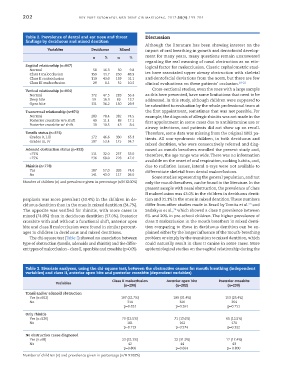
             The chi-square test (Table 3) showed no association between   problem or simply by the transition to mixed dentition, which
           type of obstruction (tonsils, adenoids and rhinitis) and the differ-  could naturally result in class II canine in some cases. More
           ent types of malocclusion – class II, open bite and crossbite (p>0.05).  epidemiological studies on the sagittal relationship during the


            Table 3. Bivariate analyses, using the chi -square test, between the obstructive causes for mouth breathing (independent
            variables) and class II, anterior open bite and posterior crossbite (dependent variables)
                                                Class II malocclusion  Anterior open bite    Posterior crossbite
                        Variables
                                                     (n=290)               (n=282)              (n=230)
            Tonsil and/or adenoid obstruction
             Yes (n=602)                            197 (32.7%)           189 (31.4%)           153 (25.4%)
             No                                       314                    320                   364
                                                     p=0.824               p=0.264              p=0.751

            Only rhinitis
             Yes (n=520)                            70 (13.5%)             71 (13.6%)           65 (12.5%)
             No                                       161                    162                   170
                                                     p=0.719               p=0.574              p=0.322
            No obstruction cause diagnosed
             Yes (n=69)                             23 (33.3%)             22 (31.9%)           12 (17.4%)
             No                                        42                    44                    43
                                                     p=0.800               p=0.604              p= 0.800
           Number of children (n) and prevalence given in percentage (n/N X100%)

