


Page 19 - SPEMD_58-4
P. 19
rev port estomatol med dent cir maxilofac . 2017;58(4):205-211         207


           Some amends were made in light of their comments. The   Table 1. Characteristics of the participants (n=95).
           questionnaire began with the description of the objective of
           the study and the ethical considerations concerning anonym-                               %     N
           ity and confidentiality of data. The questions were divided into   Gender
           two main groups. The first group referred to the sample char-  Male                       44.2  42
           acterization with questions regarding personal (age and gen-  Female                      55.8  53
           der) and professional characteristics, intended to obtain infor-  Age
           mation about the dentists’ education degree, years of clinical   24 -35 years             50.5  48
           practice and number of weekly endodontic treatments. The   36 -45 years                   33.7  32
           second group of questions concerned the prescription of an-  > 45 years                   15.8  15
           tibiotics in their clinical practice, namely, the type of antibiot-  Academic background
           ics (for patients with and without allergies), the clinical con-  Degree in Dentistry     45.3  43
           ditions in which they were used and the number of days of   Post -graduation degree       41.1  36
           treatment. All the participants were contacted in person.  Master degree                  52.6  50
                                                                                                     2.1
                                                                 PhD degree
                                                                                                           2
              All data were analyzed using the IBM SPSS Statistics 20 soft-
           ware (IBM Corporation, Chicago, IL, USA). Sample characteristics   Number of endodontic treatments per week
           were analyzed as average ± standard deviation (SD), counts or   < 5                       32.6  31
                                                                                                           43
                                                                 5 -10
                                                                                                     45.3
           proportions. The χ2 test was used for comparisons and correla-  > 10                      22.1  21
           tions between groups in nominal data. The Spearman’s rank
           correlation coefficient was also used to test for correlations. The
           differences in the prescribed number of days for antibiotic treat-
           ment between males and females and between different aca-  (SD = 7.5 years) of clinical experience. Most of the dentists held
           demic degrees (DDS degree, master or PhD) were tested with   a master degree and more than 40% held a post -graduate de-
           independent t -tests. The differences in the prescribed number   gree (Table 1). The most common number of endodontic treat-
           of days for antibiotic treatment between age groups and be-  ments performed per week was 5 to 10 (Table 1).
           tween groups of dentists with different experience/time dedi-  Regarding antibiotic prescription, the great majority of den-
           cated to endodontics practice was tested with the one -way   tists referred prescribing antibiotic therapy for 8 days (78.9%);
           ANOVA. The level of significance was set at p < 0.05.  13.7% for 7 days, 3.2% for 10 days, 3.2% for 5 days and 1.1% for
                                                               6 days.
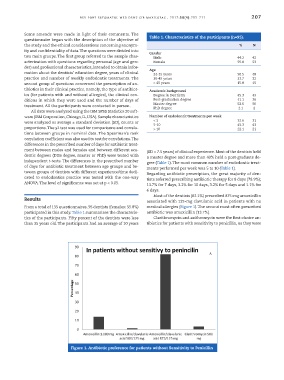
                                                                 Most of the dentists (82.1%) prescribed 875 -mg amoxicillin
           Results
                                                               associated with 125 -mg clavulanic acid in patients with no
           From a total of 135 questionnaires, 95 dentists (females: 55.8%)   medical allergies (Figure 1). The second most often prescribed
           participated in this study. Table 1 summarizes the characteris-  antibiotic was amoxicillin (13.7%).
           tics of the participants. Fifty percent of the dentists were less   Clarithromycin and azithromycin were the first -choice an-
           than 35 years old. The participants had an average of 10 years   tibiotics for patients with sensitivity to penicillin, as they were


                                                                                         A


                               Figure 1. Antibiotic preference for patients without Sensitivity to Penicillin


                                                                                        B

