


Page 13 - SPEMD_58-4
P. 13
rev port estomatol med dent cir maxilofac . 2017;58(4):199-204         201


           Materials and methods                               Results
           The present cross-sectional observational study was devel-  The mean age of the 1002 children enrolled in the study was 6.7
           oped at the Oral Respiratory Outpatient Center of the Hospi-  ± 2.7 years, ranging from 1.4 to 12.9 years. The original sample
           tal  das  Clínicas  in  the  Federal  University  of  Minas  Gerais,   lacked some data, which lead to a final number different from
           Brazil, and was approved by its Ethics Committee. One thou-  the total number of observed subjects. Table 1 shows the preva-
           sand and two patients consecutively admitted to the Center   lence of the studied variables according to gender. There were
           from November 2002 to December 2015 enrolled the study.   no statistically significant differences between boys and girls.
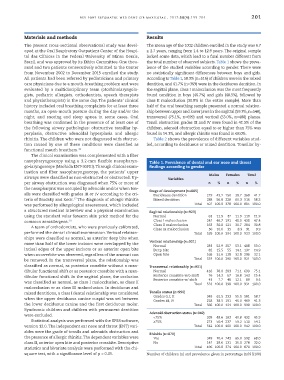
           All patients had been referred by pediatricians and primary   According to Table 1, 58.3% (n=516) of children were in the mixed
           care physicians due to a mouth-breathing problem and were   dentition, and 41.7% (n=369) were in the deciduous dentition. In
           evaluated by a multidisciplinary team (otorhinolaryngolo-  the sagittal plane, class I malocclusion was the most frequently
           gists, pediatric allergists, orthodontists, speech therapists   found condition in boys (46.7%) and girls (48.5%), followed by
           and physiotherapists) in the same day. The patients’ clinical   class II malocclusion (30.8% in the entire sample). More than
           history included oral breathing complaints for at least three   half of the oral breathing sample presented a normal relation-
           months, an open-mouth posture during the day and/or the   ship between upper and lower jaws in the sagittal (59.3%, n=548),
           night, and snoring and sleep apnea in some cases. Oral   transversal (75.1%, n=699) and vertical  (53.0%, n=488)  planes.
           breathing was confirmed in the presence of at least one of   Tonsil obstruction grades III and IV were found in 41.3% of the
           the following airway pathologies: obstructive tonsillar hy-  children, adenoid obstruction equal to or higher than 75% was
           perplasia, obstructive adenoidal hyperplasia and allergic   found in 54.1%, and allergic rhinitis was found in 68.0%.
           rhinitis. The children who were not diagnosed with obstruc-  Table 2 shows the prevalence of different variables stud-
           tion caused by one of these conditions were classified as   ied, according to deciduous or mixed dentition. Tonsillar hy-
           functional mouth breathers. 13
              The clinical examination was complemented with a fiber
           nasopharyngoscopy using a 3.2-mm flexible nasopharyn-  Table 1. Prevalence of dental and ear nose and throat
           go-laryngoscope (Machida ENT-30PIII). Through clinical exam-  findings according to gender
           ination and fiber nasopharyngoscopy, the patients’ upper
           airways were classified as non-obstructed or obstructed. Up-  Variables       Males  Females  Total
           per airway obstruction was diagnosed when 75% or more of                     n   %   n   %   n   %
           the nasopharynx was occupied by adenoids and/or when ton-  Stage of development (n=885)
           sils were classified with grades III or IV according to the cri-  Deciduous dentition  219   43.2 150   39.7 369   41.7
                                17
           teria of Brodsky and Kock.  The diagnosis of allergic rhinitis   Mixed dentition  288   56.8 228   60.3 516   58.3
           was performed by allergological assessment, which included             Total  507 100.0 378 100.0 885 100.0
           a structured medical interview and a physical examination   Sagittal relationship (n=923)
           using the standard volar forearm skin prick method for the   Normal            63   11.9   47   11.9 110   11.9
           common aeroallergens. 18                              Class I malocclusion   247   46.7 191   48.5 438   47.4
              A team of orthodontists, who were previously calibrated,   Class II malocclusion  163   30.8 121   30.7 284   30.8
                                                                 Class III malocclusion
                                                                                          56   10.6   35      8.9   91     9.9
           performed the dental clinical examination. Vertical relation-          Total  529 100.0 394 100.0 923 100.0
           ships were classified as normal, as anterior deep bite when
           more than half of the lower incisors were overlapped by the   Vertical relationship (n=921)  281   52.9 207   53.1 488   53.0
                                                                 Normal
           incisal edges of the upper incisors or as anterior open bite   Deep bite       82   15.5   55   14.1 137   14.9
           when no overbite was observed, regardless of the amount can   Open bite      168   31.6 128   32.8 296   32.1
           be removed. In the transversal plane, the relationship was             Total  531 100.0 390 100.0 921 100.0
           classified as normal, as posterior crossbite without a man-  Transversal relationship (n=931)
           dibular functional shift or as posterior crossbite with a man-  Normal       416   78.0 283   71.1 699   75.1
           dibular functional shift. In the sagittal plane, the occlusion   Posterior crossbite w/o shift    76   14.3   67   16.8 143   15.4
           was classified as normal, as class I malocclusion, as class II   Posterior crossbite w/ shift    41     7.7   48   12.1   89     9.5
                                                                                        533 100.0 398 100.0 931 100.0
                                                                                  Total
           malocclusion or as class III malocclusion. In deciduous and
           mixed dentitions, a class I dental relationship was considered   Tonsils status (n=990)
           when the upper deciduous canine cuspid was set between   Grades 0, I, II     348   61.5 233   55.0 581   58.7
                                                                                        218   38.5 191   45.0 409   41.3
                                                                 Grades III, IV
           the lower deciduous canine and the first deciduous molar.               Total  566 100.0 424 100.0 990 100.0
           Syndromic children and children with permanent dentition
           were excluded.                                       Adenoid obstruction status (n=942)  269   49.6 163   40.8 432   45.9
                                                                 <75%
              Statistical analysis was performed with the SPSS software,   ≥75%         273   50.4 237   59.2 510   54.1
           version 12.0. The independent ear nose and throat (ENT) vari-           Total  542 100.0 400 100.0 942 100.0
           ables were the grade of tonsils and adenoids obstruction and   Rhinitis (n=870)
           the presence of allergic rhinitis. The dependent variables were   Yes        349   70.4 243   65.0 592   68.0
           class II, anterior open bite and posterior crossbite. Descriptive   No       147   29.6 131   35.0 278   32.0
           statistics and bivariate analysis were performed with the chi-          Total  496 100.0 374 100.0 870 100.0
           square test, with a significance level of p < 0.05.  Number of children (n) and prevalence given in percentage (n/N X100)

