


Page 34 - SPEMD_62-3
P. 34
160                    rev port estomatol med dent cir maxilofac. 2021;62(3):157-162


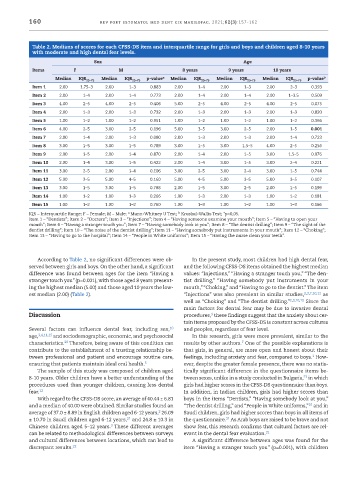
            Table 2. Medians of scores for each CFSS ‑DS item and interquartile range for girls and boys and children aged 8 ‑10 years
            with moderate and high dental fear levels.
                                Sex                                               Age
            Items         F             M                     8 years        9 years        10 years
                   Median  IQR     Median  IQR    p ‑value a  Median  IQR  Median  IQR  Median  IQR    p ‑value b
                              25 ‑75         25 ‑75                 25 ‑75         25 ‑75         25 ‑75
            Item 1   2.00   1.75–3  2.00    1–3    0.883   2.00    1–4    2.00    1–3    2.00    2–3    0.393
            Item 2   2.00    1–4    2.00    1–4    0.773   2.00    1–4    2.00    1–4    2.00    1–3.5  0.509
            Item 3   4.00    2–5    4.00    2–5    0.406   5.00    2–5    4.00    2–5    4.00    2–5    0.075
            Item 4   2.00    1–3    2.00    1–3    0.732   2.00    1–3    2.00    1–3    2.00    1–3    0.820
            Item 5   1.00    1–2    1.00    1–2    0.951   1.00    1–2    1.00    1–2    1.00    1–2    0.366
            Item 6   4.00    2–5    3.00    2–5    0.196   5.00    3–5    3.00    2–5    2.00    1–5    0.001
            Item 7   2.00    1–4    2.00    1–3    0.080   2.00    1–3    2.00    1–3    2.00    1–4    0.723
            Item 8   3.00    1–5    3.00    1–5    0.789   3.00    1–5    3.00   1.5–5   4.00    2–5    0.256
            Item 9   2.00    1–5    2.00    1–4    0.870   2.00    1–4    2.00    1–5    3.00    1.5–5  0.076
            Item 10  2.00    1–4    3.00    1–5    0.422   2.00    1–4    3.00    1–5    3.00    2–4    0.221
            Item 11  3.00    2–5    2.00    1–4    0.106   3.00    2–5    3.00    2–4    3.00    1–5    0.744
            Item 12  5.00    3–5    5.00    4–5    0.160   5.00    4–5    5.00    3–5    5.00    3–5    0.107
            Item 13  3.00    1–5    3.00    1–5    0.788   2.00    1–5    3.00    2–5    2.00    1–5    0.199
            Item 14  1.00    1–2    1.00    1–3    0.266   1.00    1–3    2.00    1–3    1.00    1–2    0.181
            Item 15  1.00    1–2    1.00    1–2    0.760   1.00    1–3    1.00    1–2    1.00    1–3    0.166
                                                            b
                                           a
           IQR – Interquartile Range; F – Female; M – Male;  Mann -Whitney U Test;   Kruskal -Wallis Test; *p<0,05.
           Item 1 – “Dentists”; Item 2 – “Doctors”; Item 3 – “Injections”; Item 4 – “Having someone examine your mouth”; Item 5 – “Having to open your
           mouth”; Item 6 – “Having a stranger touch you”; Item 7 – “Having somebody look at you”; Item 8 – “The dentist drilling”; Item 9 – “The sight of the
           dentist drilling”; Item 10 – “The noise of the dentist drilling”; Item 11 – “Having somebody put instruments in your mouth”; Item 12 – “Choking”;
           Item 13 – “Having to go to the hospital”; Item 14 – “People in White uniforms”; Item 15 – “Having the nurse clean your teeth”.

             According to Table 2, no significant differences were ob-  In the present study, most children had high dental fear,
           served between girls and boys. On the other hand, a significant   and the following CFSS -DS items obtained the highest median
           difference was found between ages for the item “Having a   values: “Injections,” “Having a stranger touch you,” “The den-
           stranger touch you” (p=0.001), with those aged 8 years present-  tist drilling,”  “Having somebody put instruments in your
           ing the highest median (5.00) and those aged 10 years the low-  mouth,” “Choking,” and “Having to go to the dentist.” The item
           est median (2.00) (Table 2).                       “Injections” was also prevalent in similar studies, 2,3,7,10,12  as
                                                              well as “Choking” and “The dentist drilling.” 2,3,10,12  Since the
                                                              main factors for dental fear may be due to invasive dental
           Discussion                                         procedures,  these findings suggest that the anxiety about cer-
                                                                       9
                                                              tain items proposed by the CFSS -DS is constant across cultures
                                                         10
           Several factors can influence dental fear, including sex,    and peoples, regardless of fear level.

           age, 3,4,11,15  and sociodemographic, economic, and psychosocial   In this research, girls were more prevalent, similar to the
                      20
                                                                                 7
           characteristics.  Therefore, being aware of this condition can   results by other authors.  One of the possible explanations is
           contribute to the establishment of a trusting relationship be-  that girls, in general, are more open and honest about their
                                                                                                         1
           tween professional and patient and encourage routine care,   feelings, including anxiety and fear, compared to boys.  How-
           ensuring that patients maintain ideal oral health. 5  ever, despite the greater female presence, there was no statis-
             The sample of this study was composed of children aged   tically significant difference in the questionnaire items be-
                                                                                                      23
           8 -10 years. Older children have a better understanding of the   tween sexes, unlike in a study conducted in Bulgaria,  in which
           procedures used than younger children, causing less dental   girls had higher scores in the CFSS -DS questionnaire than boys.
           fear. 12                                           In addition, in Indian children, girls had higher scores than
             With regard to the CFSS -DS score, an average of 40.44 ± 6.81   boys in the items “Dentists,” “Having somebody look at you,”
                                                                                                       10
           and a median of 40.00 were obtained. Similar studies found an   “The dentist drilling,” and “People in White uniforms,”  and in
                                                      2
           average of 37.0 ± 8.89 in English children aged 6 -12 years,  26.09   Saudi children, girls had higher scores than boys in all items of
           ± 10.70 in Saudi children aged 6 -12 years,  and 24.8 ± 10.3 in   the questionnaire.  As Arab boys are raised to be brave and not
                                                                            21
                                           21
                                      3
           Chinese children aged 5–12 years.  These different averages   show fear, this research confirms that cultural factors are rel-
           can be related to methodological differences between surveys   evant in the dental fear evaluation. 21
           and cultural differences between locations, which can lead to   A significant difference between ages was found for the
           discrepant results. 22                             item “Having a stranger touch you” (p=0.001), with children

