


Page 17 - SPEMD_61-2
P. 17
rev port estomatol med dent cir maxilofac . 2020;61(2):52-56             55


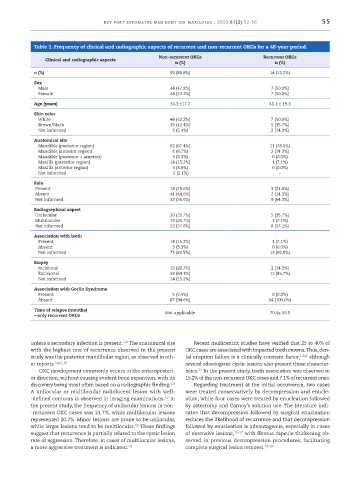
            Table 1. Frequency of clinical and radiographic aspects of recurrent and non ‑recurrent OKCs for a 48 ‑year ‑period.
                                                      Non ‑recurrent OKCs               Recurrent OKCs
                Clinical and radiographic aspects
                                                           n (%)                            n (%)
            n (%)                                        92 (86.8%)                        14 (13.2%)
            Sex
              Male                                       44 (47.8%)                        7 (50.0%)
              Female                                     48 (52.2%)                        7 (50.0%)
            Age (years)                                  34.3 ±17.7                       41.1 ± 19.3
            Skin color
              White                                      48 (52.2%)                        7 (50.0%)
              Brown/Black                                39 (42.4%)                        5 (35.7%)
              Not informed                                5 (5.4%)                         2 (14.3%)
            Anatomical site
              Mandible (posterior region)                62 (67.4%)                        11 (78.6%)
              Mandible (anterior region)                  8 (8.7%)                         2 (14.3%)
              Mandible (posterior + anterior)             3 (3.3%)                         0 (0.0%)
              Maxilla (posterior region)                 14 (15.2%)                        1 (7.1%)
              Maxilla (anterior region)                   3 (3.3%)                         0 (0.0%)
              Not informed                                 2 (2.1%)                           –
            Pain
             Present                                     18 (19.6%)                        3 (21.4%)
             Absent                                      41 (44.6%)                        2 (14.3%)
             Not informed                                33 (35.9%)                        9 (64.3%)
            Radiographical aspect
             Unilocular                                  20 (21.7%)                        5 (35.7%)
             Multilocular                                19 (20.7%)                        1 (7.1%)
             Not informed                                53 (57.6%)                        8 (57.1%)
            Association with teeth
              Present                                    14 (15.2%)                        1 (7.1%)
              Absent                                      3 (3.3%)                         0 (0.0%)
              Not informed                               75 (81.5%)                        13 (92.9%)
            Biopsy
              Incisional                                 19 (20.7%)                        2 (14.3%)
              Excisional                                 59 (64.1%)                        12 (85.7%)
              Not informed                               14 (15.2%)                           –
            Association with Gorlin Syndrome
              Present                                     5 (5.4%)                         0 (0.0%)
              Absent                                     87 (94.6%)                       14 (100.0%)
            Time of relapse (months)                    Not applicable                     70.4± 59.5
            – only recurrent OKCs


                                          7,8
           unless a secondary infection is present.  The anatomical site   Recent multicentric studies have verified that 25 to 40% of
           with the highest rate of recurrence observed in the present   OKC cases are associated with impacted tooth crowns. Thus, den-
           study was the posterior mandibular region, as observed in oth-  tal eruption failure is a clinically constant factor, 1,3,4  although
           er reports. 3,4,7,10                                several odontogenic cystic lesions also present these character-
                                                                   11
              OKC development commonly occurs in the anteroposteri-  istics.  In the present study, tooth association was observed in
           or direction, without causing evident bone expansion, with its   15.2% of the non -recurrent OKC cases and 7.1% of recurrent ones.
                                                          1,3
           discovery being most often based on a radiographic finding.    Regarding treatment at the initial occurrence, two cases
           A unilocular or multilocular radiolucent lesion with well-  were treated conservatively by decompression and enucle-
           -defined contours is observed in imaging examinations.  In   ation, while four cases were treated by enucleation followed
                                                        12
           the present study, the frequency of unilocular lesions in non-  by ostectomy and Carnoy’s solution use. The literature indi-
           -recurrent OKC cases was 21.7%, while multilocular lesions   cates that decompression followed by surgical enucleation
           represented 20.7%. Minor lesions are prone to be unilocular,   reduces the likelihood of recurrence and that decompression
           while larger lesions tend to be multilocular.  These findings   followed by enucleation is advantageous, especially in cases
                                              13
           suggest that recurrence is partially related to the cystic lesion   of extensive lesions, 15-17  with fibrous capsule thickening ob-
           rate of aggression. Therefore, in cases of multilocular lesions,   served  in previous decompression procedures,  facilitating
           a more aggressive treatment is indicated. 14        complete surgical lesion removal. 18-20

