


Page 9 - SPEMD_60-4
P. 9
rev port estomatol med dent cir maxilofac . 2019;60(4):155-162         157


           Cold was established as the minimal concentration effective   (Panreac Applichem, Darmstadt, Germany) were weighted us-
           against Candida albicans, without affecting mechanical properties,   ing a precision balance (A&D FZ-200i Company, Limited, Tokyo,
           both immediately after acrylic preparation and after thermal ag-  Japan), to obtain a 2.5%powder weight (w/w) for Kooliner and
           ing. 17,26-31  However, the effect of the chemical aging process on   a 5% powder weight (w/w) for Ufi Gel Hard and Probase Cold.
           the resin properties may also be relevant since, when in function   They were then mixed with a mortar and a pestle until homog-
           inside the oral cavity, reline acrylic resins may biodegrade faster   enization was achieved. Two groups were set for each materi-
           due to daily exposure to an acidic environment. 32-34  al: one control group without CHX, and one experimental
              The surface free energy of a solid consists in the sum of   group with CHX incorporation.
           components arising from dispersive (apolar) and polar contri-  For the surface free energy (γ) study, a metallic rectangular
           butions. Changes in this property will impact the surface wet-  mold was used to prepare 42 specimens (n=7) with standard-
           tability of the material and, consequently, its interaction with   ized dimensions (25x16x1 mm). After allowing the resin to
           saliva molecules, microbial molecules and other materials. 13,35    polymerize under pressure, the specimens were polished with
           Also, an adequate bonding between the denture base resin and   a 600-grit silicon carbide paper (Carbimet Paper Discs, Buehler
           the reline material is essential since a failure can harbor bac-  Ltd., Lake Bluff, IL). They were then submitted to a chemical
           teria, promote staining, decrease the strength of the denture   aging process in a graduated falcon tube filled with artificial
           and cause fractures. 11,16-39                       saliva, with a ratio of 1 g / 5 mL, in an incubator (Memmert,
              The objective of this study was to evaluate the impact of   Schwabach, Germany) at 37 ± 2ºC with constant gentle shaking
           incorporating CHX in reline acrylic resins subjected to oral pH   (300 rpm). 40,41  The specimens were exposed to pH fluctuations
           fluctuations on their surface free energy and their microtensile   in cycles of 6 hours in saliva at pH=3 and 18 hours at pH=7, for
           bond strength to the denture base resin. The following hypoth-  28 days. Between each cycle, specimens were washed with
           eses were established: 1) no differences in surface free energy   distilled water and dried with absorbent paper (Figure 1).
           and bond strength are observed between the three resins; 2)   The γ test was performed with a Tensiometer K12 (Kruss,
           CHX incorporation does not influence the surface free energy;   Hamburg, Germany), where the specimen was suspended and
           and 3) incorporating CHX in the reline resins does not affect   immersed 4 mm in water (Merck Millipore, Germany) and
           their bond strength to the denture base.            1,2-propanediol (1-2 Propanediol R.822324-1L; Merck, Germa-
                                                                                 -1
                                                               ny) at a speed of 20 μms . The contact angles were measured
                                                               at 25 ± 0.1ºC using the Wilhelmy plate technique, and were
           Materials and methods                               used to estimate total surface free energy (γ), as well as its
                                                                                              p
                                                                        d
                                                               dispersive (γ ) and polar components (γ ), based on the har-
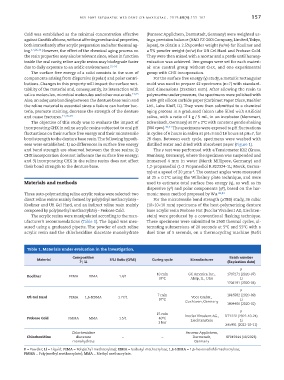
           Three auto-polymerizing reline acrylic resins were selected: two   monic mean method proposed by Wu. 42,43
           direct reline resins mainly formed by poly(ethyl methacrylate) –   For the microtensile bond strength (µTBS) study, 36 cubic
           Kooliner and Ufi Gel Hard, and an indirect reline resin mainly   (10×10×10 mm) specimens of the heat-polymerizing denture
           composed by poly(methyl methacrylate) – Probase Cold.  base acrylic resin Probase Hot (Ivoclar Vivadent AG, Liechten-
              The acrylic resins were manipulated according to the man-  stein) were produced by a conventional flasking technique.
           ufacturer’s recommendations (Table 1). The liquid was mea-  These specimens were submitted to 2500 thermal cycles, al-
           sured using a graduated pipette. The powder of each reline   ternating submersions of 20 seconds at 5ºC and 55ºC with a
           acrylic resin and the chlorhexidine diacetate monohydrate   duel time of 5 seconds, on a thermocycling machine (Refri


            Table 1. Materials under evaluation in the investigation.

                               Composition                                                       Batch number
                 Material                      P/Li Ratio (G/Ml)  Curing cycle   Manufacturer
                                  P | Li                                                        (Expiration date)
                                                                                                      P
                                                                   10 min       GC America Inc.,   1707271 (2020-07)
            Kooliner          PEMA    IBMA         1.4/1
                                                                    37ºC         Alsip, IL., USA      Li
                                                                                                1704191 (2020-04)
                                                                                                      P
                                                                   7 min                        1816582 (2020-09)
            Ufi Gel Hard      PEMA   1,6-HDMA      1.77/1                        Voco GmbH.,
                                                                    37ºC                              Li
                                                                               Cuxhaven, Germany
                                                                                                1804406 (2020-02)
                                                                                                      P
                                                                   15 min      Ivoclar Vivadent AG.,   XT1222 (2022-10-24)
            Probase Cold      PMMA    MMA          1.5/1            40ºC         Liechtenstein        Li
                                                                   3 bar
                                                                                               X45991 (2022-10-11)
                               Chlorhexidine                                   Panreac Applichem,
            Chlorhexidine        diacetate          –                –            Darmstadt,    8F015944 (10/2023)
                               monohydrate                                        Germany

           P = Powder; Li = Liquid; PEMA = Poly(ethyl methacrylate); IBMA = Isobutyl methacrylate; 1,6-HDMA = 1,6-hexanodioldimethacrylate;
           PMMA = Poly(methyl methacrylate); MMA = Methyl methacrylate.

