


Page 19 - SPEMD_60-3
P. 19
rev port estomatol med dent cir maxilofac . 2019;60(3):104-110         107


            Table 2. Descriptive statistics according to experimental group (n=8)
                                                   Knoop Microhardness (KHN)          Flexural Strength (MPa)
                 Material    CHX Concentration
                                                 Mean (SD)       Median (IQR)     Mean (SD)       Median (IQR)
                                   0%             7.0 (1.77)      7.2 (2.97)      42.5 (7.82)     42.0 (14.88)
            Kooliner
            (K)
                                  2.5%            6.9 (1.78)      7.0 (3.44)      42.9 (7.51)     42.1 (12.89)
                                   0%             7.6 (1.18)      7.6 (2.25)      37.5 (4.41)      36.5 (6.51)
            Ufi Gel Hard
            (UG)                   5%             7.6 (0.93)      7.9 (1.94)      37.7 (4.89)      37.4 (5.60)
                                   0%            13.6 (2.27)      13.1 (4.17)     82.1 (12.17)    87.3 (19.04)
            Probase Cold
            (PC)
                                   5%            12.7 (2.12)      12.4 (3.94)     65.8 (4.96)      65.6 (9.74)
           SD – standard deviation; IQR – interquartile range


           1 kN load cell at a crosshead speed of 5 mm/min and a distance   reline acrylic resins. No significant differences were found be-
           of 50 mm between supports. The width and thickness of each   tween Kooliner’s and Ufi Gel Hard’s microhardness (p=1.000)
           specimen were confirmed using a digital micrometer with a ±0.01   or flexural strength (p=0.542).
           mm precision (Mitutoyo Digimatic, MFG. Co. Ltd., Tokyo, Japan).  Microhardness was not statistically affected by CHX incor-
              Data were statistically analyzed using IBM SPSS Statistics   poration in any of the three reline acrylic resins (Kooliner –
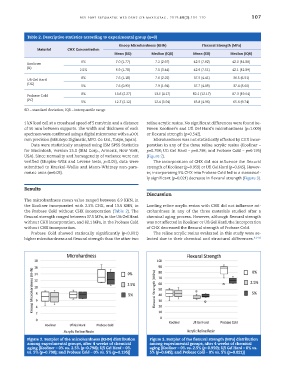
           for Macintosh, version 25.0 (IBM Corp., Armonk, New York,   p=0.798; Ufi Gel Hard – p=0.798; and Probase Cold – p=0.195)
           USA). Since normality and homogeneity of variance were not   (Figure 2).
           verified (Shapiro-Wilk and Levene tests, p<0.05), data were   The incorporation of CHX did not influence the flexural
           submitted to Kruskal-Wallis and Mann-Whitney non-para-  strength of Kooliner (p=0.959) or Ufi Gel Hard (p=0.645). Howev-
           metric tests (α=0.05).                              er, incorporating 5% CHX into Probase Cold led to a statistical-
                                                               ly significant (p=0.021) decrease in flexural strength (Figure 3).
           Results
                                                               Discussion
           The microhardness mean value ranged between 6.9 KHN, in
           the Kooliner incorporated with 2.5% CHX, and 13.6 KHN, in   Loading reline acrylic resins with CHX did not influence mi-
           the Probase Cold without CHX incorporation (Table 2). The   crohardness in any of the three materials studied after a
           flexural strength ranged between 37.5 MPa, in the Ufi Gel Hard   chemical aging process. However, although flexural strength
           without CHX incorporation, and 82.1 MPa, in the Probase Cold   was not affected in Kooliner or Ufi Gel Hard, the incorporation
           without CHX incorporation.                          of CHX decreased the flexural strength of Probase Cold.
              Probase Cold showed statiscally significantly (p<0.001)   The reline acrylic resins evaluated in this study were se-
           higher microhardness and flexural strength than the other two   lected due to their chemical and structural differences. 41-42


            Figure 2. Boxplot of the microhardness (KHN) distribution   Figure 3. Boxplot of the flexural strength (MPa) distribution
            among experimental groups, after 4 weeks of chemical   among experimental groups, after 4 weeks of chemical
            aging [Kooliner – 0% vs. 2.5% (p=0.798); Ufi Gel Hard – 0%   aging [Kooliner – 0% vs. 2.5% (p=0.959); Ufi Gel Hard – 0% vs.
            vs. 5% (p=0.798); and Probase Cold – 0% vs. 5% (p=0.195)]  5% (p=0.645); and Probase Cold – 0% vs. 5% (p=0.021)]

