


Page 18 - SPEMD_60-3
P. 18
106                    rev port estomatol med dent cir maxilofac. 2019;60(3):104-110


           Materials and methods
           Three auto-polymerizing reline acrylic resins, presented in
           powder-liquid  formulations,  were  selected. Two  were  direct
           reline resins: Kooliner  (GC  America Inc.,  Alsip, IL., USA), a
           non-crosslinking  material, and Ufi  Gel Hard (Voco GmbH.,
           Cuxhaven, Germany), a crosslinking material; these are both
           composed of pre-polymerized poly(ethyl methacrylate) pow-
           der particles and also the monomers isobutyl methacrylate
           and 1,6-hexanediol  dimethacrylate, respectively.  The other
           one was an indirect reline resin: Probase Cold (Ivoclar
           Vivadent AG., Liechtenstein), which is composed of poly(me-
           thyl  methacrylate)  and  methyl  methacrylate  (Table  1).  A
           chlorhexidine diacetate monohydrate (Panreac  Applichem,
           Darmstadt, Germany) was also selected.
             The powder of the reline acrylic  resin and CHX were
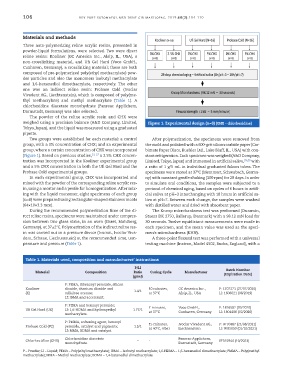
           weighed using a precision balance (A&D Company, Limited,   Figure 1. Experimental design (n=8) [CHX – chlorhexidine]
           Tokyo, Japan), and the liquid was measured using a graduated
           pipette.
             Two groups were established for each material: a control   After polymerization, the specimens were removed from
           group, with a 0% concentration of CHX; and an experimental   the mold and polished with a 600-grit silicon carbide paper (Car-
           group, where a certain concentration of CHX was incorporated   bimate Paper Discs, Buehler Ltd., Lake Bluff, IL., USA) with con-
           (Figure 1). Based on previous studies, 31-37  a 2.5% CHX concen-  stant refrigeration. Each specimen was weighed (A&D Company,
           tration was incorporated in the Kooliner experimental group   Limited, Tokyo, Japan) and immersed in artificial saliva, 35,40  with
           and a 5% CHX concentration in both the Ufi Gel Hard and the   a ratio of 1 g/5 mL in individual graduated falcon tubes. The
           Probase Cold experimental groups.                  specimens were stored at 37ºC (Memmert, Schwabach, Germa-
             In each experimental group, CHX was incorporated and   ny) with constant gentle shaking (300 rpm) for 28 days. In order
           mixed with the powder of the corresponding reline acrylic res-  to simulate oral conditions, the samples were subjected to a
           in, using a mortar and a pestle for homogenization. After mix-  protocol of chemical aging, based on cycles of 6 hours in artifi-
           ing with the liquid monomer, eight specimens of each group   cial saliva at pH=3 interchanging with 18 hours in artificial sa-
           (n=8) were prepared using rectangular-shaped stainless molds   liva at pH=7. Between each change, the samples were washed
           (64×10×3.3 mm).                                    with distilled water and dried with absorbent paper.
             During the recommended polymerization time of the di-  The Knoop microhardness test was performed (Duramin,
           rect reline resins, specimens were maintained under compres-  Stuers DK 2750, Ballerup, Denmark) with a 98.12 mN load for
           sion between two glass slabs, in an oven (Ehret, Mahlberg,   30 seconds. Twelve equidistant measurements were made in
           Germany), at 37±2ºC. Polymerization of the indirect reline res-  each specimen, and the mean value was used as the speci-
           in was carried out in a pressure device (Ivomat, Ivoclar Viva-  men’s microhardness (KHN).
           dent, Schaan, Liechtenstein) at the recommended time, tem-  A three-point flexural test was performed with a universal
           perature and pressure (Table 1).                   testing machine (Instron, Model 4502, Bucks, England), with a


            Table 1. Materials used, composition and manufacturers’ instructions
                                                          P/LI
                Material             Composition         Ratio  Curing Cycle  Manufacturer      Batch Number
                                                         (g/ml)                                (Expiration Date)
                            P: PEMA, dibenzoyl peroxide, silicon
            Kooliner        dioxide, titanium dioxide and      10 minutes,    GC America Inc.,   P: 1707271 (27/07/2020)
            (K)             cellulose acetate;           1.4/1  at 37ºC     Alsip, IL., USA  LI: 1608021 (08/2019)
                            LI: IBMA and accelerant.
                            P: PEMA and benzoyl peroxide;      7 minutes,    Voco GmbH.,     P: 1816582 (09/2020)
            Ufi Gel Hard (UG)  LI: 1,6-HDMA and hydroxyethyl   1.77/1  at 37ºC  Cuxhaven, Germany  LI: 1804406 (02/2020)
                            methacrylate.

                            P: PMMA, softening agent, benzoyl   15 minutes,    Ivoclar Vivadent AG.,   P: WT0487 (21/08/2021)
            Probase Cold (PC)  peroxide, catalyst and pigments;  1.5/1  at 40ºC, 4 bar  Liechtenstein  LI: W85050 (01/10/2021)
                            LI: MMA, BDMA and catalyst.
                            Chlorhexidine diacetate                         Panreac Applichem,
            Chlorhexidine (CHX)                           –    -                             8F015944 (10/2023)
                            monohydrate.                                    Darmstadt, Germany
           P – Powder; LI – Liquid; PEMA – Poly(ethyl methacrylate); IBMA – Isobutyl methacrylate; 1,6-HDMA – 1,6-hexanediol dimethacrylate; PMMA – Poly(methyl
           methacrylate); MMA – Methyl methacrylate; BDMA – 1,4-butanediol dimethacrylate

