


Page 10 - SPEMD_60-3
P. 10
98                      rev port estomatol med dent cir maxilofac. 2019;60(3):96-103


           less, dentin bond strength mediated by ultra-mild and inter-  tal, Zeist, Netherlands). The occlusal surfaces were cut with a
           mediately strong universal adhesives decrease significantly   diamond saw perpendicularly to the long axis of the tooth
           with aging, particularly when an etch-and-rinse strategy is   (Accutom 5, Struers, Ballerup, Denmark), under water-cool-
           employed. 9                                        ing, thereby exposing a flat mid-coronal dentin surface. All
             The instability of the dentin adhesive interfaces of simpli-  exposed surfaces were wet-ground with a sequence of 200–,
           fied one-step self-etch and universal adhesives has been at-  400- and 600-grit silicon-carbide sandpaper in a circular mo-
           tributed to the presence of permeable hybrid layers that allow   tion for 60 seconds each to standardize smear layer prepara-
                                                                  21
           the circulation of water throughout the interface after polym-  tion,  and were carefully observed under a stereomicroscope
                                                                   ®
           erization. This permeability favors water sorption by polymers   (Nikon   SMZ  1500, Tokyo,  Japan)  to  confirm  the  absence  of
           and progressive hydrolytic and enzymatic degradation of the   residual enamel and other defects.
           unprotected collagen by matrix metalloproteinases (MMPs). 14-16    The teeth were randomly assigned to two groups (n=6). In
           To overcome these problems, modified adhesive formulations   group I (SBU), dentin adhesive procedures were performed ac-
           and/or application techniques have been evaluated. 16-20  The use   cording to the manufacturer’s directions with a multi-mode
           of an extra hydrophobic resin coat after universal adhesive ap-  adhesive system in the self-etch mode: Scotchbond TM  Univer-
           plication aims to increase the thickness of the adhesive layer   sal Adhesive (3M ESPE, St. Paul, MN, USA). In group II (SBU+HL),
           and homogenize it, as well as reduce the fluid flow across the   bonding procedures started similarly, but an additional hydro-
           adhesive interface and decelerate bond degradation. 20  phobic resin layer (Adper TM  Scotchbond TM  Multi-Purpose Ad-
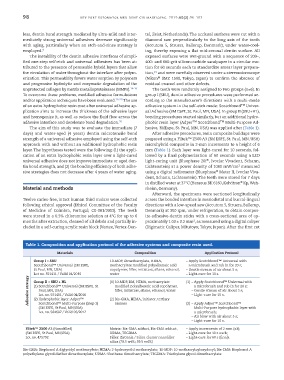
             The aim of this study was to evaluate the immediate (7   hesive, 3MEspe, St. Paul, MN, USA) was applied after (Table 1).
           days) and  water-aged (4 years) dentin  microtensile  bond   After adhesive procedures, resin composite buildups were
           strength of a universal adhesive employed using the self-etch   prepared using a Filtek™ Z500 A3 (3M ESPE, St. Paul, MN, USA)
           approach with and without an additional hydrophobic resin   microhybrid composite in 2-mm increments to a height of 6
           layer. The hypotheses tested were the following: (1) the appli-  mm (Table 1). Each layer was light-cured for 10 seconds, fol-
           cation of an extra hydrophobic resin layer over a light-cured   lowed by a final polymerization of 60 seconds using a LED
                                                                                        ®
           universal adhesive does not improve immediate or aged den-  light-curing unit (Bluephase 20i , Ivoclar Vivadent, Schann,
                                                                                                     2
           tin bond strength, and (2) the bonding efficiency of both adhe-  Lichtenstein) at a power density of 1080 mW/cm measured
                                                                                            ®
           sive strategies does not decrease after 4 years of water aging.  using a digital radiometer (Bluephase  Meter II, Ivoclar Viva-
                                                              dent, Schann, Lichtenstein). The teeth were stored for 7 days
                                                              in distilled water at 37°C (Heraeus BK 6160, Kelvitron  Kp, Weh-
                                                                                                      ®
           Material and methods                               rheim, Germany).
                                                                 Afterward, the specimens were sectioned longitudinally
           Twelve caries-free, intact human third molars were collected   across the bonded interface in mesiodistal and buccal-lingual
           following ethical approval (Ethical Committee of the Faculty   directions with a low-speed saw (Accutom 5, Struers, Ballerup,
           of Medicine of Coimbra, Portugal; CE-001/2013).  The teeth   Denmark) at 300 rpm, under refrigeration, to obtain compos-
           were stored in a 0.5% chloramine solution at 4ºC for up to 6   ite-adhesive-dentin sticks with a cross-sectional area of ap-
                                                                                  2
           months after extraction, cleaned of all debris and partially in-  proximately 1.00 ± 0.2 mm , as measured using a digital caliper
           cluded in a self-curing acrylic resin block (Vertex, Vertex-Den-  (Digimatic Caliper, Mitutoyo; Tokyo; Japan). After the first cut


            Table 1. Composition and application protocol of the adhesive systems and composite resin used.

                         Materials                       Composition                   Application Protocol
               Group I – SBU                   10-MDP, Dimethacrylate, HEMA,   –  Apply Scotchbond™ Universal with
               Scotchbond™ Universal (3M ESPE,    methacrylate modified polyalkenoic acid   a microbrush and rub in for 20 s;
               St Paul, MN, USA)               copolymer, filler, initiators, silane, ethanol,   – Gentle stream of air about 5 s;
               Lot no. 551411 / Valid 04/2016  water                           – Light-cure for 10 s.
             Adhesive strategy  (1)  Scotchbond™ Universal (3M ESPE, St   (2)  Bis-GMA, HEMA, initiator, tertiary        – Gentle stream of air about 5 s;
                                               (1)  10-MDP, DM, HEMA, methacrylate
                                                                               (1)  –  Apply Scotchbond™ Universal with
               Group II – SBU + HL
                                                                                  a microbrush and rub in for 20 s;
                                                 modified polyalkenoic acid copolymer,
                 Paul, MN, USA)
                                                 filler, initiators, silane, ethanol, water
                                                                                 – Light-cure for 10 s.
                 Lot no. 551411 / Valid 04/2016
               (2)  Hydrophobic layer: Adper™
                 Scotchbond™ Multi-Purpose (Step 2)
                                                                                  Multi-Purpose hydrophobic layer with
                 (3M ESPE, St Paul, MN,USA)      amines                        (2)  –  Apply Adper™ Scotchbond™
                 Lot no. 564607 / Valid 03/2017                                   a microbrush;
                                                                                  – Air blow with air about 5 s;
                                                                                  – Light-cure for 10 s.
            Filtek™ Z500 A3 (Nanofilled)       Matrix: Bis-GMA adduct, Bis-EMA adduct,   – Apply increments of 2 mm (x3);
            (3M ESPE, St Paul, MN,USA)         UDMA, TEGDMA                    – Light-cure for 10 s each;
            Lot no. 475792                     Filler: Zirconia / Silica cluster nanofiller   – Light-cure for 60 s (final).
                                               silica (78.5 wt%; 59.5 vol%)
           Bis-GMA: Bisphenol A diglycidyl methacrylate; HEMA: 2-hydroxyethl methacrylate; 10-MDP: 10-methacryloyloxydecyl; Bis-EMA: Bisphenol A
           polyethylene glycol diether dimethacrylate; UDMA: Urethane dimethacrylate; TEGDMA: Triethylene glycol dimethacrylate

