


Page 34 - SPEMD_58-4
P. 34
222                    rev port estomatol med dent cir maxilofac. 2017;58(4):219-224


           differences between the groups; the comparisons between   Table 2. P-values for group-to-group comparisons
           pairs were made  using  the  Mann-Whitney  test. The  Krus-  of shear strength, using the Mann-Whitney test.
           kal-Wallis and Mann-Whitney tests were also used to verify the
           differences in ARI scores between the groups. The adopted lev-  Groups  2  3  4  5  6    7     8
           el of significance was 5% (α=0.05). The data were tabulated and   1  <0.001  <0.001* <0.001*  0.003  0.001  <0.001* <0.001*
           analyzed in the software program IBM SPSS Statistics for Win-
           dows (IBM SPSS. 21.0, 2012, Armonk, NY: IBM Corp.).   2         0.494  0.130  0.141  0.756  0.852  0.002
                                                                 3               0.178  0.111  0.950  0.443  0.001
           Results                                               4                     0.002  0.330  0.044  0.011
                                                                 5                           0.120  0.085  <0.001*
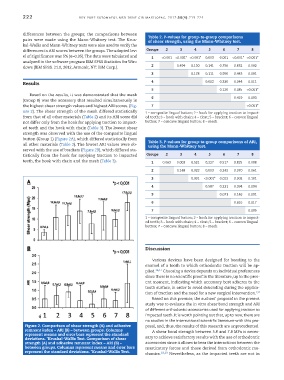
             Based on the results, it was demonstrated that the mesh
           (Group 8) was the accessory that resulted simultaneously in   6                         0.419  0.003
           the highest shear strength values and highest ARI scores. (Fig-  7                           <0.001*
           ure 2). The shear strength of the mesh differed statistically   1 – composite lingual button; 2 – hook for applying traction to impact-
           from that of all other materials (Table 2) and its ARI score did   ed teeth; 3 – hook with chain; 4 – cleat; 5 – bracket; 6 – convex lingual
           not differ only from the hook for applying traction to impact-  button; 7 – concave lingual button; 8 – mesh.
           ed teeth and the hook with chain (Table 3). The lowest shear
           strength was observed with the use of the composite lingual
           button (Group 1) (Figure 2A), which differed statistically from   Table 3. P-values for group-to-group comparisons of ARI,
           all other materials (Table 2). The lowest ARI values were ob-  using the Mann-Whitney test.
           served with the use of brackets (Figure 2B), which differed sta-
           tistically from the hook for applying traction to impacted   Groups  2  3  4  5    6     7     8
           teeth, the hook with chain and the mesh (Table 3).    1   0.063  0.003  0.521  0.227  0.517  0.825  0.008

                                                                 2         0.148  0.022  0.003  0.242  0.070  0.061
                                                                 3               0.001  <0.001*  0.022  0.002  0.181
                                                                 4                     0.587  0.231  0.394  0.004
                                                                 5                           0.071  0.146  0.001
                                                                 6                                 0.616  0.017
                                                                 7                                       0.005
                                                              1 – composite lingual button; 2 – hook for applying traction to impact-
                                                              ed teeth; 3 – hook with chain; 4 – cleat; 5 – bracket; 6 – convex lingual
                                                              button; 7 – concave lingual button; 8 – mesh.


                                                              Discussion

                                                                 Various devices have been designed for bonding to the
                                                              enamel of a tooth to which orthodontic traction will be ap-
                                                              plied. 14,17  Choosing a device depends on individual preferences
                                                              since there is no scientific proof in the literature, up to the pres-
                                                              ent moment, indicating which accessory best adheres to the
                                                              tooth surface, in order to avoid debonding during the applica-
                                                              tion of traction and the need for a new surgical intervention. 7,8
                                                                 Based on this premise, the authors’ proposal in the present
                                                              study was to evaluate the in vitro shear bond strength and ARI
                                                              of different orthodontic accessories used for applying traction to
                                                              impacted teeth. It is worth pointing out that, up to now, there are
                                                              no studies in the international scientific literature with this pro-
           Figure 2. Comparison of shear strength (A) and adhesive   posal, and, thus, the results of this research are unprecedented.
           remnant index – ARI (B) – between groups. Columns     A shear bond strength between 5.8 and 7.8 MPa is neces-
           represent means and error bars represent the standard
           deviations. *Kruskal-Wallis Test. Comparison of shear   sary to achieve satisfactory results with the use of orthodontic
           strength (A) and adhesive remnant index – ARI (B) –   accessories since it allows to bear the interactions between the
           between groups. Columns represent means and error bars   masticatory forces and those derived from orthodontic me-
           represent the standard deviations. *Kruskal-Wallis Test.  18,19
                                                              chanics.   Nevertheless, as the impacted teeth are not in

