


Page 33 - SPEMD_58-4
P. 33
rev port estomatol med dent cir maxilofac . 2017;58(4):219-224         221


           stored in a glass receptacle in a 10% formaldehyde solution for   Table 1. Experimental groups according to the accessory
           seven days and kept refrigerated.                    used, composition, fabrication and manufacturing lot.
              The minimum sample size required for this study was cal-
           culated using the following parameters: a test power of 80% (β   Groups  Accessories   Composition  Brand  Lot
           = 0.20) and an error of 5% (α=0.05). The calculation determined   Used
           a minimum sample size of 12 samples. Considering the possi-  1  Lingual button    Polycarbonate    Morelli  1801732
           bility of using non-parametric statistics (Friedman test), an in-  Composite  with glass fiber
           crease of 20% was applied, which resulted in the adjustment of   Hook for
           the minimum size required for 15 individuals. The sample cal-  2  traction    Stainless Steel  Morelli  1767974
           culation was performed in G*Power (version 3.1.9.2, Germany).  in impacted
              The teeth were embedded in PVC rings (Tigre, Joinville, Bra-  teeth
           zil) with acrylic resin (Clássico, São Paulo, Brazil) so that only   3  Hook with chain  Stainless Steel  Morelli  1809417
           their crowns were exposed. In order to maintain the surface
           to be glued to the bracket perpendicular to the ground, a   4  Cleat     Stainless Steel  Morelli  1827790
           square was used for standardization. After polymerizing the   5  Brackets  Stainless Steel  Morelli  1828477
           resin, all the test specimens were stored in distilled water and   Convex lingual
           again placed in the refrigerator at 5ºC.               6   button        Stainless Steel  Morelli  1809815
              The vestibular surfaces of the teeth received prophylaxis
           with a rubber cup (Viking, KG Sorensen, Barueri, Brazil), an   7  Concave lingual   Stainless Steel  Morelli  1834886
                                                                      button
           extra-fine pumice stone (S.S.White, Juiz de Fora, Brazil) and
           distilled water for 15 seconds. Afterwards, they were washed   8  Mesh   Plaited wires    Morelli  1430356
           with air spray/distilled water and dried with oil- and humidi-           Stainless Steel
           ty-free jets of air for the same length of time. After prophylax-
           is, etching was performed with 37% phosphoric acid (FGM,
           Joinville, Brazil) for 30 seconds, followed by washing with wa-  the mesh was placed on the tooth surface coupled with an
           ter and drying with jets of air for the same period. A thin coat   elastic, and the interior of the elastic was filled with orthodon-
           of primer (Transbond XT; 3M Unitek, Monrovia, California,   tic composite (Transbond XT, Monrovia, USA).
           USA) was applied and light polymerized for 40 seconds.  The next step was light polymerization for 40 seconds with
              Before the bonding process, the teeth were randomly di-  the light-polymerization device XL 1500 (3M Unitek, Monrovia,
           vided into groups corresponding to the accessory that would   CA, USA), using a light intensity of 400 mW/cm², regularly
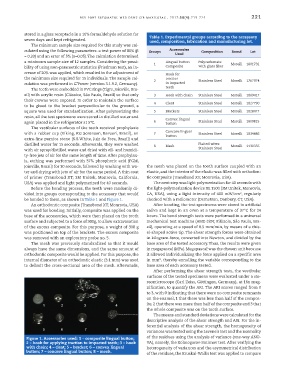
           be bonded to them, as shown in Table 1 and Figure 1.  checked with a radiometer (Demetron, Danbury, CT, USA).
              An orthodontic composite (Transbond XT, Monrovia, USA)   After bonding, the test specimens were stored in artificial
           was used for bonding. Initially, composite was applied on the   saliva and kept in an oven at a temperature of 37°C for 24
           base of the accessories, which were then placed on the tooth   hours. The bond strength tests were performed in a universal
           surface and subjected to a force of 300g, to allow extravasation   mechanical test machine (AME-2kN; Fillizola, São Paulo, Bra-
           of the excess composite. For this purpose, a weight of 300 g   zil), operating at a speed of 0.5 mm/min, by means of a chis-
           was positioned on top of the brackets. The excess composite   el-shaped active tip. The shear strength forces were obtained
           was removed with an exploratory probe no. 5.        in kilogram-force, converted into Newton, and divided by the
              The mesh was previously standardized so that it would   base area of the tested accessory. Thus, the results were given
           always have the same dimensions, and the same amount of   in megapascal (MPa). Megapascal was the chosen unit because
           orthodontic composite would be applied. For this purpose, the   it allowed individualizing the force applied on a specific area
           internal diameter of an orthodontic elastic (3.1 mm) was used   in mm², thereby annulling the variable corresponding to the
           to delimit the cross-sectional area of the mesh. Afterwards,   base area of each accessory tested.
                                                                 After performing the shear strength tests, the vestibular
                                                               surfaces of the tested specimens were evaluated under a ste-
                                                               reomicroscope (Carl Zeiss, Göttingen, Germany), at 16x mag-
                                                               nification, to quantify the ARI. The ARI scores ranged from 0
                                                               to 3, with 0 indicating that there were no composite remnants
                                                               on the enamel, 1 that there was less than half of the compos-
                                                               ite, 2 that there was more than half of the composite and 3 that
                                                               the whole composite was on the tooth surface.
                                                                 The means and standard deviations were calculated for the
                                                               descriptive analysis of the shear strength and ARI. For the in-
                                                               ferential analysis of the shear strength, the homogeneity of
                                                               variances was tested using the Levene’s test and the normality
            Figure 1. Accessories used: 1 – composite lingual button;   of the residues using the analysis of variance (one-way ANO-
            2 – hook for applying traction to impacted teeth; 3 – hook   VA), namely, the Kolmogorov-Smirnov test. After verifying the
            with chain; 4 – cleat; 5 – bracket; 6 – convex lingual   heterogeneity of variances and the asymmetrical distribution
            button; 7 – concave lingual button; 8 – mesh.      of the residues, the Kruskal-Wallis test was applied to compare

