


Page 28 - SPEMD_59-1
P. 28
20                      rev port estomatol med dent cir maxilofac. 2018;59(1):18-23


             An intra-oral observation (Appendix 2) was also conducted   In the examined military sample, the prevalence of dental
           to determine the decayed, missing, and filled permanent teeth   caries was 51.6%±7.4% (mean ± standard deviation) with a con-
           index (DMFT index), which indicates the experience of dental   fidence interval of 95%. These values mean that the prevalence
           caries and dental treatments (extraction or restoration due to   of dental caries was in the range of 44.2%-59.1% with a confi-
           dental caries). The Silness and Löe plaque index (1964) was   dence of 95%. The DMFT index in our sample was 4.6±3.5. Al-
           used to record the dental plaque in the sample studied. 18-20    though third molars are not included in the DMFT, in our sam-
           The plaque index’s score is determined based on the amount   ple, the lower third molars (teeth 38 and 48) were the teeth
           of dental plaque at the gingival margin, which is assessed by   most severely affected by dental caries. However, according to
           passing a WHO probe across the gingival margin.    the DMFT index, we can consider that the prevalence of dental
             The questionnaires were given to all army personnel avail-  caries was higher in the first and second molars (37, 36, 47, 16).
           able in the Regiment on a given day previously set by the Army   Eighty army soldiers (65.6%) had fillings, which were most
           Chief of State. The questionnaires were collected immediately   prevalent on teeth 36 and 46 (41.8%). Regarding the “missing”
           after they were completed, following the intra-oral examina-  component of the DMFT, which means that at least one tooth
           tion. The subjects were examined by a group of dental students   was lost due to dental caries, the prevalence was 32%, and the
           supervised by a military dentist in a military ward, using a   first lower molars were the most affected teeth (21.3%).
           mouth mirror and a WHO probe. The observers were trained   The most prevalent score of the Silness and Löe plaque
           and calibrated according to the diagnostic criteria for dental   index was score 2 – visible plaque (58.2%), as shown in Table 2.
           caries set out by the WHO. 21                         Concerning oral-hygiene habits, as shown in Table 3, 65.6%
             Permission to carry out the study was obtained from the   of the sample brushed their teeth at least twice a day, and only
           Army Chief of State. All the participants agreed to and autho-  4.1% did not brush their teeth daily. Nearly 27.9% brushed their
           rized this study, and signed an informed consent.  teeth after meals. The use of dental floss was very low (18%).
             The data were analyzed using the software Statistical Pack-  When we grouped the sample according to their age (≥25 years
           age for Social Sciences (SPSS) 23.0 for Windows (SPSS Inc, Chi-  and <25 years), statistical differences were found regarding the
           cago, IL, USA). The results of this study were analyzed using   use of dental floss (P=0.045; Cramér’s V=0.181). The relation-
           descriptive statistics. The level of significance (α) was set at 5%   ship was weak (18.1%), but significant, since army soldiers
           (0.05). The chi-square test was used to analyze the association   with more than 25 years old tended to use dental floss more.
           between qualitative variables. The intensity of the relationship   The analysis of the use of dental floss and the plaque index
           between the variables was obtained by the Cramér’s V.  revealed statistical differences (P=0.010; Cramér’s V=0.234).
                                                              Accordingly, the Silness and Löe plaque index was higher
                                                              (scores 2 and 3) among those who did not use dental floss
           Results                                            comparing with those who did. This association was weak
                                                              (23.4%), but significant.
           In total, 127 army soldiers were observed, but only 122 filled   Moreover, only 64.8% of the sample used fluoride tooth-
           the questionnaire correctly.  The remaining five question-  paste, although 22.1% did not know if their toothpaste con-
           naires were considered invalid because either they were not   tained fluoride. There was also a significant relationship be-
           correctly filled or they were not completely filled. The final   tween the use of fluoride toothpaste and the prevalence of
           sample examined included 122 (95.9% male) of the 408 mili-  dental caries (P=0.034; Cramér’s V=0,236), as those who used
           taries of the Infantry Regiment no. 14 of Viseu, Portugal, corre-  fluoride toothpaste seemed to have a lower risk of dental caries.
           sponding to a response rate of 29.9%. This relatively low num-  Nearly 45.9% of the sample were current smokers.
           ber was a result of many militaries being on missions overseas   Less than half of the sample (45.1%) had visited the dentist
           or posted to do tasks outside the Regiment.        in the previous six months. On the other hand, 18.9% of the
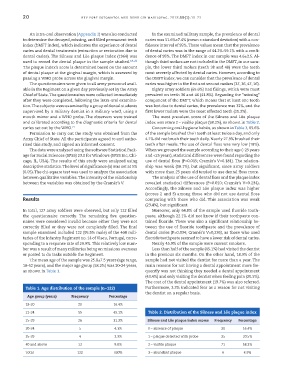
             The mean age of the sample was 25.8±7.5 years (age range,   sample had not visited the dentist for more than a year. The
           18-52 years), and the major age group (58.2%) was 20-24 years,   main reasons for not having a dental appointment more fre-
           as shown in Table 1.                               quently was not thinking they needed a dental appointment
                                                              (43.4%) and only visiting the dentist when feeling pain (20.5%).
                                                              The cost of the dental appointment (19.7%) was also referred.
            Table 1. Age distribution of the sample (n=122)   Furthermore, 3.3% indicated fear as a reason for not visiting
                                                              the dentist on a regular basis.
            Age group (years)  Frequency       Percentage
            18-20                 20             16.4%
            21-24                 55             45.1%         Table 2. Distribution of the Silness and Löe plaque index
            25-29                 26             21.3%         Silness and Löe plaque index scores  Frequency  Percentage
            30-34                 5              4.1%          0 – absence of plaque          20       16.4%
            35-39                 4              3.3%          1 – plaque detected with probe  25      20.5%
            40 and above          12             9.8%          2 – visible plaque             71       58.2%

            Total                122             100%          3 – abundant plaque            6        4.9%

