


Page 19 - SPEMD_67-1
P. 19
rev port estomatol med dent cir maxilofac . 2026;67(1):11-20             13


           being from the Air Force General Staff (21.4%), Air Base 1   (28.3%) (Figure 1). Most military personnel reported brushing
           (10.8%), Air Base 6 (12.2%), and the Lisbon Pole of the Armed   their teeth at least twice daily (81.9%) with fluoride toothpaste
           Forces Hospital (8.3%).                             (88.6%). Only 12.8% reported flossing daily (Table 3). The most
              The mean HUDBI score was 6.82 (SD=1.61), with a median   common time for brushing was “before going to bed” (81.1%)
           of 7 (range: 1–10). The items with the highest percentage of   (Figure 2). A significant association was found between the
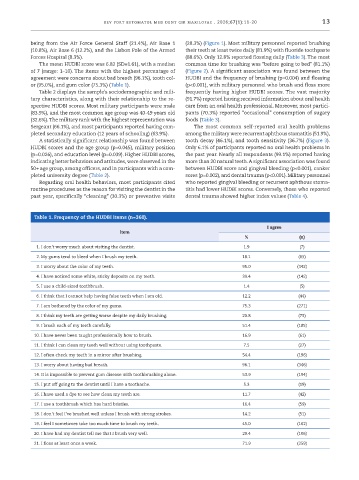
           agreement were concerns about bad breath (96.1%), tooth col-  HUDBI and the frequency of brushing (p=0.004) and flossing
           or (95.0%), and gum color (75.3%) (Table 1).        (p<0.001), with military personnel who brush and floss more
              Table 2 displays the sample’s sociodemographic and mili-  frequently having higher HUDBI scores. The vast majority
           tary characteristics, along with their relationship to the re-  (91.7%) reported having received information about oral health
           spective HUDBI scores. Most military participants were male   care from an oral health professional. Moreover, most partici-
           (83.9%), and the most common age group was 40-49 years old   pants (70.3%) reported “occasional” consumption of sugary
           (32.6%). The military rank with the highest representation was   foods (Table 3).
           Sergeant (66.1%), and most participants reported having com-  The most common self-reported oral health problems
           pleted secondary education (12 years of schooling) (63.9%).  among the military were recurrent aphthous stomatitis (51.9%),
              A statistically significant relationship was found between   tooth decay (46.1%), and tooth sensitivity (36.7%) (Figure 3).
           HUDBI scores and the age group (p=0.045), military position   Only 6.1% of participants reported no oral health problems in
           (p=0.026), and education level (p=0.039). Higher HUDBI scores,   the past year. Nearly all respondents (99.1%) reported having
           indicating better behaviors and attitudes, were observed in the   more than 20 natural teeth. A significant association was found
           50+ age group, among officers, and in participants with a com-  between HUDBI score and gingival bleeding (p<0.001), canker
           pleted university degree (Table 2).                 sores (p=0.002), and dental trauma (p<0.001). Military personnel
              Regarding oral health behaviors, most participants cited   who reported gingival bleeding or recurrent aphthous stoma-
           routine procedures as the reason for visiting the dentist in the   titis had lower HUDBI scores. Conversely, those who reported
           past year, specifically “cleaning” (30.3%) or preventive visits   dental trauma showed higher index values (Table 4).


            Table 1. Frequency of the HUDBI items (n=360).
                                                                                          I agree
                                         Item
                                                                                  %                 (n)
              1. I don’t worry much about visiting the dentist.                   1.9               (7)
              2. My gums tend to bleed when I brush my teeth.                    18.1               (65)

              3. I worry about the color of my teeth.                            95.0               (342)
              4. I have noticed some white, sticky deposits on my teeth.         39.4               (142)
              5. I use a child-sized toothbrush.                                  1.4               (5)
              6. I think that I cannot help having false teeth when I am old.    12.2               (44)
              7. I am bothered by the color of my gums.                          75.3               (271)
              8. I think my teeth are getting worse despite my daily brushing.   20.8               (75)
              9. I brush each of my teeth carefully.                             51.4               (185)
            10. I have never been taught professionally how to brush.            16.9               (61)
            11. I think I can clean my teeth well without using toothpaste.       7.5               (27)
            12. I often check my teeth in a mirror after brushing.               54.4               (196)
            13. I worry about having bad breath.                                 96.1               (346)
            14. It is impossible to prevent gum disease with toothbrushing alone.  53.9             (194)
            15. I put off going to the dentist until I have a toothache.          5.3               (19)
            16. I have used a dye to see how clean my teeth are.                 11.7               (42)
            17. I use a toothbrush which has hard bristles.                      16.4               (59)
            18. I don’t feel I’ve brushed well unless I brush with strong strokes.  14.2            (51)
            19. I feel I sometimes take too much time to brush my teeth.         45.0               (162)
            20. I have had my dentist tell me that I brush very well.            29.4               (106)
            21. I floss at least once a week.                                    71.9               (259)

