


Page 13 - SPEMD_67-1
P. 13
rev port estomatol med dent cir maxilofac . 2026;67(1):2-10              7


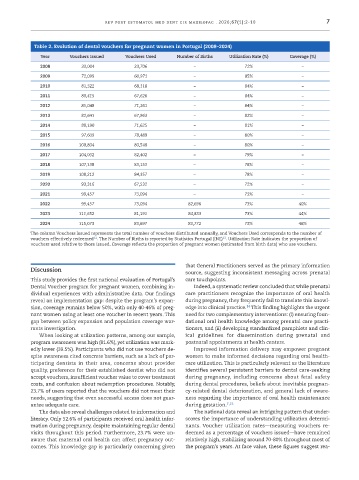
            Table 2. Evolution of dental vouchers for pregnant women in Portugal (2008–2024)
              Year      Vouchers Issued    Vouchers Used    Number of Births  Utilization Rate (%)  Coverage (%)
              2008           33,004           23,706             –                72%                –
              2009           72,099           60,971             –                85%                –
              2010           81,322           68,118             –                84%                –
              2011           80,415           67,626             –                84%                –
              2012           85,048           71,261             –                84%                –
              2013           82,641           67,963             –                82%                –
              2014           88,190           71,625             –                81%                –
              2015           97,609           78,489             –                80%                –
              2016         100,804            80,548             –                80%                –

              2017         104,032            82,402             –                79%                –
              2018         107,138            83,153             –                78%                –
              2019         108,212            84,357             –                78%                –
              2020           93,316           67,532             –                72%                –
              2021           99,457           73,094             –                73%                –
              2022           99,457           73,094           82,696             73%               40%
              2023         111,652            81,191           84,833             73%               44%
              2024         115,073            83,697           83,772             73%               46%
           The column Vouchers Issued represents the total number of vouchers distributed annually, and Vouchers Used corresponds to the number of
                                                                           13
                                12
           vouchers effectively redeemed . The Number of Births is reported by Statistics Portugal (INE) . Utilization Rate indicates the proportion of
           vouchers used relative to those issued. Coverage reflects the proportion of pregnant women (estimated from birth data) who use vouchers.
                                                               that General Practitioners served as the primary information
           Discussion
                                                               source, suggesting inconsistent messaging across prenatal
           This study provides the first national evaluation of Portugal’s   care touchpoints.
           Dental Voucher program for pregnant women, combining in-  Indeed, a systematic review concluded that while prenatal
           dividual experiences with administrative data. Our findings   care practitioners recognize the importance of oral health
           reveal an implementation gap: despite the program’s expan-  during pregnancy, they frequently fail to translate this knowl-
                                                                                   14
           sion, coverage remains below 50%, with only 40-46% of preg-  edge into clinical practice.  This finding highlights the urgent
           nant women using at least one voucher in recent years. This   need for two complementary interventions: (i) ensuring foun-
           gap between policy expansion and population coverage war-  dational oral health knowledge among prenatal care practi-
           rants investigation.                                tioners, and (ii) developing standardized pamphlets and clin-
              When looking at utilization patterns, among our sample,   ical guidelines for dissemination during prenatal and
           program awareness was high (81.6%), yet utilization was mark-  postnatal appointments at health centers.
           edly lower (39.5%). Participants who did not use vouchers de-  Improved information delivery may empower pregnant
           spite awareness cited concrete barriers, such as a lack of par-  women to make informed decisions regarding oral health-
           ticipating dentists in their area, concerns about provider   care utilization. This is particularly relevant as the literature
           quality, preference for their established dentist who did not   identifies several persistent barriers to dental care-seeking
           accept vouchers, insufficient voucher value to cover treatment   during pregnancy, including concerns about fetal safety
           costs, and confusion about redemption procedures. Notably,   during dental procedures, beliefs about inevitable pregnan-
           23.7% of users reported that the vouchers did not meet their   cy-related dental deterioration, and general lack of aware-
           needs, suggesting that even successful access does not guar-  ness regarding the importance of oral health maintenance
           antee adequate care.                                during gestation. 7,15
              The data also reveal challenges related to information and   The national data reveal an intriguing pattern that under-
           literacy. Only 52.6% of participants received oral health infor-  scores the importance of understanding utilization determi-
           mation during pregnancy, despite maintaining regular dental   nants. Voucher  utilization  rates—measuring vouchers  re-
           visits throughout this period. Furthermore, 23.7% were un-  deemed as a percentage of vouchers issued—have remained
           aware that maternal oral health can affect pregnancy out-  relatively high, stabilizing around 70-80% throughout most of
           comes. This knowledge gap is particularly concerning given   the program’s years. At face value, these figures suggest rea-

