


Page 9 - SPEMD_61-2
P. 9
rev port estomatol med dent cir maxilofac . 2020;61(2):45-51             47


              Over recent years, the industry has evolved toward produc-  was conducted in full compliance with the World Medical As-
           ing more portable and friendlier CES devices. GrindCare   sociation Declaration of Helsinki and its most recent amend-
           (GrindCare, Medotech A/S, Denmark) consists of a biofeedback   ments, following the approved clinical practice guidelines.
           device capable of measuring electromyography (EMG) activity   When accepted into the study, patients were randomly al-
           of the anterior temporalis muscle, by emitting a painless elec-  located to Group I or Group II by a computer -generated ran-
           trical pulse to the temporal region when EMG activity exceeds   domization software (GraphPad Quick -Calcs website: http://
           the individually determined threshold. 14           www.graphpad. com/quickcalcs/randomize1.cfm). The code
              The aim of this randomized clinical trial was to evaluate   for randomization was kept in a sealed envelope and opened
           the effect of 4 - and 8 -week treatment protocols with CES on   only at the end of the study. Data were analyzed by a third
           pain symptoms, EMG activity (in the anterior temporalis mus-  party blinded to the allocation results, which were referred to
           cle), and threshold intensity when grinding (per night) on SB   as treatment I or II in the SPSS worksheet (SPSS, Inc., Chicago,
           patients with myofascial pain.                      IL, USA). The medical record was assessed by a single trained
                                                               and calibrated researcher according to previously established
                                                               methods (Dworkin and LeResche 1992 – RDC -TMD 1992).
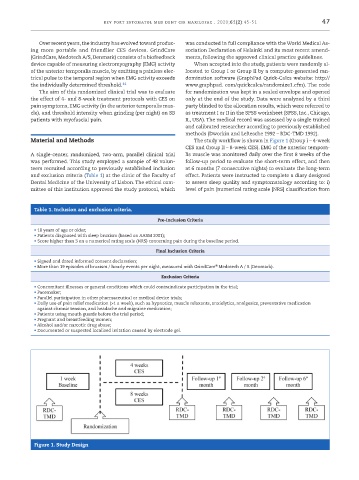
           Material and Methods                                  The study workflow is shown in Figure 1 (Group I – 4 -week
                                                               CES and Group II – 8 -week CES). EMG of the anterior tempora-
           A single -center, randomized, two -arm, parallel clinical trial   lis muscle was monitored daily over the first 8 weeks of the
           was performed. This study employed a sample of 48 volun-  follow -up period to evaluate the short -term effect, and then
           teers recruited according to previously established inclusion   at 6 months (7 consecutive nights) to evaluate the long -term
           and exclusion criteria (Table 1) at the clinic of the Faculty of   effect. Patients were instructed to complete a diary designed
           Dental Medicine of the University of Lisbon. The ethical com-  to assess sleep quality and symptomatology according to: i)
           mittee of this institution approved the study protocol, which   level of pain (numerical rating scale [NRS] classification from


            Table 1. Inclusion and exclusion criteria.
                                                     Pre ‑Inclusion Criteria
            •  18 years of age or older;
            •  Patients diagnosed with sleep bruxism (based on AASM 2001);
            •  Score higher than 3 on a numerical rating scale (NRS) concerning pain during the baseline period.
                                                     Final Inclusion Criteria

            •  Signed and dated informed consent declaration;
                                                                        ®
            •  More than 19 episodes of bruxism / hourly events per night, measured with GrindCare Medotech A / S (Denmark).
                                                       Exclusion Criteria
            •  Concomitant illnesses or general conditions which could contraindicate participation in the trial;
            •  Pacemaker;
            •  Parallel participation in other pharmaceutical or medical device trials;
            •  Daily use of pain relief medication (>1 a week), such as hypnotics, muscle relaxants, anxiolytics, analgesics, preventative medication
             against chronic tension, and headache and migraine medication;
            •  Patients using mouth guards before the trial period;
            •  Pregnant and breastfeeding women;
            •  Alcohol and/or narcotic drug abuse;
            •  Documented or suspected localized irritation caused by electrode gel.


            Figure 1. Study Design

