


Page 10 - SPEMD_61-2
P. 10
48                      rev port estomatol med dent cir maxilofac. 2020;61(2):45-51


           0 -10), ii) fatigue and muscle tension (NRS classification from   -normal distribution (p<0.001). Whenever data were analyzed
           0 -10), iii) adverse events. The clinician calibrated each EMG   with this variable, non -parametric tests were used. The EMG/h,
           device individually on day 0, and each participant adjusted   pain score, and TI data were described. Baseline (1st week –
           stimulus intensity for CES daily.                  Bas) data was used to evaluate the correlation between pain
                                                         14
             The EMG device uses a signal recognition algorithm    score and EMG activity or TI parameters for the entire sample
           based on the signals collected from three electrode contacts.   using the appropriate tests (Pearson’s coefficient or Spear-
           An EMG episode is recorded when the amplitude of the EMG   man’s  rho tests).  Multiple  comparisons  between  variable
           signal exceeds the pre -defined threshold of more than 100 ms   means were performed using a t -test with the Bonferroni cor-
           for up to 1s. Longer -lasting EMG events are counted as addi-  rection. The level of significance was set at 5%.
           tional events.  The EMG activity was expressed as the number
                     22
           of grinds per hour of sleep (NG), by previously established
           methods. Briefly every night, participants were requested to   Results
           relax their jaw muscles for 10 s and then clench their teeth at
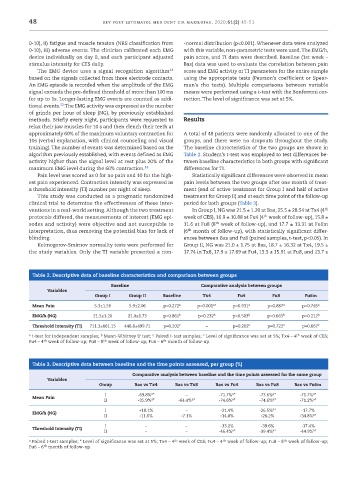
           approximately 60% of the maximum voluntary contraction for   A total of 48 patients were randomly allocated to one of the
           10s (verbal explanation, with clinical counseling and visual   groups, and there were no dropouts throughout the study.
           training). The number of events was determined based on the   The baseline characteristics of the two groups are shown in
           algorithm previously established, with events defined as EMG   Table 2. Student’s t -test was employed to test differences be-
           activity higher than the signal level at rest plus 20% of the   tween baseline characteristics in both groups with significant
           maximum EMG level during the 60% contraction. 14   differences for TI.
             Pain level was scored as 0 for no pain and 10 for the high-  Statistically significant differences were observed in mean
           est pain experienced. Contraction intensity was expressed as   pain levels between the two groups after one month of treat-
           a threshold intensity (TI) number per night of sleep.  ment (end of active treatment for Group I and half of active
             This study was conducted as a pragmatic randomized   treatment for Group II) and at each time point of the follow -up
           clinical trial to determine the effectiveness of these inter-  period for both groups (Table 3).
                                                                                                             th
           ventions in a real -world setting. Although the two treatment   In Group I, NG was 21.5 ± 1.20 at Bas, 25.5 ± 28.54 at Tx4 (4
                                                                                        th
           protocols differed, the measurements of interest (EMG epi-  week of CES), 16.9 ± 10.88 at Fu4 (4  week of follow -up), 15.8 ±
                                                                        th
           sodes and activity) were objective and not susceptible to   11.6 at Fu8 (8  week of follow -up), and 17.7 ± 13.31 at Fu6m
                                                               th
           interpretation, thus removing the potential bias for lack of   (6  month of follow -up), with statistically significant differ-
           blinding.                                          ences between Bas and Fu8 (paired samples, t -test, p<0.05). In
             Kolmogorov -Smirnov normality tests were performed for   Group II, NG was 21.0 ± 1.75 at Bas, 18.7 ± 16.32 at Tx4, 19.5 ±
           the study variables. Only the TI variable presented a non-  17.74 in Tx8, 17.9 ± 17.69 at Fu4, 15.5 ± 15.91 at Fu8, and 13.7 ±

            Table 2. Descriptive data of baseline characteristics and comparison between groups
                                      Baseline                      Comparative analysis between groups
                 Variables
                                 Group I    Group II   Baseline     Tx4         Fu4        Fu8        Fu6m
            Mean Pain           5.3±1.56    5.9±2.06   p=0.272 a  p=0.001 *   p=0.931 a   p=0.887 a  p=0.745 a
                                                                        a
            EMG/h (NG)          21.5±1.20  21.0±1.75   p=0.861 b   p=0.232 b  p=0.503 b   p=0.665 b  p=0.212 b
            Threshold Intensity (TI)  711.3±661.15  448.8±499.71  p=0.202 c  –  p=0.202 c  p=0.722 c  p=0.667 c
           a  t -test for independent samples;   Mann -Whitney U test;   Paired t -test samples; * Level of significance was set at 5%; Tx4 – 4  week of CES;
                                                                                                   th
                                  b
                                                    c
                                   th
                                                       th
                th
           Fu4 – 4  week of follow -up; Fu8 – 8  week of follow -up; Fu6 – 6  month of follow -up.
            Table 3. Descriptive data between baseline and the time points assessed, per group (%)
                                             Comparative analysis between baseline and the time points assessed for the same group
                 Variables
                                  Group       Bas vs Tx4   Bas vs Tx8    Bas vs Fu4   Bas vs Fu8   Bas vs Fu6m
                                                   a
                                                                                           a
                                                                              a
                                                                                                         a
                                    I           -69.8% *       –           -71.7% *     -73.6% *     -71.7% *
            Mean Pain                              a             a            a            a             a
                                    II          -35.9% *     -64.4% *      -74.6% *     -74.6% *     -71.2% *
                                    I          +18.1%          –           -21.4%       -26.5% *      -17.7%
                                                                                           a
            EMG/h (NG)
                                                                                                         a
                                    II          -11.0%        -7.1%        -14.8%       -26.2%       -34.8% *
                                    I            –             –           -33.2%       -39.6%        -37.4%
            Threshold Intensity (TI)
                                                                                           a
                                    II           –             –           -46.4% *     -39.4% *     -44.9% *
                                                                              a
                                                                                                         a
                                                           th
                                                                           th
                                                                                               th
           a  Paired t -test samples; * Level of significance was set at 5%; Tx4 – 4  week of CES; Fu4 – 4  week of follow -up; Fu8 – 8  week of follow -up;
                th
           Fu6 – 6  month of follow -up.

